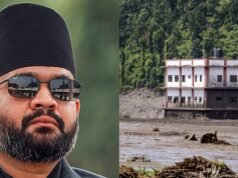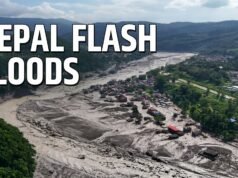

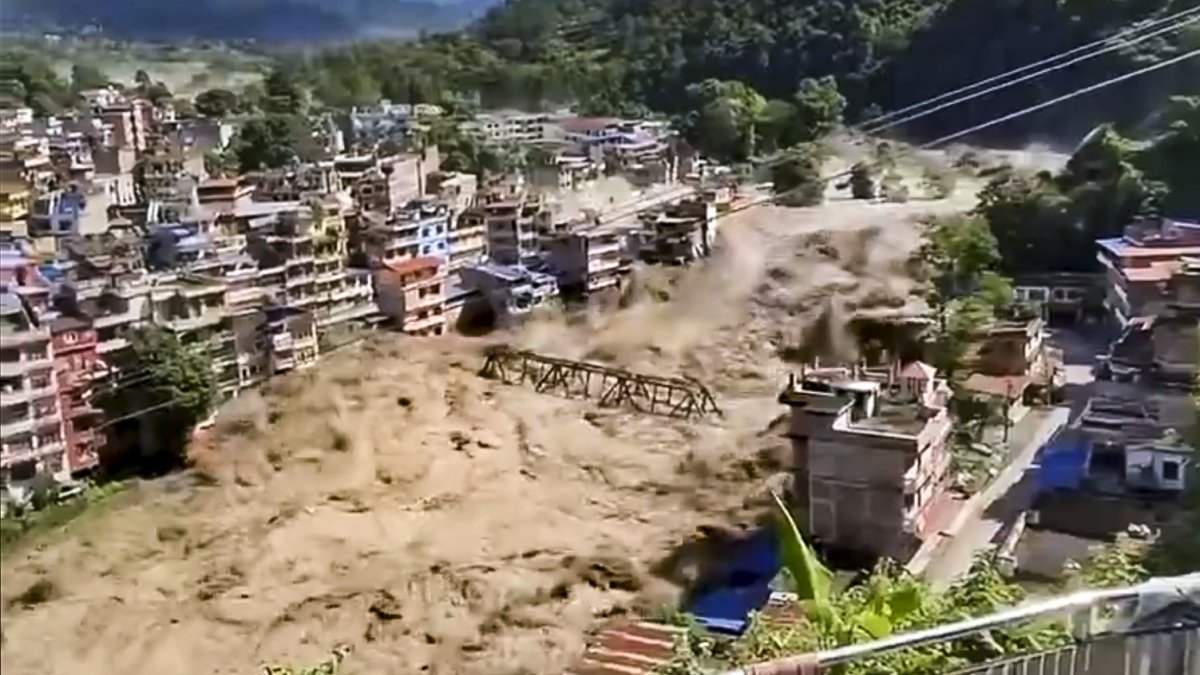

Floods wreaked havoc in Nepal on Wednesday (August 26) after a sudden rise in the Bhote Koshi River inundated Rasuwa district near the Tibet border, leaving more than 90 people dead and hundreds, including foreign nationals, missing. The flood surged through the Bhote Koshi River at around 9 am (local time), affecting Rasuwa and Dhading districts bordering Tibet, officials said. It then spread to Dhading, Nuwakot and Chitawan districts, damaging at least four permanent bridges and a few temporary ones.
Ice avalanche triggered deadly floods?
Authorities are investigating the cause of the devastating flash flood, with initial assessments suggesting that an ice avalanche may have blocked the Lhende River, triggering the sudden flood in the Bhotekoshi River.
According to The Kathmandu Post, Rijan Bhakta Kayastha, a professor at Kathmandu University and climate researcher, said the assessment was based on discussions with scientists in Nepal and China. He said an ice avalanche from the Nepal side appeared to have fallen into and blocked the Lhende River, causing water to build up before bursting downstream.
“There is information that an ice avalanche from the Nepal side blocked the Lhende River,” Kayastha said. “An earthquake also occurred on the Tibetan side around the same time.”
Earthquake triggering large landslide?
Meanwhile, Nepal Foreign Minister Shisir Khanal said a magnitude 4.4 earthquake in Tibetan territory may have triggered an avalanche that led to the devastating flash flood in Nepal’s Bhote Koshi River. “An earthquake occurred at 8:37 a.m. today, and due to it, a large landslide occurred, blocking the river, which appears to have caused the flood,” Khanal said during a meeting at the House of Representatives.
According to the United States Geological Survey (USGS), which records earthquakes worldwide, a 4.4 magnitude earthquake was recorded in the region at around 8:37 am, approximately 47 kilometres north of Gosainkunda.
However, it is still unclear whether the earthquake had any role in triggering the floods. Scientists are also examining the possibility of a glacial lake outburst contributing to the disaster.
Kayastha said it could take several days to establish whether a glacial lake had burst. The possibility is being investigated as similar incidents have occurred in the area in the past.
The region witnessed a comparable disaster on July 8, 2025, when a sudden flood in the Lhende River was attributed to a glacial lake outburst. Satellite images at the time suggested that a glacial lake near the Nepal-China border had burst.
What do satellite images reveal?
Nepal’s National Disaster Risk Reduction and Management Authority said an initial study based on the analysis of satellite images indicates that a glacier-inclusive flood occurred in the Lhende River due to a snow-rock landslide that took place on the Nepal-China border approximately 20 kilometers northeast of the Nepal-China Rasuwagadhi border crossing.
Also Read
Nepal flood LIVE: 46 killed, nearly 400 missing; IAF keeps transport fleet on standby for relief ops
Deadly flash floods in Nepal: Five major deluges that ravaged the Himalayan nation in recent times