

Leading a nearly 300-member business delegation to India, Canada’s trade minister is pitching the country as a partner for energy, critical minerals and investment as both countries seek to expand economic ties and diversify trade
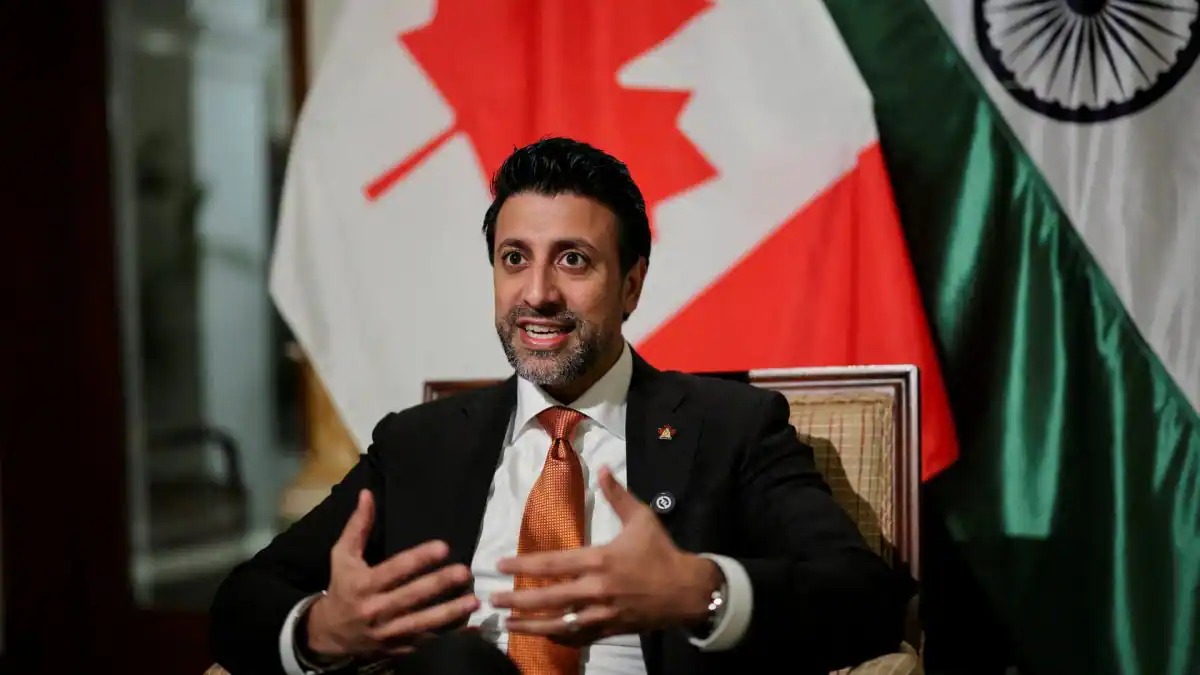
Canada is looking to attract investment and diversify its trade partnerships through incentives, dialogue and a more competitive business environment, rather than pressure, International Trade Minister Maninder Sidhu said at the Bloomberg Economic Forum in New Delhi.
“We don’t use a stick to attract investments. We use conversations, we use initiatives, we use tax provisions to attract those investments, and we create an environment to attract those investments,” Sidhu said.
His remarks come as Canada seeks to deepen economic engagement with India and reduce its dependence on a limited number of trading partners. Sidhu is leading nearly 300 Canadian business representatives on a trade mission to India from October 12 to 17, the largest Canadian trade delegation to the country in more than 30 years. The mission includes companies from sectors such as aerospace, clean technology, energy transition, information and communications technology, life sciences and agri-food.
The visit comes amid efforts by India and Canada to reset their economic relationship after a period of strained ties. Prime Minister Narendra Modi and Canadian Prime Minister Mark Carney discussed trade, energy, technology, finance and security on October 13, reaffirming their commitment to conclude a Comprehensive Economic Partnership Agreement (CEPA) at the earliest opportunity and work towards doubling bilateral trade by 2030.
The fifth round of CEPA negotiations was held in Ottawa from October 5 to 9. Both countries are aiming to conclude the agreement by the end of 2026. Modi is also scheduled to visit Canada in December, providing another opportunity for the two sides to advance their economic agenda.
 More from Business
Two-way trade in goods and services between Canada and India totalled $30.4 billion in 2025, according to the Canadian government. Ottawa is targeting annual bilateral trade of $70 billion by 2030.
Canada pitches energy and investment opportunities
Energy security is emerging as a key area of potential cooperation. Sidhu said India’s energy requirements would rise sharply as its economy expands, making it an important market for Canadian energy resources.
“India is growing very quickly, and they need 70 per cent more energy by 2035,” he said, arguing that Canada could help meet some of that demand.
The two countries are exploring opportunities across energy, critical minerals, clean technology and other strategic sectors. Canada’s trade mission is intended to connect Canadian businesses with Indian companies and decision-makers, helping them identify commercial partnerships and investment opportunities.
The energy focus comes as India seeks to secure reliable supplies while expanding its economy and transitioning towards cleaner sources of power. Canada, which has substantial energy and mineral resources, is looking to diversify its export markets and build longer-term commercial relationships in the Indo-Pacific.
Sidhu said Canada was moving quickly to diversify its economic relationships, citing recent agreements with countries including Indonesia, Ecuador and the United Arab Emirates, alongside negotiations with India and other partners.
He also pointed to Canada’s efforts to improve its investment climate through tax measures and reduced regulatory barriers. Sidhu said Canada had attracted more than $90 billion in foreign direct investment last year, which he described as its highest inflow in two decades.
Investment ties already provide a foundation for closer engagement. Canadian government figures put Canadian direct investment in India at $11.4 billion in 2025, while direct investment from India into Canada stood at $9.7 billion. Canadian pension funds and asset managers also reported approximately $108 billion in total exposure to India in 2025, including portfolio holdings, direct investments and other investment vehicles.
India seeks resilience without isolation
India, meanwhile, is pursuing greater domestic capacity in critical sectors while maintaining access to global markets and technology.
Commerce and Industry Minister Piyush Goyal, who also took part in the panel discussion, said the pandemic had exposed vulnerabilities in international supply chains and reinforced the need for India to build self-sufficiency in essential areas.
“It’s not about isolation,” Goyal said, explaining that India wanted to combine domestic capabilities with trusted international partnerships.
India has been expanding its network of trade agreements as it seeks new markets for its businesses and more reliable sources of critical inputs. The proposed pact with Canada is part of that broader effort, with negotiations covering a potential expansion of commercial ties across goods and services.
Critical minerals are another potential area of cooperation. Sidhu said Canada was working with partners to support projects and strengthen access to minerals needed for strategic industries. He also referred to a Canadian-led critical minerals partnership initiative aimed at bringing countries together around investment and supply security.