
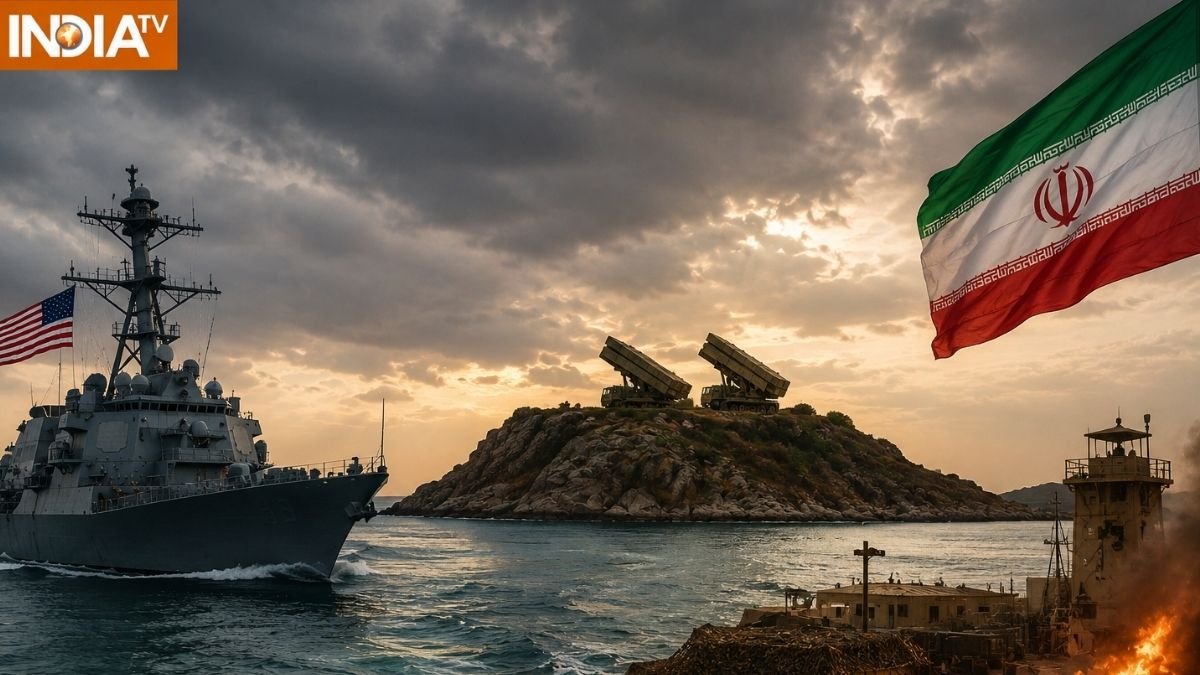

The United States struck Iranian rocket launchers on Larak Island in the Strait of Hormuz on Sunday, marking its first military strikes on Iran in a month and prompting Tehran to retaliate.
The US said the strikes targeted two Iranian launchers after Revolutionary Guard forces were observed preparing to launch rockets carrying sea mines into the strategic waterway. Iran’s Revolutionary Guard Corps said the US strikes caused casualties and later launched ballistic missiles at US military targets in Jordan, according to Iranian state media.
US strikes two launchers on Larak Island
A US Central Command spokesperson said American forces struck two Iranian launchers on Larak Island. Navy Captain Tim Hawkins, a spokesperson for US Central Command, said Iranian Revolutionary Guard forces had been observed preparing to launch rockets with sea mines into the Strait of Hormuz.
The US military said the operation was aimed at preventing Iran from launching more sea mines into the waterway. CENTCOM had announced the previous week that it had completed clearing sea mines from the strait’s international shipping routes. “US forces are monitoring the area closely and remain prepared to protect the free flow of commerce through this essential waterway,” Hawkins said.
Iran retaliates with strikes on US bases in Jordan
Iran’s Revolutionary Guard Corps said the US attack resulted in casualties. Iranian state television later reported that the Guards had targeted US military facilities in Jordan with ballistic missiles. According to state TV, the targets included technical infrastructure, maintenance facilities and positions of US fighter jets at the King Hussein and Al-Azraq airbases in Jordan. Iranian state media claimed the strikes caused “heavy damage”.
The exchange marks a fresh escalation after months of intermittent fighting between the US and Iran.
Strait of Hormuz remains major flashpoint
The latest strikes came shortly after the US-Iran war reached the six-month mark. Hostilities had been relatively subdued after an April ceasefire brought an end to the most intense fighting. However, sporadic attacks, particularly around the Strait of Hormuz, have continued to threaten prospects for a final peace agreement.
The strategic waterway has remained at the centre of the conflict. Iran has effectively blocked the Strait of Hormuz, through which around one-fifth of the world’s oil passed before the US and Israel began hostilities with airstrikes on Iran on February 28. Iran’s closure of the waterway has contributed to price increases and shortages of fertiliser and energy.
US shifts focus to economic pressure
The latest military strikes come as the Trump administration has increasingly prioritised what it describes as “economic warfare” against Tehran. A US naval counterblockade of Iranian ports has put pressure on petrol supplies in Iran amid a shortfall in domestic production. Diplomatic efforts involving mediators including Pakistan and Qatar have continued for months but have so far failed to produce a final agreement.
A ceasefire was agreed in April, followed by a memorandum of understanding towards a final peace deal in June. However, no final agreement has been reached.
Last US strike came on July 29
Before Sunday’s operation, the last US strike on Iran was carried out on July 29. The US military said that strike was in response to an attempted surprise attack on US forces in the region. Earlier in July, CENTCOM had carried out attacks on Iran for 13 consecutive nights.
Throughout the conflict, Iran has retaliated by targeting US facilities and allies in the Gulf region, including targets in Kuwait, Oman, Saudi Arabia and the UAE.
Oil prices rise after fresh strikes
Oil prices rose following news of the latest US strikes on Iran. North Sea Brent crude, the international benchmark, climbed above the USD 90 mark to USD 90.31 a barrel. West Texas Intermediate, the US benchmark, rose to USD 85.41. The renewed military exchange comes as the conflict remains politically contentious in the United States, with the November midterm elections approaching.
US Senator Jack Reed, the top Democrat on the Senate Armed Services Committee, criticised President Donald Trump over the war in a statement on Friday. “Six months later, not a single objective has been achieved,” Reed said, arguing that the conflict had weakened the US position in the Middle East and globally.
(With inputs from AFP)
Also read:
‘Recognise your real enemy’: Iran Supreme Leader Mojtaba Khamenei calls for unity among Muslim countries