
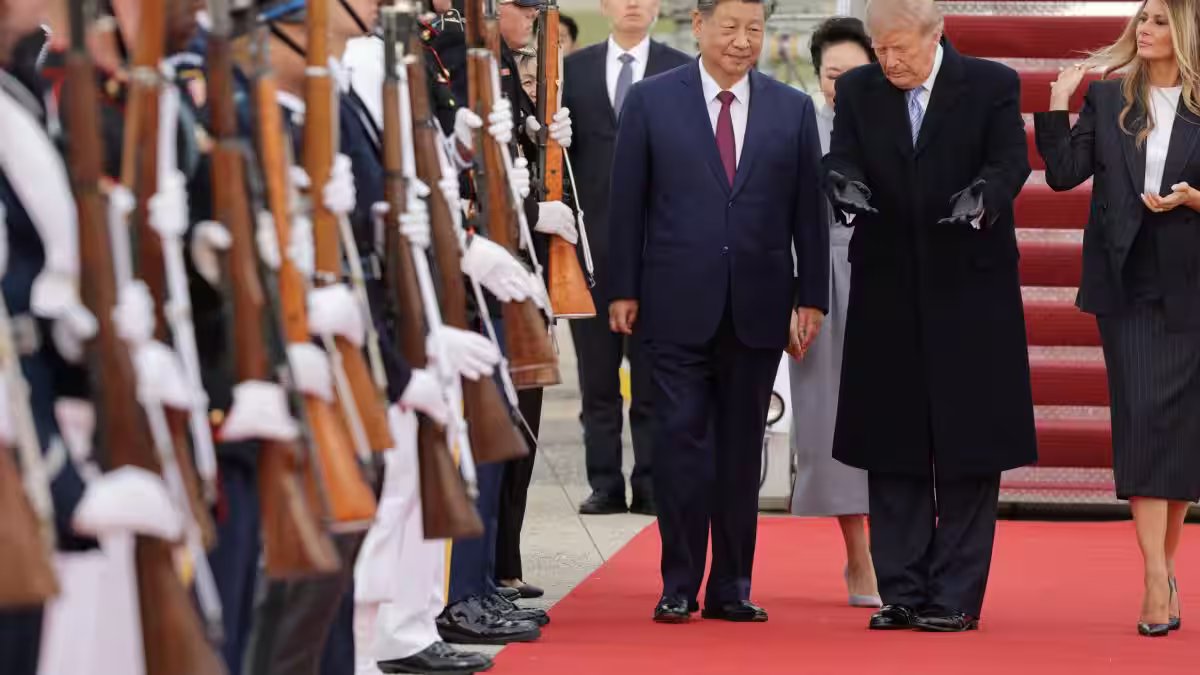

Trump and Xi are meeting again in Washington as several commitments from their May summit remain under implementation
US President Donald Trump and Chinese President Xi Jinping are meeting in Washington again just months after their May summit produced a package of trade and economic commitments. But several of those pledges have moved slowly, leaving the latest talks focused not only on new concessions but also on whether earlier promises can translate into actual trade flows.
The May agreement was framed by Washington as a broader effort to build “constructive strategic stability” between the world’s two largest economies. It included commitments covering agricultural purchases, Boeing aircraft, rare earths, tariffs, investment and artificial intelligence. Four months on, implementation has been uneven.
Trade and tariffs
One of the biggest unfinished items is the proposed US-China Board of Trade and reciprocal tariff reductions covering $30 billion of goods in each direction.
The two sides had agreed in May to create the board to manage bilateral trade in non-sensitive goods. China’s Commerce Ministry has since indicated that Beijing and Washington want to implement the tariff reductions, but the scope and timing remain under discussion.
US Treasury Secretary Scott Bessent said Washington and Beijing had agreed to extend their existing trade truce from November 10 to January 10. The extension gives negotiators additional time to work on what Bessent described as a potentially bigger deal.
 More from Business
US farm exports
China agreed in May to buy at least $17 billion a year of US agricultural products in 2026, 2027 and 2028, in addition to an earlier commitment to purchase 25 million metric tonnes of US soybeans annually.
The US Department of Agriculture, however, has forecast Chinese imports of US farm products at about $21.5 billion for the 12 months beginning October 1, suggesting the broader $30-billion annual target could prove difficult to reach.
There has been some movement on market access. China has renewed registrations for US beef plants, although technical issues still need to be resolved before some shipments can clear Chinese ports.
Boeing orders
China also agreed in May to purchase 200 Boeing aircraft, a significant commitment for the US aerospace industry.
The orders have not yet been fully formalised. But there has been movement in recent days. US Trade Representative Jamieson Greer said around 140 of the aircraft were in a “good state”, while another 10 were going through formal documentation.
Boeing CEO Kelly Ortberg has also said Chinese airlines will announce orders on their own schedule.
Rare earths and investment
Rare earths remain another area where implementation has been closely watched. Beijing agreed to address US concerns over shortages of rare earths and other critical minerals, as well as restrictions involving related production equipment and technology.
The proposed US-China Board of Investment has been harder to advance. Chinese investment in the US faces scrutiny over national security, while Chinese authorities remain cautious about technology transfers and investment exposure in America.
(With inputs from agencies.)