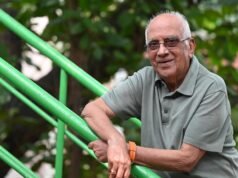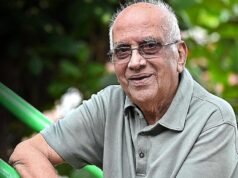


On September 22, my Guruji Pt. Indudhar Nirody, passed away at the age of 91. Indudharji, a prolific vocalist, musicologist and mentor, leaves behind an invaluable treasury of traditional wisdom, ragas and bandishes. His musical worldview was firmly rooted in the Bhatkhande parampara, upholding the vision of Pt. Vishnu Narayan Bhatkhande, who undertook the monumental task of framing Ragasangeet into a comprehensive Shastra, while preserving a vast collection of gharanedar bandishes for future generations.
Having trained directly under four of acharya S.N. Ratanjankar’s (Annasaheb) prime disciples — S.C.R. Bhat, K.G. Ginde, Pt. Chidanand Nagarkar and Pt. Dinkar Kaikini, Indudharji became the direct descendant of Annasaheb’s legacy, who himself was trained under Gwalior stalwart Pt. Antubua Joshi, Pt. Vishnu Narayan Bhatkhande and Aftab-e-Mousiqi Ustad Faiyaz Khan. His taalim under these stalwarts made his art evolve as a seamless synthesis of Agra and Gwalior gayaki, with Gindeji serving as his primary ideal. Indudharji often recalled that both Gindeji and Bhatji had also trained under the Gwalior maestro Pt. Rajabhaiya Poochwale.
For six decades, Indudharji remained associated with his gurus, accompanying them across India, and in the process had the opportunity to absorb every intricacy of a performance and raag development. A testament to his mastery occurred when his guru Annasaheb, auditioned him, asking if he could sing raag Hameer without its defining phrase ‘Ga ma dha.’ Indudharji rendered it flawlessly, much to Annasaheb’s delight.

Pt. Indudhar Nirody dedicated himself more to teaching music after his retirement.
| Photo Credit:
M. Sudhakara Jain
While Khayal was Indudharji’s main domain, he was equally at ease with dhrupad-dhamar and thumri, both as a performer and a teacher. He was deeply rooted in tradition and was often critical of modern trends. For him, grammar (shastra) always took precedence over glamour. He believed true mastery stems from patient taalim, devotion, purity and perseverance.
Beyond concerts, Guruji worked as a senior executive in a government Insurance firm. Post-retirement, he dedicated himself more to teaching music. He served as a visiting professor at Dr. Gangubai Hangal Music University, Mysuru, and Karnataka University, Dharwad. He mentored disciples including Aditi Kaikini-Upadhya, Veerabhadrayya, Sharada Bhat, Bhaskar and me. He also wrote essays on subjects such as samay chakra and thaat frameworks; anchored a 13-episode programme on the Agra Gharana, broadcast on Akashvani Bangalore; and presented lecture-demonstrations, particularly on the 10 thaats and their associated raags.
One of his lifelong missions was to create an audio reference for all the 1,896 compositions contained in Bhatkhandeji’s six-volume Kramik Pustak Malika. Indudharji recorded this entire body of work as ‘Samarpan’, offering it as his gurudakshina. It was later made available online, free of cost, as an archival resource for students, and earned acclaim from legends including Pt. Rajeev Taranath, Pt. Sharad Sathe, and Pt. Ajoy Chakrabarty.
A top-grade All India Radio and Doordarshan artiste, Guruji’s artistic journey was recognised with several honours. These included the Central Sangeet Natak Akademi Award (2014) presented by the former President Pranab Mukherjee; the Rajya Sangeet Vidvan Puraskar (2014); an honorary doctorate from Dr. Gangubai Hangal Music University (2015); the Gaurav Prashasthi (2006); and first prize in the All India Music Competition (1955), which he received from former President Rajendra Prasad.

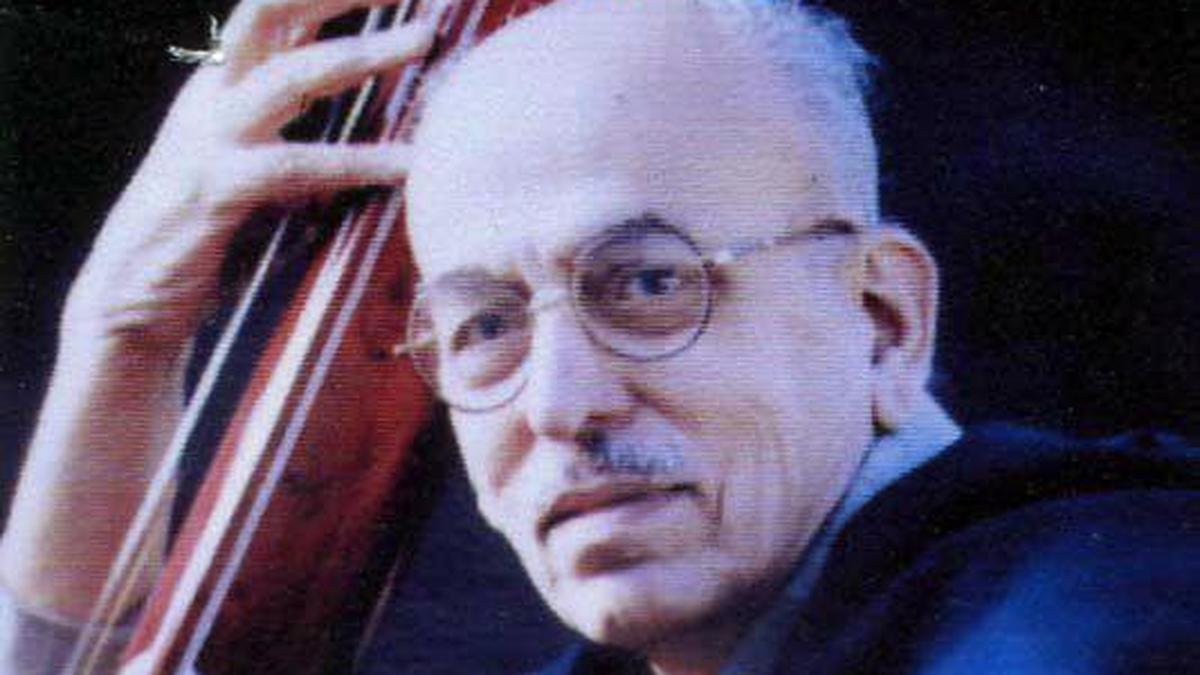
Vyasamurthy Katti, a senior disciple of Pt. Indudhar Nirody.
| Photo Credit:
S.R. Raghunathan
My journey as his disciple began in November 2002. Having quit my IT profession in Bengaluru in 2001 to pursue music full-time, I sought his guidance. I had accompanied Guruji on the Harmonium before becoming his student, and that privilege continued later, when I provided him vocal support during concerts.
Guruji accepted me on two conditions — there would be no tuition fees, as he believed knowledge should be passed on freely as his gurus had done; and I would travel every fortnight from Bengaluru to Mysuru for two-day residential stays.
These visits continued until the pandemic, after which our lessons moved online. In his final months, when his health restricted vocal exertion, our musical exchanges continued quietly through text messages.
My taalim in November 2022 began with raag Bhimpalas and continued for 11 months as guruji wanted me to absorb every subtle nuance of the raag. That first lesson humbled me and made me realise that vocal music was a profound new world that I had barely begun to understand.
Over the years, Guruji imparted the nuances of more than a hundred raags and several hundred compositions, demonstrating how each bandish could open up a distinct aesthetic approach to raag development. He taught me both Dhrupad and Khayal styles of nom-tom alap, revealing their subtle architectural beauty and strength. His approach to raga badhat demanded precision in swar shuddhata, raga shuddhata, swarocchar, aakar, kan swar, meend, gamak, bol upaj, taan and breath control. While teaching, he always kept theka on the dagga while I played the tanpura. He refrained from using any modern digital gadgets during taalim sessions.
During our stays in Mysuru, musical discussions would often continue late into the night. Guruji never spoke disparagingly of fellow musicians; instead, he would highlight their strengths and tell me what could be learnt from each of them. Whenever his gurus were mentioned, he would say “You can’t imagine how fortunate I am to have learnt from such stalwarts. You will not understand.” Those words stay with me so are his training, music and philosophy.
Published – October 05, 2026 02:52 pm IST