


Few restaurants are as inseparable from their destination as The Rock Zanzibar.
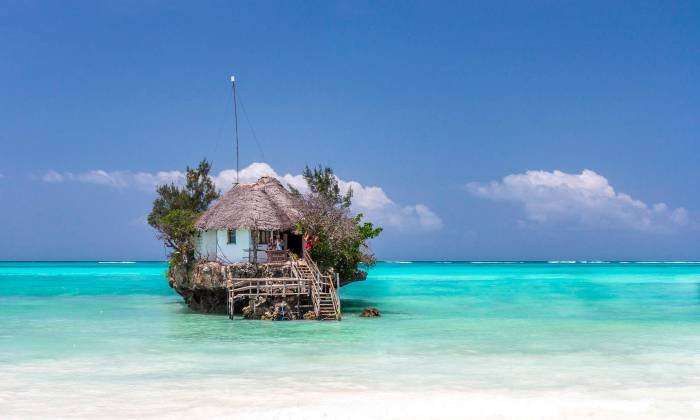
Perched on a natural outcrop just offshore from Michamvi Pingwe on Zanzibar’s east coast, the diminutive restaurant appears to float in the Indian Ocean at high tide, while at low tide guests can simply walk across the exposed shoreline to reach it. It is an image that has travelled around the world and helped turn The Rock into one of Zanzibar’s most recognisable landmarks.
Yet the story behind that image began remarkably simply.
The Rock was founded in 2011 by Nigel Firman, Andrea Brunetti and Claudio Moras, three long-time friends who saw potential in what had previously served as a fisherman’s outpost. Firman had already spent years living and investing in Zanzibar when repeated walks along the beach planted the seed of an idea.
“I was just seeing this piece of rock,” he recalls. Eventually, he approached the local community and asked whether it could become a restaurant. The answer was yes.
What followed was the transformation of a tiny offshore rock into an international dining destination, one that would have to overcome the practical challenges of operating with limited space, changing tides and the logistical realities of being surrounded by the sea.
A restaurant shaped by the tide
The Rock’s location is not simply its backdrop; it defines the entire experience.
As the tide withdraws, the restaurant reconnects with the beach and diners can approach on foot. As the Indian Ocean rises, the same building becomes completely surrounded by water and guests arrive by small boat.
That constantly changing relationship with the sea is part of what makes a visit so memorable.
“We’re in the middle of the sea when the tide comes in and then when the tide goes out you can walk to The Rock,” Firman says.
The setting also explains why The Rock has become far more than a restaurant. Its profile has grown alongside Zanzibar’s emergence as one of the Indian Ocean’s most desirable luxury and experiential destinations, with photographs of the tiny building surrounded by turquoise water becoming instantly associated with the island.
Zanzibar on the plate
The culinary concept reflects both the Italian heritage of its founders and the ingredients of Zanzibar.
Seafood naturally plays a leading role, supported by locally sourced fish, lobster, octopus, calamari and prawns, while Zanzibar’s celebrated spices bring a distinctly local identity to dishes that often retain an Italian foundation.
Firman describes the menu as a fusion shaped by both worlds.
“We’re Italian, so we have this Italian influence in our cuisine, but of course it’s rich of Zanzibar spices,” he says.
Homemade pasta, fresh seafood and tropical flavours sit at the centre of the experience. Current dishes range from lobster tagliatelle and seafood paccheri to gnocchi paired with prawns and Zanzibar vanilla, illustrating how the restaurant brings European technique together with the island’s produce and spice heritage.
The result is food designed to live up to a setting that could easily overshadow it.
More than an Instagram moment
The Rock’s global fame owes something to photography and social media, but reducing it to a picture-perfect restaurant misses much of its appeal.
Its success lies in the combination of place, journey and anticipation. Guests arrive on a remote stretch of Zanzibar’s east coast, watch the tide determine how they will reach their table, and dine within metres of the Indian Ocean.
There is no conventional luxury architecture and little attempt to overpower the surroundings. The building is small, intimate and visually simple. It is precisely that restraint that has helped make it so distinctive.
For Firman, the objective has always been to ensure that what happens inside the restaurant is as memorable as what guests see outside.
“The overall experience, I would say, is wow,” he says.
A connection to the community
The restaurant’s story is also closely tied to the surrounding community.
Through The Rock for Community, the business has supported local education, sanitation, access to clean water and initiatives including swimming and lifesaving programmes for local children and women.
That relationship is significant because The Rock’s very existence depended on cooperation with the local fishing community from the beginning. What started as permission to transform a fisherman’s outpost has developed into a longer-term connection between one of Zanzibar’s best-known tourism businesses and the people living around it.
Fifteen years of The Rock
Fifteen years after opening, The Rock remains one of the most unusual dining experiences in the Indian Ocean.
Its success has never depended on scale. Quite the opposite. The restaurant’s identity comes from its compact size, its isolation and the fact that nature still controls the experience every day.
The tide comes in.
The tide goes out.
And the restaurant remains exactly where it began: on a single piece of rock off the coast of Zanzibar.
What started as an idea during a walk along the beach has become something far larger — not physically, but symbolically. The Rock is now part restaurant, part landmark and part expression of Zanzibar itself.