

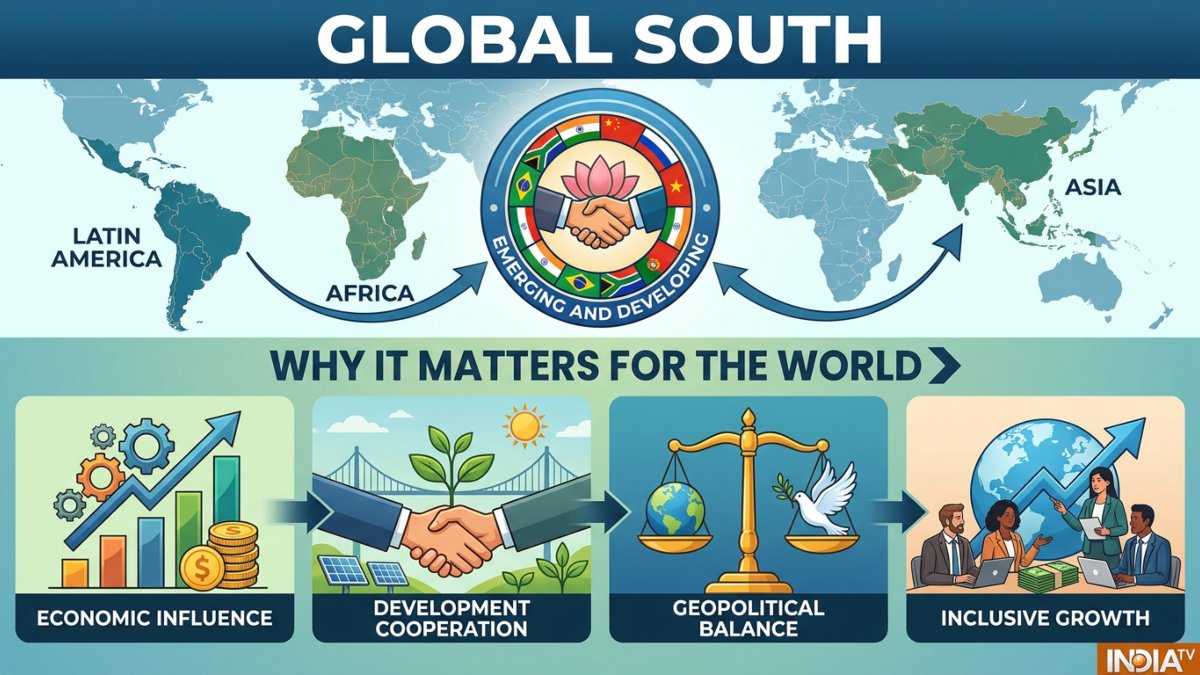

The term “Global South” has been dominating the headlines and conversation topics for the past few days as various leaders landed in New Delhi for the BRICS Summit 2026. With India being the chair this year, the push is for a stronger voice for developing countries in global decision-making. The New Delhi Declaration called for greater representation of developing countries in international institutions and backed reforms of the UN Security Council and the global financial architecture.
With so much being talked about the Global South. Here’s a deep dive into what the Global South actually is and why it holds significance as of now.
What is the Global South
The Global South is a political and economic term mostly used for developing and emerging countries across Asia, Africa, Latin America and the Caribbean. It is not a defined geographical category: Countries in the Global South can be located in the Northern Hemisphere as well. The term broadly reflects differences in wealth, development, historical experience and influence in global institutions rather than simply location on a map.
Notably, it also does not mean that all these countries share the same political system, foreign policy or economic interests. India, China, Brazil, Indonesia, South Africa, Saudi Arabia and Egypt, for example, have very different priorities. What brings many of them together is a shared interest in having greater influence over decisions that affect the global economy and international governance.
Why Global South matters?
The economic weight of developing countries has changed dramatically. According to UN Trade and Development (UNCTAD), the Global South accounts for 42% of world GDP, 44% of merchandise exports and 65% of foreign direct investment inflows in 2023.
The most prominent argument for its greater representation is that the growing economic weight has not always translated into comparable influence in institutions created in a very different era.
Behind the Global South’s push for reform lies the fact that the global economy has changed, but the structures governing it have not changed at the same pace. So, the demand naturally goes beyond getting more seats around the table. Developing countries want a greater say in setting the rules themselves.
BRICS as a platform for Global South push
BRICS provides one of the most prominent platforms through which emerging economies can pursue that collective influence.
Originally built around Brazil, Russia, India and China and later expanded to include South Africa, the grouping has now grown to 11 members, giving it a much larger geographical and economic footprint. The bloc represents more than 40% of the world’s population and nearly a quarter of the global economy, according to Reuters.
Its importance lies partly in its ability to bring together countries that may disagree on geopolitics but share concerns over the existing international economic and political architecture.
That makes BRICS less about creating a single alternative bloc and more about creating collective bargaining power for emerging economies.
What do Global South nations aim to achieve?
At the Delhi Summit, several priorities became particularly clear. First, greater representation in global institutions. BRICS called for comprehensive reform of the UN, including the Security Council, as well as reforms of the IMF and World Bank. China and Russia backed greater roles for India and Brazil in the UN system.
Second, a stronger voice in global trade. The New Delhi Declaration slammed unilateral tariffs, protectionist measures and economic coercion. The underlying argument is that developing economies should not bear disproportionate costs from decisions made by larger powers.
Third, greater financial choice. BRICS is not currently moving towards an immediate common currency. Instead, it is focusing on local-currency settlements, payment-system interoperability, cross-border payments and strengthening the New Development Bank. At the summit, India also pushed the idea of linking digital payment systems and exploring interoperability between central bank digital currencies.
Fourth, technology access and cooperation. AI, digital public infrastructure, quantum technology, semiconductors and other emerging technologies have become part of the BRICS agenda. India used its chairship to give technology cooperation a strong Global South focus.
Prime Minister Narendra Modi has repeatedly framed this as a transition from being “rule-takers” to “rule-shapers”, with India saying it is ready to help lead that effort.
The Delhi Declaration reflects that approach: reform the UN and financial institutions, make global trade more equitable, expand development finance and ensure emerging technologies serve developing economies as well.
India’s role in Global South
India’s approach at the BRICS Summit has been notable because New Delhi has not presented the Global South agenda simply as an attempt to replace one global system with another. New Delhi has called for reforming existing institutions while creating additional mechanisms where they are needed.
That approach can be seen across India’s BRICS priorities: reforming the UN and international financial institutions, encouraging local-currency trade without proposing an immediate common currency, linking payment systems, expanding technology cooperation and promoting resilient supply chains.
India’s BRICS chairship has also sought to turn these ideas into practical initiatives, from the BRICS MSME Portal and Startup Innovation Fund to cooperation on digital public infrastructure and the showcasing of 37 Indian deep-tech innovations, including AI, quantum and advanced satellite technologies.
Also Read:
Digital infrastructure, pharma and a pitch to Global South: Understanding what India brings to BRICS