
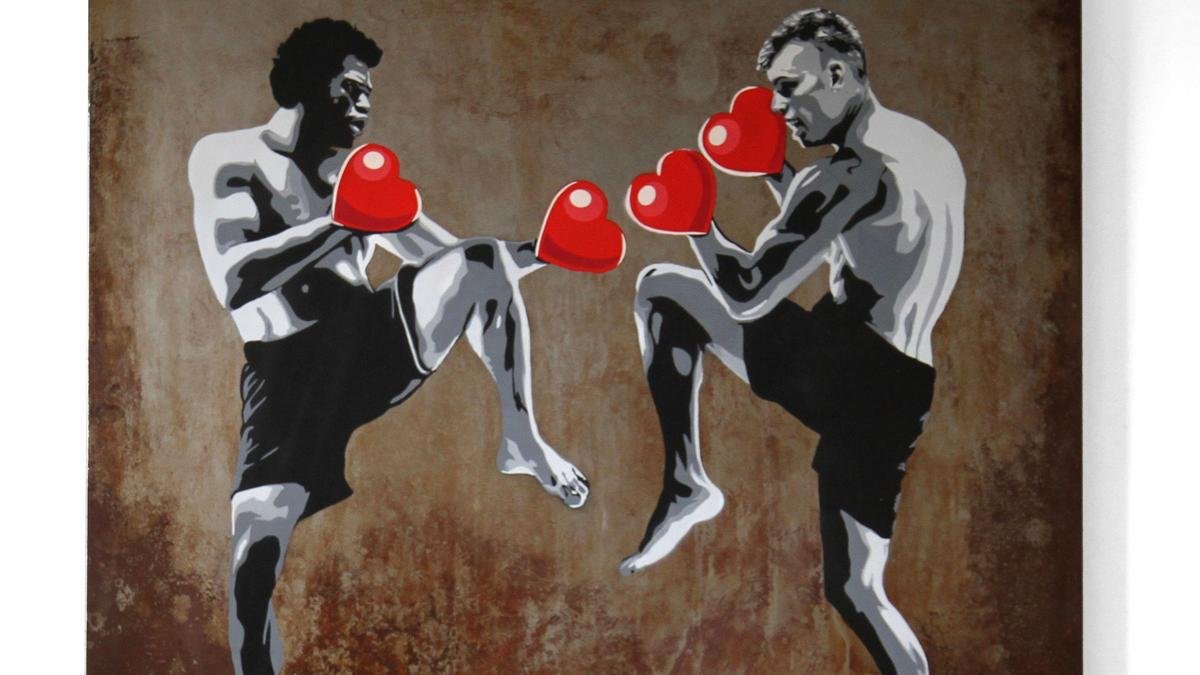

Street artist Guesswho needs no introduction. His ‘arrival’ on the art scene, coinciding with the first edition of the Kochi-Muziris Biennale, was a “reaction” to the Biennale. Creating his works anonymously, not just in Fort Kochi, he has been consistently questioning the status quo. His works, subversive and politically aware, pop up in unexpected corners of cities — thought-provoking nuggets of art, mostly irreverent in tone. Some label them subversive, for they hold up a mirror on popular culture, politics and society.
At Stick No Bills, his solo show, which opened in August at Muziris Contemporary, Mumbai, the works are on display in a gallery space. The second part of the show, with a different set of works, travels to Kochi this month. Over the past 14 years, his works have appeared in other cities across the country. He holds his anonymity close, while questioning the curiosity around his identity and the desire to know who he is. The Kochi show, at Muziris Contemporary, opens on September 13. A total of 25 works will be on show, 13 in Mumbai and 12 in Kochi.
Graphic novelist and artist Appuppen writes in his curatorial note, “If art can be a reflection of society, then Guesswho holds a most irreverent mirror, unflinching in its deeply subversive thoughts on culture, media, class, politics and art.”

Street art is an ‘outside’ form of expression. With Stick No Bills you have moved ‘into’ the gallery space. How did that come about, with Muziris Contemporary?
A practice born in the streets, often at odds with institutional and commercial structures, now being presented inside a gallery is naturally an interesting paradox. But it should not be taken as a contradiction or a confrontation, but rather could be considered as another kind of public space; for example, social media is another one. The gallery experience was limited to an elite and informed audience 14 years ago, when Guesswho started painting on the streets. But art fairs and events like Biennales started attracting common people inside galleries. Though the process is slow, the number of people stepping inside the gallery has definitely increased over the years. Social media also plays a big (maybe bigger) role in introducing people to, and getting them interested in, contemporary art practices. (The irony is that people who walk past street art often miss it on the streets because they are glued to their screens).
No one would have thought of a show like this 10-15 years ago. It started as an attempt to reclaim public spaces, while now it’s time to reclaim gallery spaces as a kind of public space. But it remains a space for institutional practice at large and stays distant from the common viewer. Stick No Bills aims to challenge those so-called ‘gallery standards’ or ‘eligibility’ of being presented in a gallery. It is also about making a statement that street art or urban art can’t be ignored and is not lesser than any other contemporary form of art just because of it speaks plain and straight to the viewer.
Once it is in the gallery space, did your work change to ‘fit the space’? Does the inspiration change, become ‘not subversive’? There is the other tempting alternative of being even more irreverent. Which route did you take? Did you create works specially for this show? Because this is a new audience.
As the word suggests, street art is first and foremost intended for the streets. The gallery exhibition is only an extension of the practice. But, of course, the context and purpose changed. Unauthorised painting on public spaces forces you to paint quickly as the only intention is to put it out there on the streets. (Hence the use of stencils) One wouldn’t worry too much about mistakes and perfection. While studio works do not need to be made that way even when the same stencils and painting techniques are used.
Paintings on the streets are often whitewashed quickly and remain only in photographs. So the gallery shows end up being a documentation of the works that once existed on the streets and remain in the visual memory. Almost all of the works in the show are created and painted on the streets over and over again before they lived their lives. Some works are remastered and repainted for the gallery experience because the viewer goes to the gallery specifically to see the art and has enough time to sit (or stand) and see them in detail. Other than that, there are no differences between the two. Moreover, certain works in the show, like Hidden Meaning address these questions while being presented in the gallery.
Would your works be on sale? Do you think the value of the work increases when graffiti enters a gallery?
Yes. They’re on sale. People who have seen them on the streets once (or not seen them) and want to own it and bring it to their living rooms can fulfil their wishes. But, of course, they have to pay a price for it (pun intended) for never being able to buy the experience of owning it with the original and natural surroundings that it inhabited once.
Would the same works be on show at Kochi as well? How does it feel coming back to the place where you first started, but in a new setting?
No. The Kochi show will have a new set of works because works more relevant to Kerala can be better enjoyed in full by those who understand the larger context. (For example, a non- Malayali may not understand the context of the word pacha, not just as a Malayalam word for the colour green, but also as a word for one of the five different costume categories for the characters in Kathakali according to their character attributes).
What does anonymity mean to you? I have written about you but never had the chance to ask you so…what made you choose anonymity? Banksy?
Anonymity is as much part of the practice itself. You should look at it more as statement, not a stunt. It also gives you some advantages. For example, it helps to keep the limelight on the content and not on the creator. One of the works is titled ‘Who the Hell is Banksy?’
Stick No Bills opens at Muziris Contemporary, AB Salem Road, Jew Town, Kochi on September 13, and will be on view till November 30. The Kochi gallery is open from Wednesday to Sunday.