

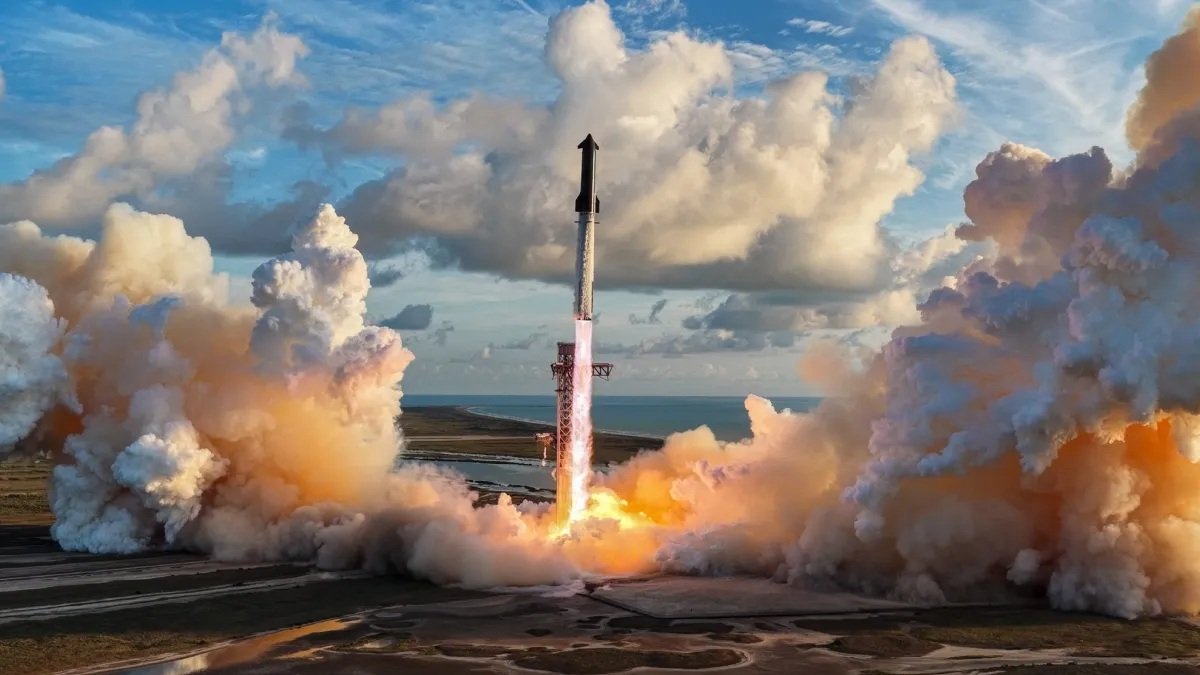

SpaceX’s giant Starship achieved a major milestone by reaching orbit for the first time, but the landmark mission ended several hours earlier than planned after one of its engines shut down prematurely. The spacecraft successfully deployed 26 of SpaceX’s latest-generation Starlink satellites before flight controllers decided to terminate the mission early as a precaution. Starship later re-entered Earth’s atmosphere and splashed down in the Pacific Ocean north of Hawaii, roughly three hours after lifting off from Texas. The dramatic conclusion came after Starship tipped over and burst into flames following the splashdown.
Starship reaches orbit despite engine failure
The launch initially faced a tense moment when one of Starship’s engines stopped working earlier than expected. However, the remaining systems continued to perform as intended, and the failed engine was no longer required for the next phase of the mission.
After assessing the situation, SpaceX flight controllers chose to continue with the planned orbital flight. “Starship is orbital,” Mission Control announced, triggering cheers at SpaceX’s Starbase launch facility in Texas. NASA Administrator Jared Isaacman also congratulated SpaceX for reaching orbit, praising the company’s approach to carrying out the mission safely and responsibly.
Starship reached an altitude of around 170 miles (275 kilometres) and travelled at approximately 17,500 mph (28,000 kph), completing a couple of laps around Earth before controllers brought it home earlier than originally scheduled.
26 advanced Starlink satellites deployed
One of the biggest achievements of the mission was the successful deployment of 26 advanced Starlink satellites. The satellites were released individually from Starship and are intended to join the more than 11,000 older Starlink satellites already providing internet connectivity.
The deployment demonstrated Starship’s potential as a high-capacity launch vehicle capable of carrying large numbers of satellites into orbit.
However, SpaceX later confirmed that the remainder of the planned mission would not go ahead. The company said the decision to bring Starship back early was taken “out of an abundance of caution” following the earlier engine problem.
SpaceX had planned a much longer orbital test
The mission was originally designed as a roughly 10-hour test flight during which Starship would have completed six circuits around Earth. Instead, flight controllers opted for an early return after just a couple of laps. The spacecraft was eventually brought down over the Pacific, north of Hawaii, rather than continuing toward the originally planned splashdown area near Chile. The mission marked Starship’s 14th full-scale launch from southern Texas in about three years. Earlier test flights had travelled only as far as the Indian Ocean and frequently ended with the spacecraft breaking apart or exploding. This flight was different because Starship successfully achieved the intended orbital trajectory, marking a significant step forward in SpaceX’s efforts to make the vehicle operational.
Why this flight matters for SpaceX
Starship is central to SpaceX’s long-term plans for transporting people and cargo beyond Earth. The 407-foot (124-metre) vehicle was designed to be fully reusable, with the aim of significantly reducing the cost of future launches. The company is now studying the data gathered during the orbital flight before deciding when and how to conduct the next mission.
SpaceX has also been working on recovering and reusing Starship hardware. Engineers previously salvaged a Starship that came down in the Indian Ocean in July, allowing them to inspect the vehicle directly and make changes to the heat shield on the newly launched spacecraft. The first-stage booster used in Monday’s launch was not scheduled to return to the Texas launch site. It instead came down in the Gulf of Mexico shortly after liftoff.
SpaceX eyes Starship’s return to launch pad
A major future objective is to bring Starship back to the launch site and catch the spacecraft using the giant mechanical arms installed at Starbase. The company wants to establish that the vehicle can safely complete its missions before attempting increasingly ambitious operations.
If the latest flight review clears the way, the next Starship could attempt a return to the launch site. A successful catch would open the door to rapid reuse of the spacecraft, potentially allowing another flight by the end of this year or early next year. SpaceX founder Elon Musk has previously stressed that safety remains a major consideration as the company moves toward more frequent Starship operations.
Starship’s role in NASA’s Artemis moon missions
The successful orbital demonstration is also important for NASA’s Artemis programme, under which Starship is expected to play a role as a lunar lander. NASA’s Artemis III mission is currently planned as a complex sequence involving an Orion spacecraft carrying astronauts and competing lunar landers. Blue Origin’s Blue Moon lander and SpaceX’s Starship are both part of NASA’s broader lunar landing architecture.
Artemis IV is currently targeted for no earlier than 2028 and is expected to involve astronauts travelling to the lunar surface using one of the selected landers, depending on readiness. For SpaceX, getting Starship certified for orbital operations is therefore a crucial step toward its role in future crewed lunar missions.
From Mars ambitions to moon missions and satellite launches
Musk originally envisioned Starship primarily as a vehicle for transporting large numbers of people to Mars and supporting the establishment of a human settlement there. For now, however, SpaceX is focusing heavily on lunar missions and commercial satellite launches. The company also intends to use Starship’s enormous payload capacity to place large numbers of satellites into orbit, eventually reducing its reliance on the smaller Falcon 9 rocket for some missions. SpaceX is simultaneously expanding its launch infrastructure. A second Starship launch site is nearing completion at NASA’s Kennedy Space Center in Florida, while a third site is planned in Louisiana.
(With inputs from AP)
Also Read:
SpaceX AI device prototype leaked: Report claims Elon Musk’s company is building a phone-like AI gadget