

Chilean-Indian filmmaker Shalini Adnani’s Our Share of Sand enters the 41st Venice International Critics’ Week as one of seven debut features competing in the secstion. The film, which has its world premiere on September 4, follows 12-year-old Maya as she returns to rural India with her mother and reconnects with her estranged father, a sand-mining businessman whose operation employs young workers in hazardous conditions. An accident involving Maya’s friend and family help, Kiran, turns her into a witness to the family’s carefully maintained version of events.

Born in Chile to a Sindhi Indian family and now based in London, Shalini grew up moving between two cultures that gave her very different but equally intimate ideas of home. Her family’s roots brought her repeatedly to India, where she divided her time between Ahmedabad, Mumbai and Chennai, while Chile remained the other place that shaped her sense of belonging.
“I think I couldn’t separate those two identities for me as a person,” she says in a virtual interview with The Hindu. “I did grow up between two cultures that I actually love. I love Latin American culture and I love Indian culture. I almost feel like I’m pulled to pick one in a society or in a world that is constantly asking us to be binary and pick one or the other.”

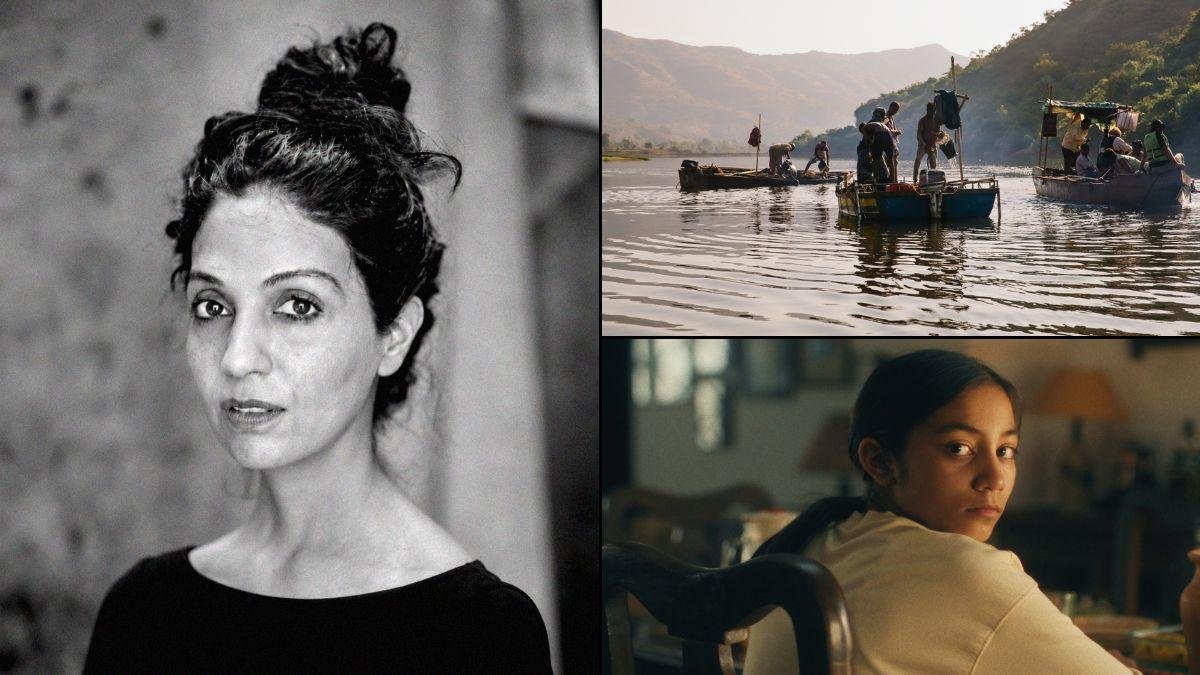
Chilean-Indian filmmaker Shalini Adnani
| Photo Credit:
Special Arrangement
That tension between belonging and observation is also built into Maya, played by newcomer Maya Mehta, whose place within the family gives her an intimate view of its privilege while her position as an outsider to the world around it leaves her unusually alert to what the adults have learned to accept. “The heart of Our Share of Sand came from my experiences going to India and spending time as a sort of NRI in the house,” Shalini says. “Understanding a country through the microcosm of a family,” was the thought behind Maya becoming close enough to inherit the family’s assumptions and young enough to still find their consequences difficult to absorb.
That family bubble also shaped what Shalini noticed outside it. In Our Share of Sand, Maya’s father is an industrialist whose cement business depends on the manual extraction of river sand, with workers diving into the riverbed to collect it by hand, exposing them to the physical dangers of barotrauma. When Maya joins one of her father’s nighttime mining trips, 14-year-old Kiran is sent underwater and fails to resurface, eventually emerging with ruptured eardrums and permanent hearing damage. The accident becomes the point at which Maya begins to question the version of her family’s world that she has inherited.

A still from ‘Our Share of Sand’
| Photo Credit:
Matthew Thorne – Fifth Mirror Pictures, Global Constellation
Shalini’s own interest in sand mining came from seeing similar activity during her visits to India, while members of her extended family were involved in development and construction. “I ended up having a very strong understanding of how India was progressing through what it was building,” she says. “I think my understanding of India really came through the excavation of these raw materials, turning into this… Western dream, or development.”
The film’s premise draws from a real labour system. According to Maharashtra government project documentation, manual sand mining involves workers digging and loading river sand by hand, a system that places much of the physical burden of extraction on labourers. The Union environment ministry’s latest available response on illegal sand mining, issued in August 2024, lists riverbed degradation, loss of aquatic habitat, groundwater depletion, soil erosion and flooding among its environmental consequences, while stating that legal extraction is governed by limits on the volume and depth of mining.

Shalini’s understanding of that labour was shaped by her experience of growing up in Chile. “Chile is a country of extraction as well. It’s a mining country,” she says. “I think I have grown up in societies that have a lot of natural resources and riches.” She connects the extraction of natural resources to a broader hierarchy around labour. “We all know this in India, right? It’s a society where people sometimes consider human lives expendable, with a reliance on human labour, but not necessarily a value of human labour.”
The film’s embedded class politics also surface in the ease and banality with which its privileged characters talk about workers, displacement and development. “It’s the existence of these realities and the ways that we take them for granted,” Adnani says. “I don’t think we question them at all. It’s just a way of being.” Maya occupies an uncomfortable position within this system, with enough privilege to observe it and enough distance to question what her family has normalised. “The outsider is in a privileged position to be able to observe something, but it’s also a kind of entitled position to say, this is right or this is wrong,” Shalini says.

A still from ‘Our Share of Sand’
| Photo Credit:
Matthew Thorne – Fifth Mirror Pictures, Global Constellation
These concerns with morality stretch back through Adnani’s earlier work. Her Sundance-premiering short White Ant centred on a man returning to his ancestral Indian home as termites consume the property, while Somebody’s Daughter followed a young girl whose understanding of her father changes after she accompanies him to a humiliating job interview.
“I was particularly interested in exploring the grey areas of morality and what’s right and wrong,” she says. “Especially today, we’re in such a binary place, where we think that one thing is right and one thing is wrong, and the reality is that morality is a lot more malleable.”
The production itself required Shalini to rethink the film’s relationship with its landscape. She had initially planned to shoot in the south, where she had imagined a different physical and social environment, but budget constraints kept the production in Maharashtra. The change went beyond finding new locations. “I had to adapt a big part of what I think the film was,” she says, describing a visual shift that happened “literally down to the colour of the sand.”

A still from ‘Our Share of Sand’
| Photo Credit:
Matthew Thorne – Fifth Mirror Pictures, Global Constellation
The 37-day shoot eventually took the crew to Mahabaleshwar and Jambhali, a tiny village without Wi-Fi or mobile reception, where the practical isolation became part of the filmmaking process. Since sand mining is more regulated in Maharashtra than in several other parts of India, Shalini also had to recalibrate her understanding of the industry on the ground. “A big part of the process was trying to understand the local experience a little bit more,” she says. “There was an element of adaptation, and working with the locals, and really trying to have a better understanding of the extraction, and the infrastructure of extraction there.”

Venice marks another major step for Shalini, who was named a Screen International Star of Tomorrow in 2025. Our Share of Sand will premiere at Critics’ Week alongside a distinctly international crop of debut features from filmmakers working across Colombia, Tunisia, Brazil, France, Italy and China, placing Adnani’s first feature within a section built around new voices and formal risk-taking.
Her next projects will likely take her beyond India, including projects in the UK and Los Angeles, but she till intends to return. “I have a particular book that I want to adapt,” she says. “I think there’s an element of me being an NRI and thinking, I can only tell NRI stories, but I think I’m slowly spending so much time in India that I know that there are other stories I want to tell there.”
Published – August 28, 2026 11:56 am IST