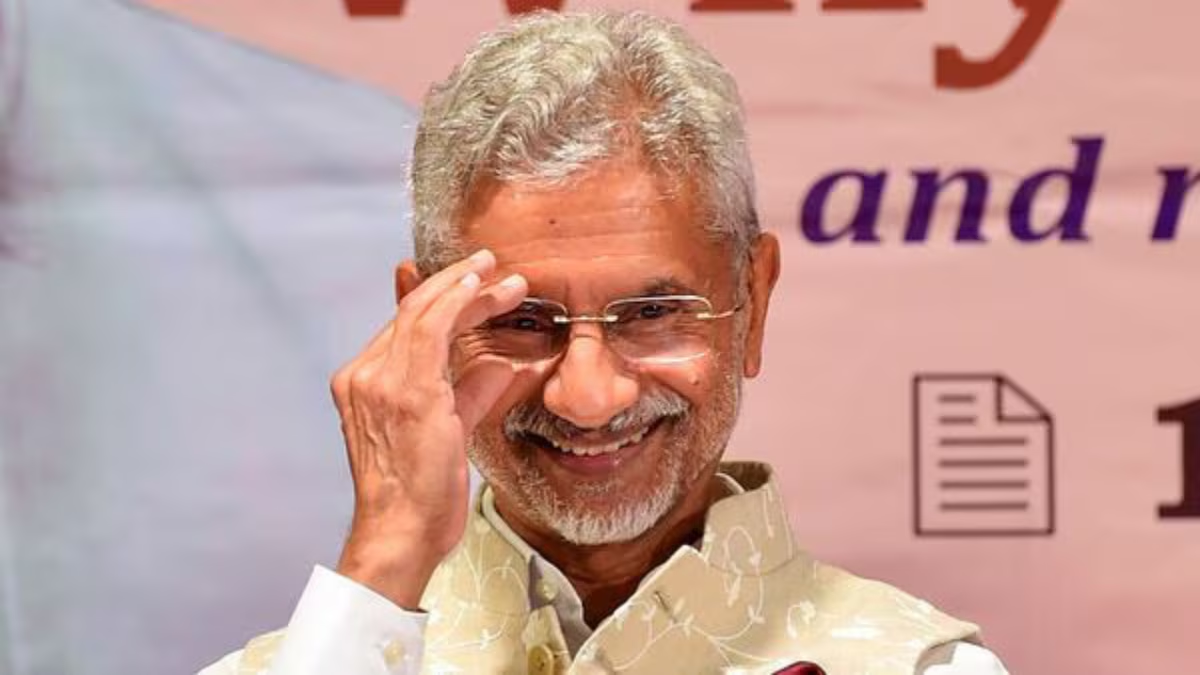

On Saturday, External Affairs Minister S Jaishankar stated that in the current period, politics “trumps” economics more and more, and that the nation must constantly diversify its supply sources to ensure its demands in a “uncertain world.”
He added that by interacting with nations one-on-one, the US has established drastically different parameters of engagement. After receiving an Honorary Doctorate from IIM-Calcutta on this campus, Jaishankar was speaking to an audience. “India has been actively pursuing self-reliance and establishing itself as a manufacturing base for industries,” he continued.
Politics is becoming more and more important in this day and age—and it’s not a pun. We must constantly diversify our supply sources to ensure our country’s demands in an uncertain environment,” Jaishankar stated.
“The United States, which has long supported the current system, has established drastically different conditions for participation. He pointed out that it is accomplishing this by working one-on-one with nations.
In tandem, India and the US are negotiating a comprehensive trade agreement and a framework trade agreement to address tariffs.
China has “long played by its own rules” and continues to do so, according to the ministry of external affairs.
According to him, other countries are unsure about whether the focus should be on outward competitiveness or the compromises and agreements that accompany it.
“Faced with such pulls and pressures of globalisation, of fragmentation and of supply insecurity, the rest of the world responds by hedging against all contingencies,” Jaishankar stated.
He claimed that India has been making exponential progress in both the most recent scientific discoveries and infrastructure.
Jaishankar stated that the “resilience and reliability” of supply chains have come to light because a third of the world’s production today occurs in China.
The likelihood of that disruption has increased due to conflicts and climate catastrophes. According to Jaishankar, India is quickly catching up to some of the more prosperous Asian economies in terms of infrastructure, including ports, highways, railroads, aviation, energy, and power.
“We are now moving ahead, by any standards,” he declared, insisting that the world is aware of India’s progress.
“… With these considerations in mind, we are today endeavouring to forge new trade arrangements and promote fresh connectivity initiatives,” stated the minister.
He stated that “we will naturally be guided by our people-centric vision, just as our connectivity plans will be by strategic as well as economic considerations” when it comes to commerce.
According to Jaishankar, “the goal of foreign policy is to steadily expand our footprint beyond its current confines” as the government prepares for a developed India by 2047.
He claimed that a foundation for doing so is created by India’s solidarity with the Global South.
According to Jaishankar, India’s diplomatic mission is “active rather than passive” in terms of boosting overall national power.
“A major power, that too with high aspirations like us, must have a significant industrial base,” he stated.
The minister maintained that the focus on “Make in India” during the past ten years reflects a “different mindset and greater ambition,” saying that “promoting industrial growth and even incentivizing it, is today a key economic priority.”
In order to prevent India from falling behind, he claimed that innovative manufacturing and technology are receiving attention.
These days, we live in a world of semiconductors and chips, batteries and electric cars, space and drones, or nanotech and bioscience. Each of them has a chance to advance and develop special skills, according to Jaishankar.