
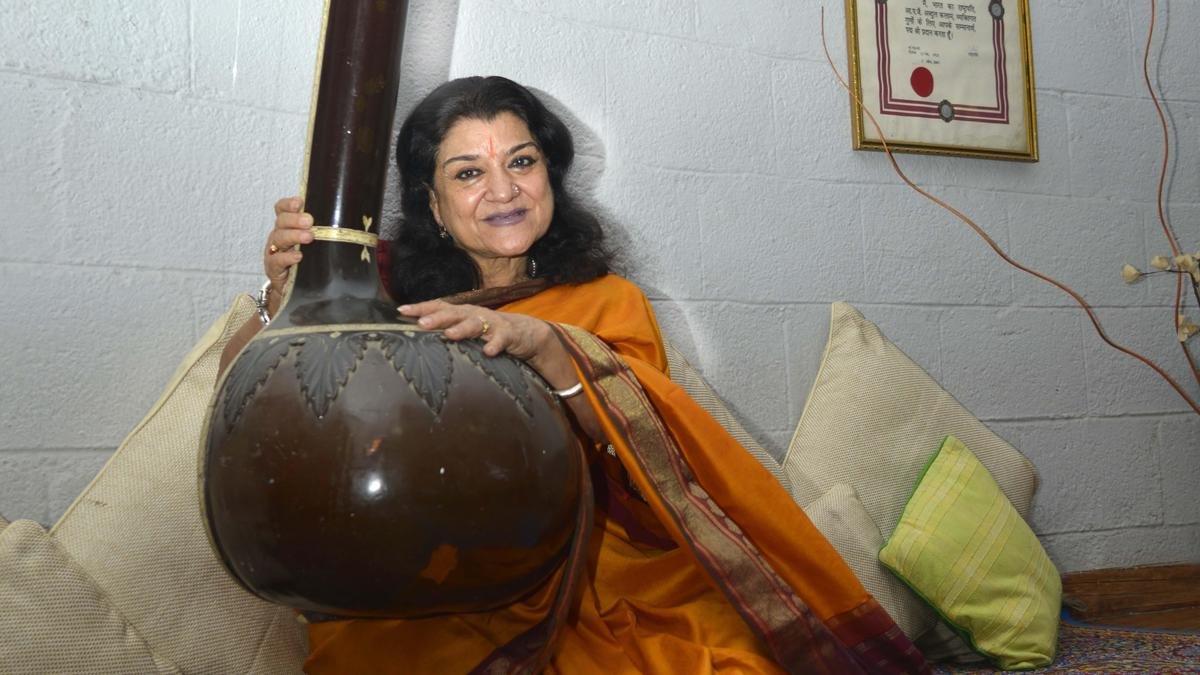

Entering Rita Ganguly’s spacious, airy home in Kaladham, Noida, one is first struck by the lush greenery that surrounds it. The ambience speaks of a lifetime spent in the arts. Tamburas stand neatly stacked in a corner, while a wood-panelled performance space speaks of a long creative journey. Recently conferred the Sangeet Natak Akademi (SNA) Fellowship, Rita Ganguly joins an elite group of artistes whose influence has resonated across generations. Yet accolades alone cannot define her. Singer, dancer, actor, director, author and patron of the arts, she has moved effortlessly across disciplines. Equally remarkable are her wit and refined intellect. Her attention to detail is evident in everything she undertakes. At her music festival Arohi, for instance, she once insisted on a carefully coordinated colour theme and candlelit stage décor, creating an immersive experience that seamlessly blended the visual and the aural.
Born in 1940 in Lucknow, Rita Ganguly was drawn to the arts from a young age. She came to be known as ‘Baby Rita’ after an unexpected performance on the stage. Recalling the incident, the veteran says with a laugh, “I was quite young. Ustad Allaudin Khan and his disciples were on stage when the curtain got stuck, refusing to roll down. I too tried to do my bit, along with others, to extricate it. But I am told that amidst it all, I walked to the centre of the stage, did a namaskar, and started dancing! That, in a way, was my first public performance. I discovered I loved dancing and copied all the dancers I watched perform. Later, I trained in Kathakali at Shantiniketan.”
Her dance training was formidable — Kathakali under guru Kunchu Kurup and guru Chandu Panikkar, abhinaya from Pt. Shambhu Maharaj and Manipuri from guru Maisnam Amubi Singh.
Rita Ganguly speaks of her gurus with deep reverence. Her musical training brought her in contact with some of the greatest exponents of the 20th century: Begum Akhtar for ghazal, Siddheshwari Devi for thumri, Pt. Gopeshwar Bandopadhyay for dhrupad, and Kirana gharana vocalist Pt. Mani Prasad for khayal. “I used to go to his house most evenings. There would always be rasikas gathered there, and he was a very giving guru,” she recalls. She also learnt the Rajasthani maand from the legendary Allah Jilai Bai.

Rita Ganguly shared a close bond with her guru, Begum Akthar.
| Photo Credit:
R.V. Moorthy
A widely travelled performer, Rita Ganguly looks back on her years abroad with fondness. “I was fortunate to participate in many events overseas. I performed Kathakali, travelled with Yamini Krishnamurthy’s Bharatanatyam productions, Birju Maharaj’s Kathak presentations and the Jhaveri Sisters’ Manipuri performances. Putana Moksha was my most popular work. I travelled all over the world with it,” she recalls. It was during this period that she met her husband, Keshav Kothari. “He supported me in every way and was always so proud of me.” She attributes her success simply to hard work and an unwavering pursuit of perfection.
The diversity of Rita Ganguly’s training is remarkable, but she sees no boundaries between artistic disciplines. “The arts are linked,” she says. “You should not separate them. Without being a trained musician, you can’t be a dancer. Without being a dancer, you cannot be a theatre artiste.” Explaining why dance training is indispensable to the stage, she adds, “You have to be in total control of your body and its movements. Theatre is all about movement; you cannot falter on stage.”
Rita Ganguly’s influence on generations of theatre practitioners is profound. Associated with the National School of Drama since 1968, she remains actively engaged with the institution. Her most recent production, the 2025 Sanskrit play Damayanti Nal Gatha, based on a work attributed to sage Veda Vyasa, was an ambitious five-hour outdoor spectacle. Drawing on descriptions of classical Sanskrit theatre in the Natyashastra, she choreographed the production to recreate the grandeur and aesthetic world of an ancient theatrical tradition. Yet she is modest about her achievements. “It was music that was my entry into theatre,” she says.
Audiences also remember Rita Ganguly for her memorable rendition of the wedding song ‘Dhinak Dhinak Dha’ in the 2005 film Parineeta. She was 65 at the time. Dismissing the experience, she says, “Films were a waste of time for me. Without the live interaction, acting in films didn’t appeal.”
Rita Ganguly primarily identifies herself as a musician. “I have really worked hard on this; accepted almost all concerts that came my way.” Her daughter Meghna, who sat with her throughout the interview concurs, “I remember Ma literally accepting any baithak however small. Baba (Keshav Kothari) used to play the tabla, accompanying her during her extensive riyaz at home.”
Indeed, the major awards she has been honoured with have all been for her contribution in music; in 1999 the Sangeet Natak Akademi, the Padma Shri in 2003, and finally the SNA Fellowship for 2025.
A role model to many, Rita Ganguly talks about the artistes who have inspired her. “The dancer who moved me the most was Yamini Krishnamurthy. As a singer, right now I feel it is young Dagar (Ustad Wasifuddin Dagar)… what voice control! Ravi Shankar was the finest musician, I feel. In theatre, Ebrahim Alkazi. And in the past, I loved the rendition of‘Nadiya kinare’ by Badi Moti Bai.”
The multifaceted artiste has also authored two books, and is particularly excited that her book on Begum Akhtar in English is set to be adapted into a film. Looking back on a life rich with artistic achievement across disciplines, she admits to just one regret. “I wish I could have produced more plays,” she says. “Perhaps the Mahabharata.”
Published – September 07, 2026 06:07 pm IST