
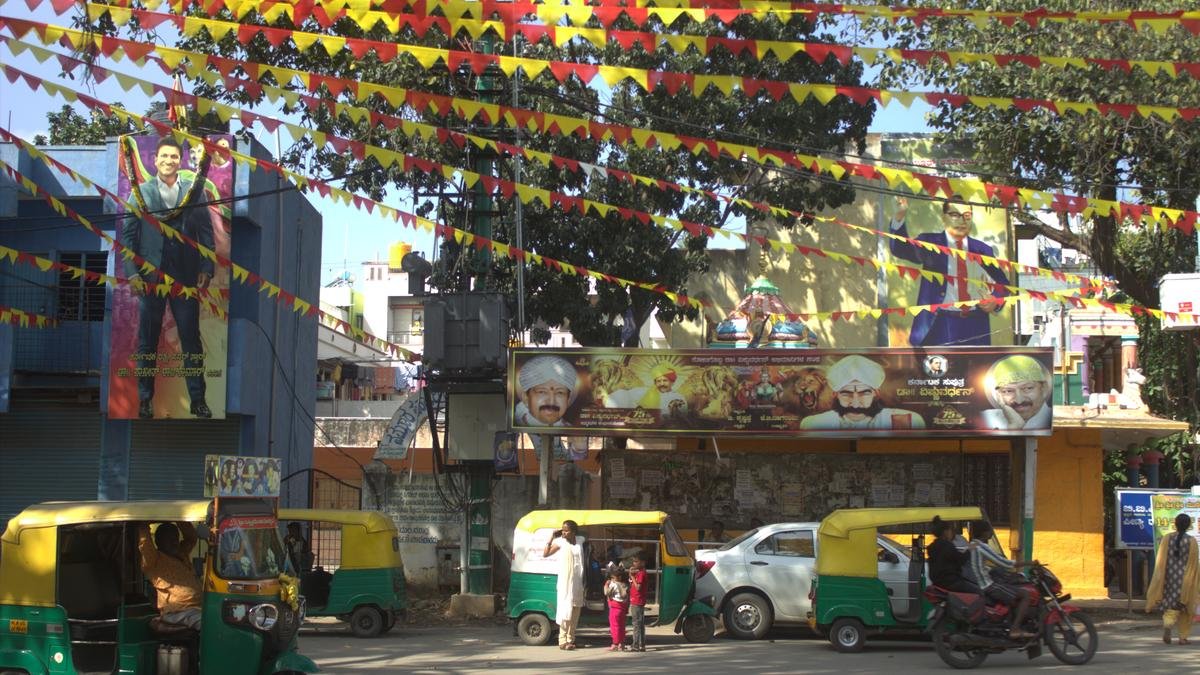

When Eshwari R and Mahima Gowda first visited the industrial neighbourhood of Laggere in 2024 as part of a fellowship project, something caught their eye: a prominent statue of Kannada actor Vishnuvardhan. “Since both of us are from Bengaluru and so familiar with the film culture here, it was the first thing we recognised. We had never seen such a wonderful statue of him before, and that too, right outside someone’s house. It was a public thing, but also very personal,” says Mahima.

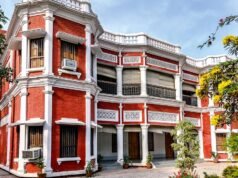
As they continued to explore the area, they found other things that hinted at Laggere’s close association with films, most notably Akash Cinemas, a single-screen movie theatre. “It is literally this giant space within a curious residential structure. And the fact that so much space was allotted to a single screen, given that most single screens in the city had been demolished, made us curious about Laggere, its people and cinema culture.”

A republic day celebration in Laggere
| Photo Credit:
Special Arrangement
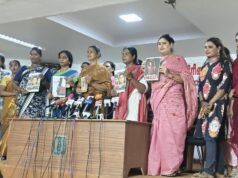
This was the starting point of Reel Duniya, Real Duniya: Cinema, Memory, and Leisure in Laggere, a photo-illustrated essay book by Eshwari and Mahima exploring how cinema is experienced in this area. Launched at the BLR Design Centre earlier this month, the book was “born out of friendship, fieldwork and endless talk about cinema in our shared accommodation room, on WhatsApp, over Instagram and while eating puffs at Friends Bakery,” as the preface states. “Between drawings, photographs, fragments of dialogue in the essays, the book maps how cinema seeps into the social life of Laggere and into our own.”

At the recent launch of the book
| Photo Credit:
Special Arrangement
Having had that first brush with this neighbourhood, Eshwari and Mahima wanted to probe further. So, in April last year, they applied to the India Foundation for the Arts’ Project 560 programme, whose mandate is described as “an artistic provocation to look beyond the familiar hubs and zoom into the peripheries with layered pasts, chaotic present times, unimagined futures of a rapidly mutating metropolis,” according to the IFA website.

“We thought this was a perfect opportunity for us to discover Laggere,” says Eshwari, noting that although they had both lived in Bengaluru for a long time, they hadn’t heard of Laggere until they visited it as part of the fellowship. “We thought that maybe, at least through this project, we could learn more about the place and its people.”
The project’s research was mostly place-based: baithaks, or informal gatherings, and discussion-driven conversations with garment workers, theatre employees, fan club members, residents, and cinema lovers in the area.
“There is a sort of learning exchange that happens, something that is non-negotiable. When we go there, we learn something about their life, while also sharing things about our life,” explains Eshwari. “We call it baithaks, because we are literally sitting and talking.”

Kannada actor Vishnuvardhan
| Photo Credit:
Special Arrangement
One of the most interesting threads in the book is gender and leisure. For instance, at Akash Cinemas, Mahima and Eshwari ran into two women who worked there, Mabu and Chanbi, who had them thinking about exactly this. “Both of them had left by the time we returned to Laggere with the IFA project,” says Eshwari, recalling how the women told her the advantage of the job was that they could watch films whenever they wanted and bring their children to work.
It was a similar setup at Maruthi Theatre, two kilometres away, where two other women workers expressed similar views, remembers Mahima. “Their idea of leisure and work within the same space was surprising to us.”
Another thing that they realised from their visits to the area was that “our conversations with women would not happen in the same way as our conversations with men. There was such a huge time and space restraint,” says Mahima.
From the auto union members they casually bumped into and had 45-minute conversations with, to Krishnappa, an admirer of Vishnuvardhan whose home they visited, access to the men of the area was relatively easy. The women, on the other hand, were working all the time, whether in the garment industry, other gigs or at home, and were often a little shy and suspicious, says Mahima. “There was a lot of negotiation to find time with them. Also, it took some time to gain their trust.”

At Akash Cinemas
| Photo Credit:
Special Arrangement
Over the course of six months, the two ended up speaking to anywhere between 35 and 40 people from Laggere. The conversations helped them understand a bit more, not just about the space, but also the different ways in which people celebrate cinema.
While the initial plan was to put together a zine from these conversations, the project’s scope soon expanded. “We had a lot of conversations and stories, even those coming from the field, with some of the people we spoke to saying that they were happy to write an essay for the book,” says Eshwari.
The book finally materialised, with support from LLN Press – Living Labs Institute, where Eshwari works. “We printed 200 copies, some of which went to the people of Laggere who worked with us. The rest are being sold on the press’ website.”

While the two of them are happy to have brought out the book, they see the whole experience as an entry point and want to see what other kinds of work can come from it. “We have a lot of different threads to follow, and I hope we can do that in the future,” explains Mahima.
Published – September 30, 2026 10:23 am IST