
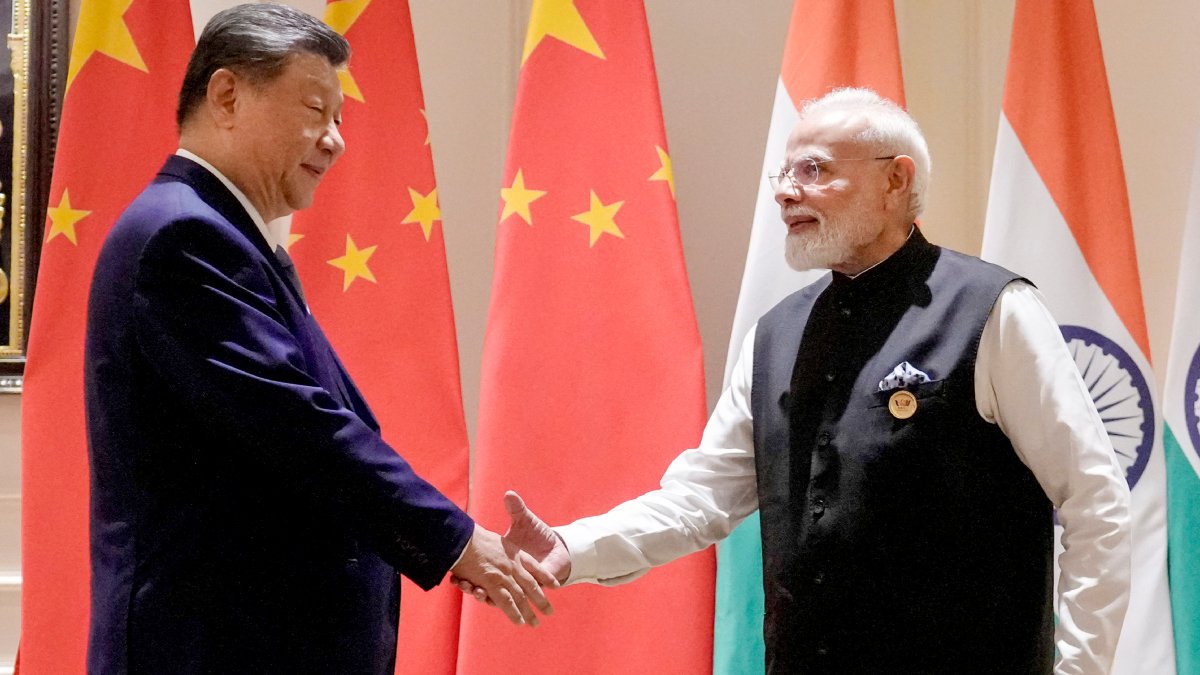

President Xi Jinping and Prime Minister Narendra Modi reached the “most important consensus” during their meeting on the sidelines of the BRICS Summit that China and India should be partners rather than rivals, Chinese Foreign Minister Wang Yi said on Monday.
Summing up Xi’s two-day visit to New Delhi on September 12-13 for the 18th BRICS Summit and his meeting with PM Modi, Wang said the two leaders held a candid and in-depth exchange of views on strategic, long-term and directional issues concerning bilateral ties.
The most important consensus
“The most important consensus they reached was that China and India should be partners,” Wang told Chinese state media on Sunday.
According to Wang, Xi said China and India could draw on each other’s strengths, support one another, help each other succeed and pursue common development. The two leaders also agreed to jointly maintain peace and tranquillity in border areas and support each other’s BRICS chairmanship.
Wang said the Modi-Xi meeting had attracted widespread international attention. He said that under the strategic guidance of the two leaders, China-India relations had gradually moved out of a low point, progressing from a “restart” to a “renewed elevation”.
Areas of cooperation between the two countries are expanding, trade has reached record levels and people-to-people exchanges have become more dynamic, Wang said. He added that improving China-India relations was welcomed by the more than 2.8 billion people of the two countries and represented an important pillar for strengthening cooperation across the Global South.
Takeaways from Modi-Xi meeting
Wang said both sides had pledged to further build political mutual trust, appropriately manage differences and contradictions and jointly maintain peace and tranquillity along the border. He described the development paths of China and India as a shared opportunity, saying cooperation between the two countries had implications far beyond their bilateral relationship.
He said the normalisation and improvement of ties had been hard-earned and should be valued. Wang expressed hope that India would work with China to translate the leaders’ consensus into action, reiterating that the two countries should remain partners rather than rivals and steadily advance bilateral relations without stagnation or backsliding.
Wang also said the border issue should be viewed in the broader context of bilateral relations, with dialogue and cooperation remaining the prevailing trend. He said both countries should accelerate their respective development and national renewal while contributing to regional and global peace and shared prosperity.
Peace and tranquillity at border
During his meeting with Modi, Xi called on the two countries to draw on political wisdom based on mutual respect and understanding to overcome disruptions. He urged both sides to pursue parallel progress in bilateral relations and on the border issue, with the two tracks reinforcing each other to maintain peace and tranquillity in border areas.
Wang said Modi responded positively, affirming that India has always viewed China-India relations from a strategic and long-term perspective. According to the Chinese foreign minister, Modi said India was ready to be a partner, not an adversary, to China and viewed each other’s development as an opportunity rather than a challenge.
Wang also quoted Modi as saying that India’s approach to its relationship with China was independent of third-party influence and that New Delhi would not allow any forces to conduct anti-China activities from Indian territory.
India, Wang said, remains committed to high-level exchanges with China, deeper strategic communication and expanded people-to-people ties based on mutual respect and trust, with the aim of further advancing bilateral relations.
The two leaders also agreed to make development the foundation of shared interests, deepen friendly ties and mutually beneficial cooperation, and expand collaboration in areas including cultural and people-to-people exchanges and direct air connectivity. These measures, Wang said, would help increase mutual understanding between the Chinese and Indian people and strengthen public support for bilateral relations.
The leaders further agreed to support each other’s BRICS chairmanships, strengthen coordination in multilateral forums including the United Nations, the Shanghai Cooperation Organisation and the G20, and advance cooperation across the Global South. They also agreed to promote a more multipolar world order and act as a stabilising and progressive force amid global uncertainty.
Elaborating on Wang’s remarks, Chinese Foreign Ministry spokesperson Guo Jiakun said on Monday that China would work with India to implement the important common understandings reached by Xi and Modi.
“As the two leaders have charted the course for the future development of the bilateral ties, China will work with India to implement the important common understandings reached between the two leaders,” Guo said.
He said China would expand the areas of cooperation, deepen people-to-people exchanges, strengthen coordination in multilateral forums and continue efforts to improve and develop bilateral ties. Beijing, he added, would also firmly support India’s development and national revitalisation, with the two countries contributing to peace and prosperity in the region and beyond.
China will take over the BRICS chairmanship in 2027.
With inputs from PTI
Also Read:
India, China can learn a lot from each other: PM Modi, Xi Jinping hold talks to reset ties