


There are landscapes that impress from a distance, and then there are those that seem to belong to another world entirely. In central Vietnam, the limestone mountains of Phong Nha–Kẻ Bàng National Park rise through dense tropical forest, concealing beneath them a subterranean universe of rivers, chambers and caverns on a scale that can be difficult to comprehend.
That extraordinary landscape has once again received international recognition. At the 2026 World Travel Awards Asia, Oceania & Indian Ocean Gala Ceremony, held in the Maldives on 27 September, Phong Nha–Kẻ Bàng was named Asia’s Leading National Park 2026, while also receiving the title of Vietnam’s Leading Nature Destination 2026.
The awards add another chapter to the story of a destination whose appeal is rooted not in man-made spectacle, but in geological time, wilderness and the extraordinary world hidden beneath the surface.
A landscape shaped over hundreds of millions of years
Phong Nha–Kẻ Bàng lies within the Annamite Range of central Vietnam, close to the country’s border with Laos. Its limestone landscape began forming approximately 400 million years ago, making it the oldest large-scale karst system in Asia. UNESCO describes the wider transboundary World Heritage property as one of the world’s most exceptional and intact limestone karst landscapes.
The result is a landscape of extraordinary contrasts.
Above ground are steep limestone mountains, deep valleys, dense forests and dramatic rock formations. Below them lies a labyrinth of caves and underground waterways, with more than 220 kilometres of documented caves and subterranean rivers within the wider UNESCO property.
It is this hidden geography that gives Phong Nha–Kẻ Bàng its almost mythical quality.
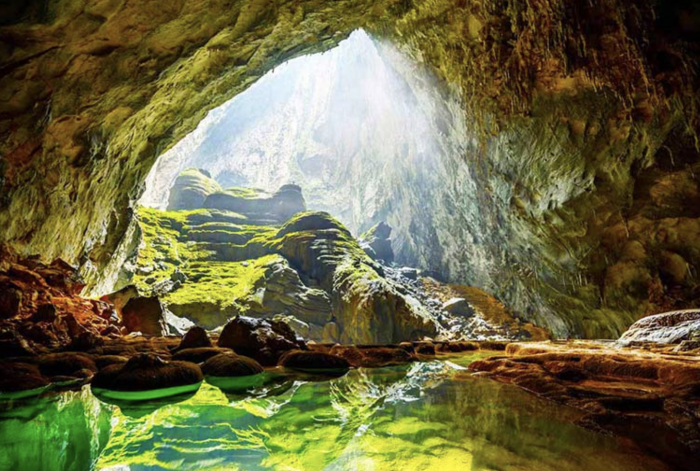
The park has become known as a “Kingdom of Caves”, and for good reason. Among its most celebrated natural wonders is Son Doong, recognised as the world’s largest cave, while Phong Nha Cave, Paradise Cave, Hang En and other spectacular systems offer very different ways of experiencing the subterranean landscape.
For visitors, the experience can range from relatively accessible boat journeys into enormous caverns to demanding multi-day expeditions deep into the wilderness.
Into a world beneath the jungle
The journey into Phong Nha Cave begins on the water, with boats travelling along the Son River before entering the darkness of the cave itself.
Inside, daylight gradually disappears and the landscape changes completely. Limestone formations emerge from the shadows, while the underground river becomes the route through a vast natural cathedral shaped over geological time.
Elsewhere, Paradise Cave offers another perspective on the region’s extraordinary geology, with immense chambers and formations that demonstrate the scale and intricacy of the underground world.
For adventurous travellers, the possibilities become considerably more demanding.
Expeditions into caves such as Hang En take visitors beyond conventional sightseeing, combining jungle trekking, river crossings, cave exploration and overnight camping. Son Doong represents the ultimate expression of this adventure, with its enormous passages and subterranean ecosystem creating an experience that is as much expedition as holiday.
Recent international attention has helped reinforce the destination’s reputation among travellers seeking experiences beyond conventional sightseeing. The Times, for example, recently highlighted Phong Nha–Kẻ Bàng among Vietnam’s most beautiful places, particularly for its caves and adventure experiences.
Where nature is the attraction
Yet the caves are only half the story.
Phong Nha–Kẻ Bàng is also a remarkable biodiversity refuge, with forests extending across a landscape of limestone peaks, valleys and underground ecosystems.
UNESCO records more than 2,700 species of vascular plants and 800 vertebrate species within Phong Nha–Kẻ Bàng, including hundreds of species endemic to the central Laos–Vietnam region and numerous globally threatened species.
For travellers, this creates opportunities to experience Vietnam away from its better-known urban and coastal destinations.
Trekking routes lead into the forest, while wildlife encounters and birdwatching provide another reason to explore beyond the caves. The landscape changes constantly: dense jungle gives way to towering karst cliffs, rivers thread through valleys and caves appear unexpectedly among the forest.
It is an environment where simply walking through the landscape can feel like an expedition.
Adventure with a lighter footprint
The growing popularity of Phong Nha–Kẻ Bàng also brings a responsibility that the park’s management increasingly places at the centre of its future.
The park’s management has emphasised that conservation must remain the foundation of tourism development. Following the 2026 World Travel Awards recognition, Deputy Director Dinh Huy Tri described the accolade as both an honour and a greater responsibility to protect the area’s natural and World Heritage values.
That philosophy is particularly important in a landscape as fragile as this.
UNESCO identifies sustainable tourism, infrastructure development, resource exploitation, hunting and land-use change among the issues that require continued monitoring and management across the transboundary property.
The ambition is therefore not simply to bring more visitors to Phong Nha–Kẻ Bàng, but to develop tourism in ways that help protect the landscape while creating opportunities for local communities.
The park’s own future vision includes strengthening conservation and scientific research, improving ecotourism infrastructure and expanding community-based tourism initiatives so that local people can participate in and benefit from the destination’s long-term preservation.
More than a cave destination
For all its fame, it would be a mistake to think of Phong Nha–Kẻ Bàng simply as a collection of caves.
The destination offers an unusually broad range of experiences.
There are gentle boat trips for travellers who want to admire the landscape without undertaking a major expedition. There are jungle treks and cycling routes for those who want to explore at ground level. The Chay River and Dark Cave provide more active adventures, including kayaking, ziplining and the unusual experience of mud bathing inside a cave.
Then there are the serious expeditions: multi-day journeys through remote cave systems, underground rivers and jungle landscapes where camping beneath enormous limestone formations becomes part of the experience.
This diversity is one of Phong Nha–Kẻ Bàng’s greatest attractions. A first-time visitor does not need to be an experienced adventurer to appreciate the region, while those looking for something more challenging can venture considerably deeper.
A new chapter for a remarkable landscape
The 2026 World Travel Awards recognition is also significant because it comes as the heritage status of the wider region continues to evolve.
In 2025, UNESCO extended the World Heritage property to include Hin Nam No National Park in neighbouring Laos, creating the transboundary Phong Nha–Kẻ Bàng National Park and Hin Nam No National Park property. Together, the protected landscapes cover more than 217,000 hectares, with a further extensive buffer zone.
The expanded designation recognises that the extraordinary karst landscape and ecosystems do not stop at an international border. They form part of a much larger ecological and geological story running through the Annamite mountains.
For visitors, that sense of scale is perhaps the most memorable thing about the destination.
You can stand beside a river in the tropical forest and know that beneath your feet an entirely different landscape is unfolding: rivers disappearing into rock, chambers large enough to contain forests and geological formations that have been developing for hundreds of millions of years.
Vietnam’s wild side
Vietnam is rightly celebrated for its cities, cuisine, coastline and cultural heritage, but Phong Nha–Kẻ Bàng reveals another side of the country.
This is Vietnam at its most elemental — ancient limestone, thick jungle, underground rivers and a sense of wilderness that can still make the modern world feel very distant.
Being named Asia’s Leading National Park 2026 places that experience firmly on the international travel map. Yet the real attraction remains the landscape itself: extraordinary, ancient and still capable of surprising even the most experienced traveller.
In Phong Nha–Kẻ Bàng, the greatest adventure is not simply discovering what lies beyond the next bend in the jungle trail.
It is discovering what lies beneath it.