

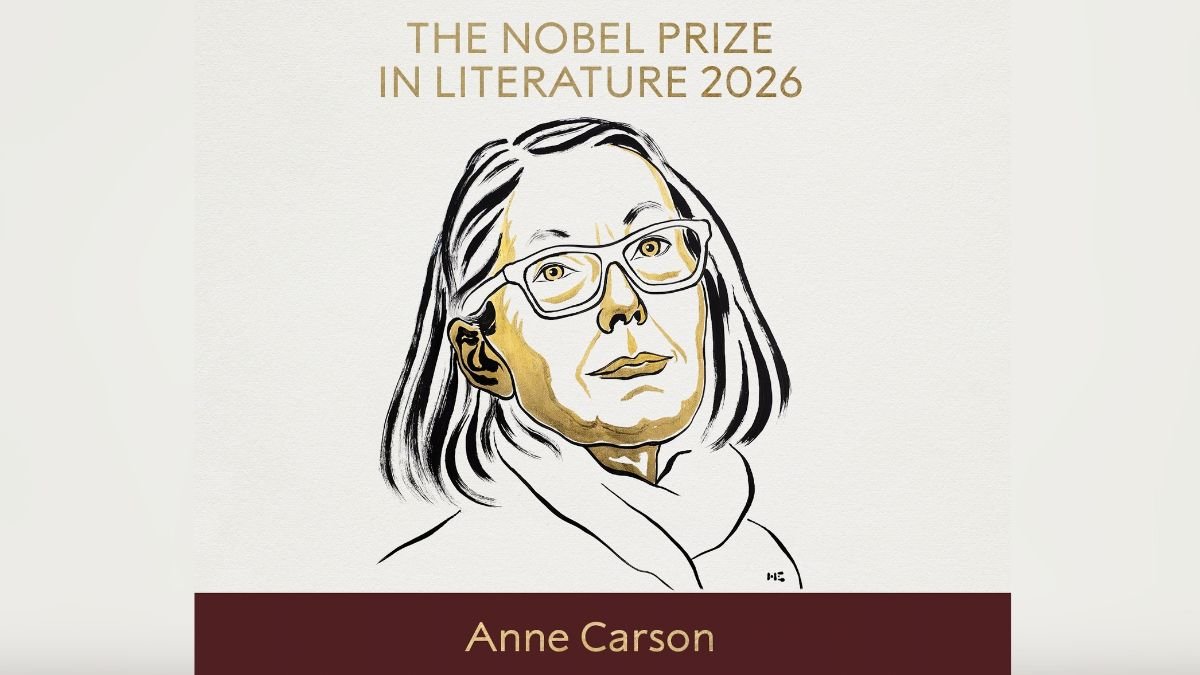

The Nobel Prize 2026 in Literature has been awarded to the Canadian author Anne Carson, “for her bold and inventive oeuvre that, in playful dialogue with the classical tradition, has created new forms for contemporary literature.” The prize was announced by the Swedish Academy in Stockholm. The prize money this year is 12 million Swedish kronor (about USD 1.2 million). 76-year-old Carson’s selection recognises a career spanning poetry, prose, translation, classical scholarship and teaching, with her writing often moving freely between different literary forms.
Carson had emerged as one of the prominent names in the run-up to this year’s Nobel announcement. As per reports, betting markets had placed her among the leading contenders alongside Chinese experimental writer Can Xue. Ladbrokes had listed both writers at 10/1 shortly before the announcement, highlighting the growing expectations surrounding Carson’s chances. However, her eventual selection reflects something broader than her standing in pre-award predictions. The Nobel recognition encompasses a literary career in which Carson has repeatedly blurred the boundaries between poetry, prose, translation, scholarship and performance.
A career shaped by classical literature
Born in Toronto, Canada, in 1950, Carson developed a deep engagement with the classical world early in her academic career. In 1981, she published her doctoral thesis in Classics, titled ‘Odi et Amo Ergo Sum’.
Throughout her career, she has combined literary writing with translation and academic teaching. Her work has repeatedly brought together the precision of a philologist with the creative instincts of a poet, particularly through her fascination with language, words and their origins.
Carson has identified the etymology of words as an important starting point for her writing. That interest has helped shape a distinctive body of work in which ancient texts, myths and ideas are not simply revisited, but reimagined through a contemporary literary lens.
Autobiography of Red brought myth into a modern coming-of-age story
One of Carson’s best-known works is her 1998 verse novel Autobiography of Red. The book draws on the Greek myth of Heracles and transforms it into a contemporary story of identity, desire and growing up.
The work is notable for its hybrid form, combining poetry with elements of narrative fiction. Carson’s approach allows an ancient myth to become the foundation for a distinctly modern and queer coming-of-age story. Her ability to move between historical periods and literary forms has remained a defining feature of her work, making her writing difficult to confine to a single genre.
Nobel recognition for a writer who refused literary boundaries
The Nobel Prize places Carson alongside some of the most celebrated names in literature, including Canadian author Alice Munro and American writers Ernest Hemingway and Alexander Solzhenitsyn.
Her selection also underlines the Swedish Academy’s recognition of a literary career rather than a single defining book. Carson’s writing has consistently experimented with form while maintaining a strong connection to classical texts and linguistic scholarship. The award brings international attention to a writer whose career has been built around making unexpected connections between ancient and contemporary worlds.
Also Read:
Nobel Prize in Physics goes to Francis Halzen for discovery of high-energy neutrinos of astrophysical origin