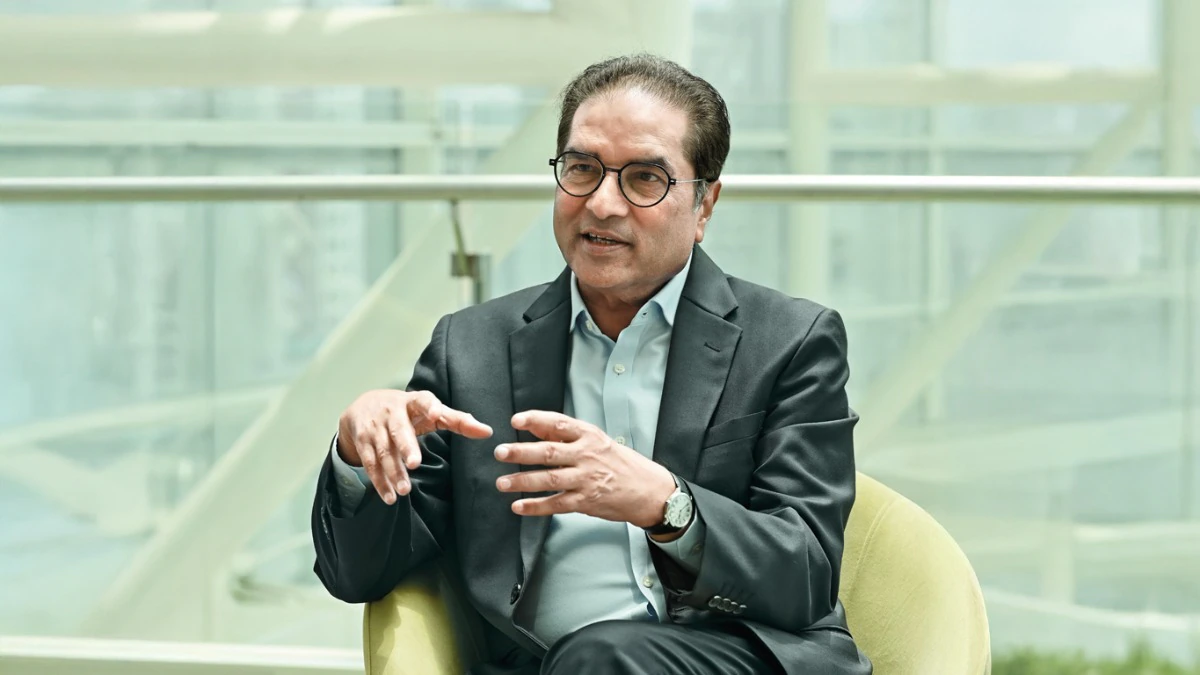

Raamdeo Agrawal has devoted his entire life to pursuing compounders and developing a reputation for identifying stocks before they become well-known. He revealed at least five behaviors that influence his strategy in a recent interview with CNBC-TV18. This is how the chairman of Motilal Oswal Financial Services considers, selects, and prices his wagers.
Agrawal prefers small, under-followed companies with clear fundamentals that the market hasn’t yet embraced. His story about Balkrishna Industries is instructive: “Today, Balkrishna Industries is a very large and well-known company.” However, there was no taker when I purchased the Rs 100 crore company at 1 P/E (price-to-earnings), with a 40–30% return on equity. I visited the business. They told me the whole story and handed me rasgulla. Next, we made a purchase. In just two years, the stock climbed from Rs 100 to Rs 1,200, and we sold everything.”
Price Is Just as Important as Growth
Agrawal is as enthusiastic about growth stories as he is cautious about prices. He acknowledges that by refusing to pay Asian Paints’ desired multiple, he lost out on profits: “When I wanted to pay 50, it was 20.” I didn’t buy when I wanted to pay $20, so it ended up being $25. After I eventually agreed to buy at $23, my dear friend remarked, “Let’s wait a little while longer.” And it reached ninety. Thus, I never received any money from that. He use the PEG ratio—price/earnings to growth—as a valuation screen because of this way of thinking. According to him, a PEG of one or less indicates that a share’s price is commensurate with its growth.
Don’t Just Depend on ROE; Include Cash Collection Quality
The key is return on equity. Although he adds operational inspections, Agrawal aims for a minimum of 25% ROE. A warning sign is a high ROE combined with a lack of working capital discipline: “Can he (the business) collect his money in 30 days? He cautions, “God knows what you are writing if you have a 25% RoE but 100–120 days (to collect the dues).”
Have an obsession with the business narrative
In order to grasp distribution, product durability, and management character, Agrawal would rather meet the founders and management. He distinguishes between ephemeral tailwinds and long-term competitive advantage through his practical curiosity.
Avoid FOMO by adhering to your price discipline.
He emphasizes patience a lot. Overpaying for the next hot stock is more unpleasant than missing a multi-bagger. The Asian Paints incident serves as a warning: even if you have unending admiration for a company, the trade isn’t worthwhile if valuation is flawed.