


4 min readNew DelhiUpdated: Aug 28, 2026 12:43 PM IST
As the second edition of the robot Olympics hosted in Beijing, China, wrapped up this week, social media feeds were flooded with impressive, viral videos of humanoid robots sprinting, sparring, clearing obstacles, and even karate-kicking the air under stadium lights.
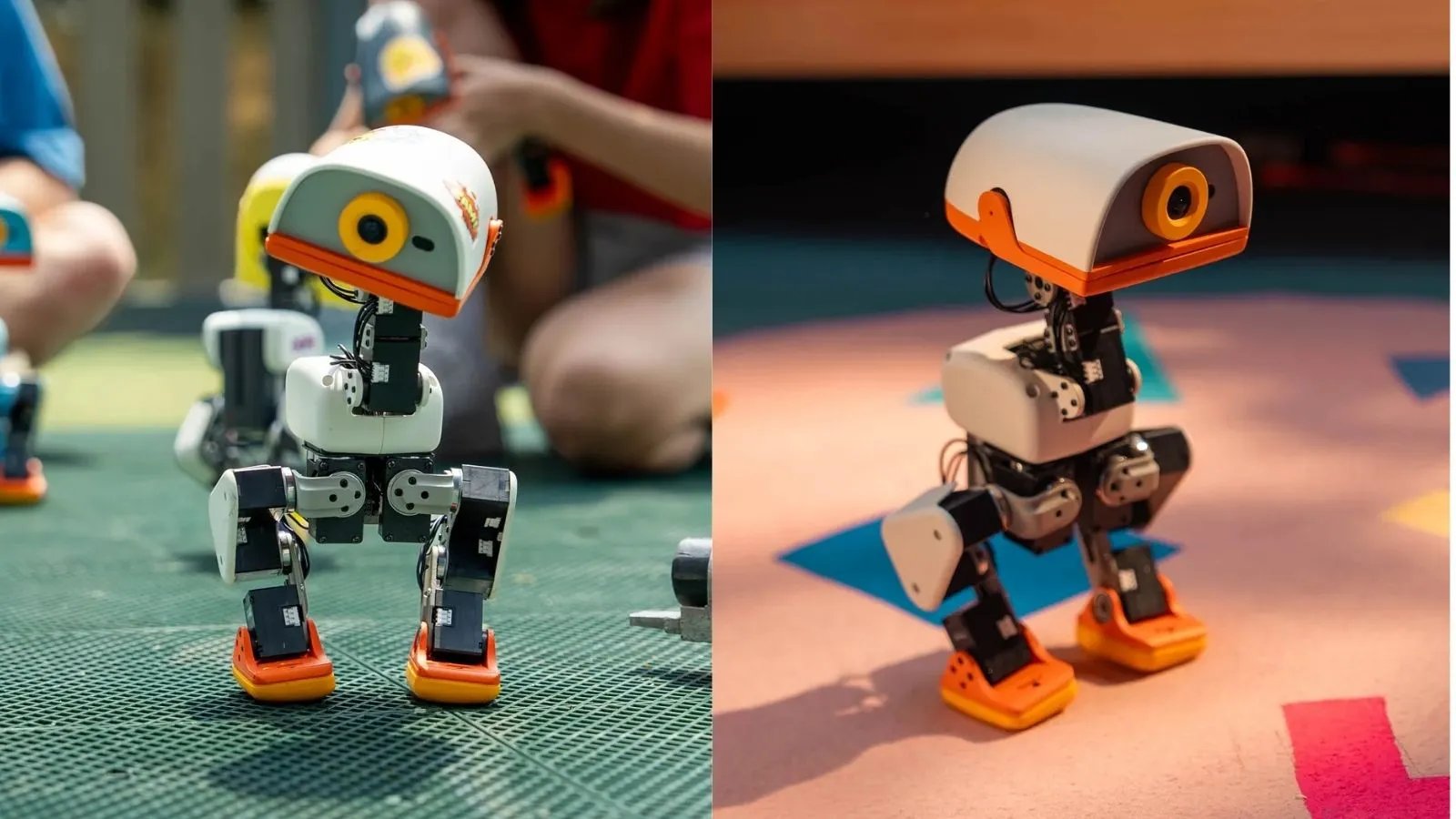
Halfway across the world, the robot everyone is talking about does none of that. Instead, it has a beak to pick things up, waddles unmistakably like a cute little duck, and sells for $399.

The Microduck unveiled by Hugging Face on Thursday, August 27, is a biped robot that is just 25 centimetres-tall and weighs up to 800 grams. It comes with balance restoration and can get back up when it falls. The robot is equipped with over 15 motors, a camera, lidar sensors, and two IMUs (inertial measurement units) to interact with the world.
 Microduck comes with seven pre-trained moves out of the box. (Image: Hugging Face)
What makes it more than a glorified Roomba, however, is that it is an open-source robot. This means that customers can teach Microduck new tricks through reinforcement learning.
The fact that Microduck is an open-source robot is a clear giveaway that Hugging Face is behind it. Hugging Face is best known as a platform for the open-source community where developers and researchers share, find, test, and deploy open-weight AI models.
But Microduck is hardly an unusual product for Hugging Face given its acquisition of French startup Pollen Robotics in April 2025 to build affordable, open source AI hardware. The company has previously launched two small desktop robots, Reachy Mini which is powered by a Raspberry Pi computer and Reachy Mini Lite, powered by a Mac or PC.
Microduck’s debut also comes as Hugging Face itself is reportedly set to be acquired by US chip giant Nvidia at a $13 billion valuation. The company has also been in the news recently over a cybersecurity incident that occurred after OpenAI’s agents breached its sandbox during safety testing and hacked into Hugging Face’s servers.
Story continues below this ad
What can Microduck do?
Microduck comes with seven pre-trained moves out of the box. This includes walking, sitting and standing, kicking, picking up things with its beak, roller-skating and getting back up from being flat on its back.
If these moves fail to impress, customers can always train Microduck in simulation and directly deploy it on the robot. Developers can also fine-tune the bot, retrain it, and redeploy it.
 Developers can fine-tune the bot, retrain it, and redeploy it. (Image: Hugging Face)
Hugging Face has also uploaded the SDK (software development kit), simulation, and full RL training stack on GitHub.
Microduck is expected to ship before Christmas 2026, with pre-orders open today (August 27). Its shells come in four colourways, namely: orange and grey, purple and grey, black and grey, and blue and grey. In the box, customers will receive a USB-C cable and game controller along with the robot.
Story continues below this ad
 The robot is equipped with over 15 motors, a camera, lidar sensors. (Image: Hugging Face)
They can also choose to purchase additional batteries, dual-slot battery charger, spare motors, spare screws, motor cables, NFC tags, roller attachments, stickers, ball, and laser pen at additional costs.