

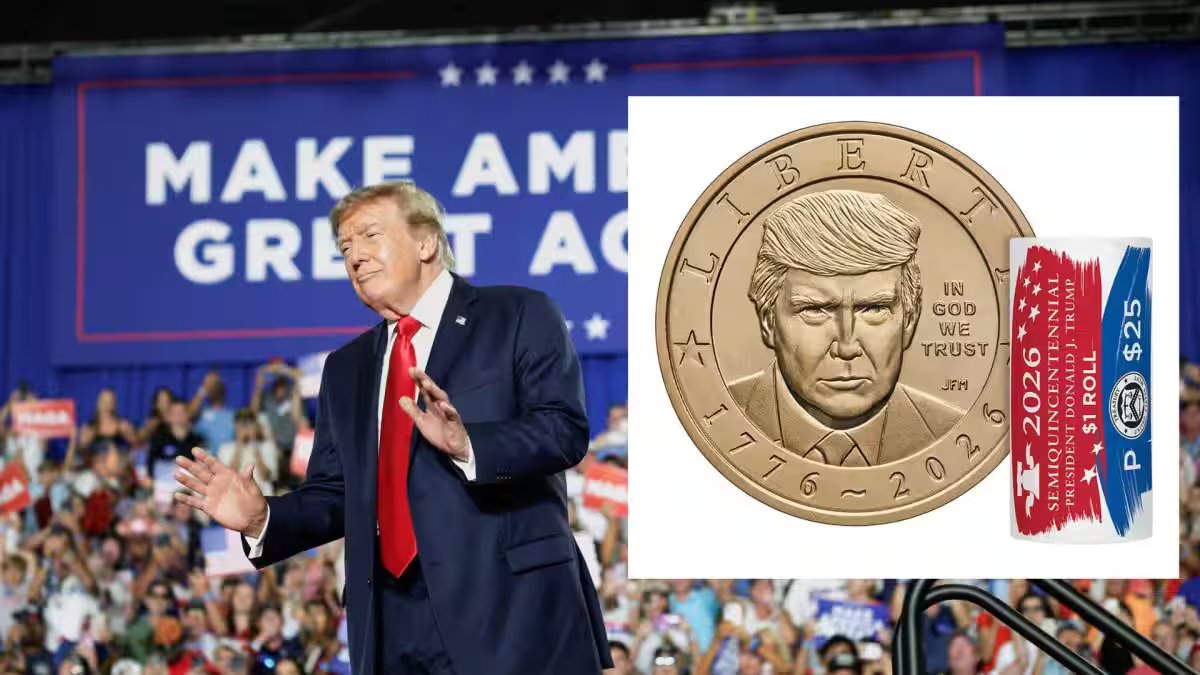

The US Mint has begun selling the 2026 Donald Trump $1 coin, a legal-tender issue marking America’s 250th anniversary. Rolls of 25 cost $61, while 100-coin bags cost $154.50. The coin has a $1 face value and features Trump alongside the Presidential Seal as part of the Semiquincentennial programme
On September 2, the United States Mint officially opened sales for the 2026 Semiquincentennial President Donald J Trump $1 Coin, marking the first time in a century that a sitting American president has been depicted on circulating US currency.
Released at noon EDT through the Mint’s online catalog and physical retail locations, the gold-coloured dollar coin commemorates the nation’s 250th anniversary.
The coin is valid legal tender under federal law, carrying an official face value of $1.
However, its release has turned heads amongst significant debate amongst numismatists and lawmakers regarding long-standing statutory prohibitions against placing living individuals on US money.
What the Trump coin look like?
Despite being publicly referred to as a “golden dollar,” the coin contains no gold or precious metal content.
The heads side features a high-relief profile portrait of Trump sculpted by US Mint chief engraver Joseph Menna, based on an official White House photograph.
Inscriptions include “LIBERTY,” “IN GOD WE TRUST,” “1776 ~ 2026,” and the sculptor’s initials “JFM”.
The tails side features the official presidential seal depicting an eagle holding an olive branch and arrows, with the inscription “250” emblazoned across the central shield to denote the Semiquincentennial.
 More from Explainers
Surrounding inscriptions read “UNITED STATES OF AMERICA,” “ONE DOLLAR,” and “E PLURIBUS UNUM”.
The metallic composition includes clad manganese brass over a pure copper core, consisting of 6 per cent zinc, 3.5 per cent manganese, 2 per cent nickel, and the remaining balance copper.
The coin has a diameter of 1.043 inches (26.49 mm), thickness of 0.079 inches (2.00 mm), and a total weight of 0.286 ounces (8.10 grammes) with a plain edge finish, struck at the Philadelphia Mint without a traditional mint mark.
Where is the Trump coin being sold?
The US Mint began offering the circulating-quality $1 coins struck at the Philadelphia Mint in direct-to-consumer packaging:
- Roll options: A paper-wrapped roll of 25 circulating coins is priced at $61.00.
- Bag options: A canvas bag containing 100 circulating coins is priced at $154.50.
- Purchase restrictions: Orders are capped at two units per product per household for the initial 24-hour sales window.
- In-person sales: Special coin-dispensing vending machines were deployed at the US Mint headquarters store in Washington, DC, vending individual coins at $5.00 each.
- July 4th privy mark: The Mint randomly dispersed 250,000 coins struck specifically on July 4, 2026, bearing a special “July 4th” privy mark into the commercial bags and rolls.
The coins are also available online at the website of the US Mint, although as of Thursday, the product was unavailable or on back-order due to rising demand.
Because the coins are sold at a premium above face value, the US Mint is categorising them primarily as collectible numismatic products, even though they are legally minted as circulating currency.
Is the Trump $1 coin legal tender?
To understand how the coin is structured under US federal law, Firstpost looked at three legal frameworks:
Legal tender status
Under Title 31 of the United States Code (31 USC § 5103), all coins and currency of the United States issued by the US Mint are legal tender for all debts, public charges, taxes, and dues.
The Trump $1 coin holds an official $1 face value, meaning it can legally be deposited in banks or used for transaction settlement at face value.
However, federal law does not compel private businesses or individuals to accept cash or specific denominations of cash for transaction payments. Unless prohibited by specific municipal or state statutes, merchants retain the right to set their own payment acceptance rules.
The living person prohibition
The primary legal challenge to the coin stems from longstanding federal statutory restrictions regarding living persons on US money.
- 31 USC § 5112(d)(1): Mandates that portraiture on US coins must depict individuals who are deceased.
- Presidential $1 Coin Act of 2005 (Public Law 109-145): Expressly prohibited issuing dollar coins featuring any sitting or living president, requiring that a former president must have been deceased for at least two years prior to coin issuance.
The historical origin of this rule dates back to the American Revolution, when the Continental Congress deliberately rejected the European monarchical tradition of placing living rulers on currency to highlight democratic principles.
In 1866, Congress enacted formal legislation banning living individuals on currency following a scandal involving Spencer M Clark, the Superintendent of the National Currency Bureau, who placed his own face on a 5-cent fractional currency note.
The 2020 statutory loophole
The US Treasury Department justified the legality of the Trump $1 coin by relying on the Circulating Collectible Coin Redesign Act of 2020 (Public Law 116-330).
Enacted during Trump’s first term, Public Law 116-330 authorised the US Secretary of the Treasury to issue redesigned circulating coins in 2026 to mark the US Semiquincentennial (250th anniversary).
The statute granted the Treasury Secretary discretionary authority to select designs “emblematic of the United States semiquincentennial”.
Treasury legal counsel determined that this 2020 authorisation superseded general prohibitions in Title 31 for the specific one-year 2026 commemorative programme.
Have sitting presidents appeared on US money?
While the appearance of a sitting president on US currency is exceptionally rare, Trump is not the first:
- Calvin Coolidge (1926): US President Calvin Coolidge appeared alongside George Washington on the obverse of the 1926 United States Sesquincentennial half-dollar to mark the nation’s 150th anniversary. Coolidge was the only living sitting president depicted on official US legal tender prior to 2026.
- Carter Glass (1936): US Senator Carter Glass appeared on the 1936 Lynchburg, Virginia, Sesquincentennial commemorative half-dollar while still alive and serving in office.
- Thomas E Kilby (1921): Governor Thomas E Kilby of Alabama appeared on the 1921 Alabama Centennial commemorative half-dollar while in office.
But unlike the 1926 Coolidge half-dollar, which was a limited-run commemorative coin distributed through local celebration committees, the 2026 Trump $1 coin is categorised as circulating-quality coinage distributed directly via federal channels.
What was the push-back against the Trump coin?
The Wednesday release followed months of procedural debate among federal coin design advisory boards.
In late 2025, draft renders of the proposed Trump dollar were presented to the Citizens Coinage Advisory Committee (CCAC). Bipartisan members of the committee objected, arguing that placing a sitting president on circulating money bypassed historic norms.
Legal experts on the committee noted that proceeding without a formal recommendation from the advisory panel violated standard procedural protocols.
In response, mint officials asserted that advisory committee evaluations are strictly consultative rather than binding, empowering US Treasury Secretary Scott Bessent to authorise production unilaterally.
Broader oversight tensions emerged following leadership changes within the Commission of Fine Arts (CFA), which eventually approved additional numismatic designs associated with the 2026 programme.
Has the US released any other coin for its 250 years?
The $1 coin is part of a larger suite of commemorative currency releases introduced for the 2026 Semiquincentennial celebration.
Additional circulating coins released for 2026 include the Emerging Liberty Dime, Enduring Liberty Half Dollar, and a series of five distinct quarter designs depicting the Mayflower, Revolutionary War, Declaration of Independence, US Constitution, and Gettysburg Address.
The US Mint simultaneously launched official Donald J Trump bronze medals, alongside historical presidential medals for Woodrow Wilson and Warren G Harding.
US Treasury officials have also previously proposed non-circulating $250 commemorative currency concepts and 24-karat gold medals as part of the broader 2026 celebration series.
With sales officially underway, officials expect high initial demand driven by both collectors and political enthusiasts, even as many continue to debate the long-term precedent of issuing currency featuring sitting heads of state.
With inputs from agencies