

When I visited Mokai 2.0, the popular café’s expansive new home in Bandra’s Pali Hill, a few months after it opened in March 2026, I expected what many viral cafés tend to deliver: impeccable aesthetics, a formidable social media presence and food that merely held its own.
Mokai, which first opened on Chapel Road (also in Bandra) in 2024, had already become a celebrity hangout. Its Instagram account has 62,600 followers, while Suraksha, one of its baristas, has emerged as an unlikely social media star.

Floating matcha bar inside Mokai in Mumbai
| Photo Credit:
Special arrangement
Mokai’s rise says something about what it takes to sell a cup of coffee in 2026. An Instagrammable interior is now merely the entry requirement. In an increasingly crowded café market, social media must generate FOMO (fear of missing out) and keep the café in public conversation after the opening buzz has faded.
That visibility has made the café a sought-after platform for celebrity collaborations, brand launches and film promotions. Director Imtiaz Ali was among its more recent guests for the promotion of his film, Main Vaapas Aaunga. Brands and public figures are not merely using the café as an attractive backdrop; they are tapping into its audience, online personality and potential for a viral moment.
Founder Karreena Bulchandani, however, is careful not to mistake visibility for loyalty.
“Social media plays an important role in helping spread the word, but that’s where its job ends,” she says. “Social media may bring people in, but food, drinks and hospitality are what bring them back.”
For Karreena, a more meaningful measure of success is the regulars who continue to return despite long waiting times.

A customer wear red light therapy goggles at Mokai
| Photo Credit:
Special arrangement
The new wellness bar extends Mokai’s online philosophy into the physical space. Karreena studied skincare and nutrition in Singapore and spent time in Japan learning about matcha before opening the café. Drawing on the relationship between food, skincare and wellness she encountered across Japan, South Korea and Singapore, she conceived an “inside-out” experience: guests can mill and whisk their own matcha using custom stone mills sourced from Japan, sip collagen matcha and settle in with face or LED masks.
The competition for customers, and their attention, is intensifying. According to Project Café India 2025 by World Coffee Portal, a global research platform,India’s branded café market grew 12.7% over the previous year to reach 5,339 outlets.
Café-going is also becoming deeply embedded in urban life. Of the 4,000 consumers surveyed, 24% said they visited a coffee shop every day.
Coffee, however, remains a relatively expensive indulgence rather than an everyday necessity. The average café bill, including food and beverages, stands at ₹660.86 per visit, with espresso-based drinks often costing nearly twice as much as the food they accompany.

The Ranwar village walk in Bandra, hosted by Veronica’s
| Photo Credit:
Special arrangement
For Yash Bhanage, founder and COO of Hunger Inc. Hospitality — the company behind Veronica’s, Bombay Sweet Shop, The Bombay Canteen, and Papa’s — the conversation begins somewhere less fashionable: consistency.
“One of the things that does not get spoken about enough is that true community is built through product consistency,” he says.
As cafés increasingly turn to workshops, run clubs, book readings and cultural programming to build loyalty, Yash cautions against treating community as an experience that can be layered over an unreliable product.
At Veronica’s in Bandra’s Ranwar Village, community programming begins with the neighbourhood itself. Guided walks explore the history, homes and smaller details of Ranwar and Pali Village. The sandwich shop also hosts coffee takeovers, inviting cafés and roasters from across India to run its coffee bar for a weekend.
Get moving
When Brevé opened in Mumbai in 2020, co-founder Usman Bhadelia, a cyclist and triathlete, imagined a space where athletes, creatives, entrepreneurs and everyday coffee drinkers could cross paths. Soon, weekend cycle rides were ending over breakfast, while conversations moved beyond training plans into friendships and business ideas.

Brevé’s running club
| Photo Credit:
Special arrangement
Some customers who first met at Brevé have since trained for races together, launched businesses and become close friends.
“Coffee was simply the medium through which connections happened,” says Usman.
In May, Brevé opened its larger Bandra flagship around 200 metres from the original café. The new outpost is home to Running Late by Brevé, which the brand describes as Mumbai’s only café-run club. Its first run was held on May 10; its WhatsApp community has since grown to around 200 members, with between 30 and 40 runners typically joining its Sunday runs after registering through Instagram.

Weekend cyclists at Brevé
| Photo Credit:
Special arrangement
Usman says, “Running creates a different kind of inclusivity.”
For Usman, that need is personal. When he moved to Mumbai around a decade ago, many of the friendships that made the city feel like home emerged through cycling, running and triathlon. Brevé was partly an attempt to create the kind of place he had once needed.
Come one, come all
LastHouse Coffee: By The Lake in Hyderabad just wants its customers to speak to one another.
Architect Naina Polavarapu founded the Jubilee Hills café in 2023. The café has since expanded from 50 seats to around 150–160. It is also India’s first crop-to-cup café championing Robusta coffee sourced from Naina’s family farm in Sakleshpur, Karnataka.
When community manager Katikaneni Amrutha began curating events last year, she hoped to activate The Pantry, the café’s retail and community space. “Even though we had large community tables, nobody spoke to each other,” she says, adding, “we’ve always wanted LastHouse to feel social.”

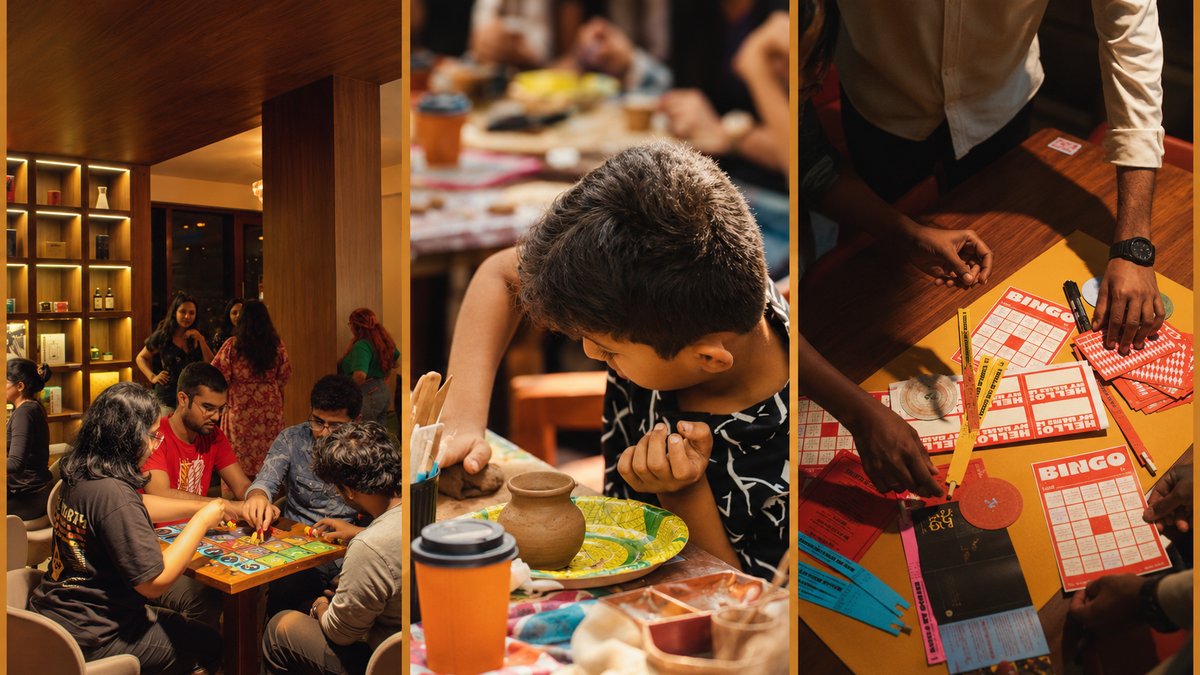
Game night at LastHouse
| Photo Credit:
Special arrangement
The programming reflects interests already taking shape in the city. LastHouse sells vintage cameras and film rolls, connects customers with local film developers and works with one of Hyderabad’s few second-generation analogue-camera repair specialists. One exhibition brought together more than 150 vintage cameras, while the veteran repairman restored cameras as visitors watched.
Other collaborations include portrait sessions with The Sketching Collective, whose members became known during the pandemic for sketching heritage buildings and public spaces before bringing their workshops to the lakeside café..”

Pottery by the lake at LastHouse
| Photo Credit:
Special arrangement
Programming, however, requires continual reinvention. “We’re constantly learning what works,” Amrutha says. “A game night might sell out the first time, dip the second and almost disappear by the third. Then we have to rethink the format.”
The team now curates niche tabletop and social-deduction sessions instead of generic game nights. Other formats have proved more durable: weekly workshops with The Pottery Circle routinely sell out, attracting 45–60 participants per session, with multiple sessions often held on Sundays.

LastHouse also sells vintage cameras and film rolls
| Photo Credit:
Special arrangement
Amrutha now works with around 35 community partners from Hyderabad and elsewhere in India.
Music at 11am
At Kat & Kin Coffee Roasters, on South Cross street in Chennai, co-founder Anek Ahuja is wary of allowing programming to overshadow the cup. “Coffee has always been what we’re known for, and we’re never going to negate that experience,” he says.
The family-run business began during the COVID-19 lockdown in 2020, when Anek and his wife, roast master Kathryn, went looking for good coffee and decided to roast their own. Funded entirely through their savings, the business grew into a dedicated roastery and, in 2023, a coffee bar intended to make Kat & Kin more visible in the city.
Over time, Anek recognised that good coffee alone would not necessarily bring new customers through the door. Rather than pay influencers to photograph its drinks, Kat & Kin turned to live music.

A performance inside Kat & Kin in Chennai
| Photo Credit:
Special arrangement
Anek is a member of Chennai blues band Blues Conscience and has longstanding relationships within the city’s independent music scene. The café’s first gig featured his own band and was free. When the space filled up, he recognised an audience for live music at an unusual hour: 11am on Saturdays.
“If you’re at a café, the best time to drink coffee is in the morning,” he says. “Nobody is going to question having a coffee at 11 am”
The morning slot also removes some of the friction associated with evening gigs. “There are older people who don’t want to go to bars to watch a band. Here, you come for a one-hour gig, the music is good, the environment is good, you have a coffee and something to eat, and then you have the rest of your day,” says Anek.

A poster promoting one of the acts at Kat & Kin
| Photo Credit:
Special arrangement
The format has created a daytime platform for Chennai’s independent musicians. Tickets cost ₹499, of which ₹400 goes directly to the performing band; the remainder largely covers ticketing-platform commissions and taxes. Kat & Kin’s performance calendar is often booked two months in advance, with musicians increasingly approaching Anek for slots.
For a cafe with only 28 seats, the response has been significant. Some gigs have drawn around 45 people, leaving little room to stand. Saturdays are now among Kat & Kin’s highest-sales days. Some visitors buy beans or brewing equipment; others return to learn more about roasting and home brewing.
Open book
Long before “community” became the café industry’s favourite buzzword, co-founder Avneesh Gadgil of Bookbar in Pune, was building one around books, poetry and independent cinema in Pune.
After establishing a presence across Pune, Bookbar recently opened a compact café in Bandra — its first location outside its home city. Grey, cement-finished walls lined with books lend the small space intimacy.

A community reading event hosted by Bookbar in Mumbai
| Photo Credit:
Special arrangement
At the Bandra outpost, Avneesh estimates that nearly 90% of the books have been donated. Bookbar’s Pune libraries, too, have grown largely through community donations. Authors, whether first-time writers or established names, are invited to host readings and leave copies of their books for customers to discover.
Bookbar has also moved from hosting writers to publishing them. Its first book, Beyond the Drafts, brings together poetry by writers connected to the café’s community. Its cultural programming extends to cinema. Bookbar has hosted the Pune Film Movement, a collaborative filmmaking collective that brings aspiring filmmakers and cinephiles together through screenings, open meet-ups, workshops and hands-on filmmaking.
Its move to Mumbai will test whether a community built over years in Pune can travel without becoming formulaic.

The vinyl player at Bookbar Pune
| Photo Credit:
Special arrangement
But beneath the run clubs, book readings, live gigs, workshops, neighbourhood walks, viral reels and weekly menu drops lies a less romantic question: can cafés afford to function this way?
In Mumbai, Yash says, the economics of running a café has become considerably more difficult over the past five years, with commercial rents placing mounting pressure on operators.
“In many cases, people are opening cafés or restaurants with rental commitments that simply are not scalable or sustainable in the long run. That puts enormous pressure on the business from day one.”

A customer at Bookbar Pune
| Photo Credit:
Special arrangement
Community, then, cannot be separated from the fundamentals of running a café. It may sell much more than a cup: friendship, discovery, culture, movement, belonging, or simply permission to linger, yet the strongest of them understand that these experiences cannot be layered over a weak foundation.