

When I finished demoing Specs, Snap’s $2,195 (about Rs 2,10,394) augmented reality (AR) glasses, for the first time on the last day of Qualcomm’s Snapdragon Summit in Maui, Hawaii, I asked myself: Will it become a part of my daily life? More importantly, will it replace my smartphone?
Snap says it doesn’t see Specs as just another gadget, but as a potential smartphone replacement. That’s a bold statement. Tech companies will obviously market their devices as a “godsend” product, and I don’t have a problem with that.
But Specs is not like Meta Ray-Ban glasses, which have become fairly common these days. These are standalone AR glasses aimed at consumers, not developers. They don’t require a phone to work, nor do they need controllers. They are already available for pre-order, meaning they are a real product rather than a prototype device.
In the 30-odd minutes I spent with Specs, I felt that these AR glasses were the closest thing to real spatial computing I had seen yet, but they have plenty of flaws too. The real question, though, is how long I could wear them and what I could actually do with these unmistakably chunky glasses, which cost a lot of money, that I can’t already do on my phone or laptop.
Here’s my early take on Snap’s Specs and where I find it most useful in my everyday life.
Comfortable to wear, but they feel chunky
I wear prescription glasses and switch between my Meta Ray-Bans and regular glasses. I am also used to thick frames because of my prescription, so when I first saw Specs, the glasses looked perfectly normal to me. But if you are used to sleek glasses or aviators, Specs can feel a bit chunky. It will not be to everyone’s taste, but if you like oversized, chunky Louis Vuitton or Gucci designer glasses, Specs comes pretty close.
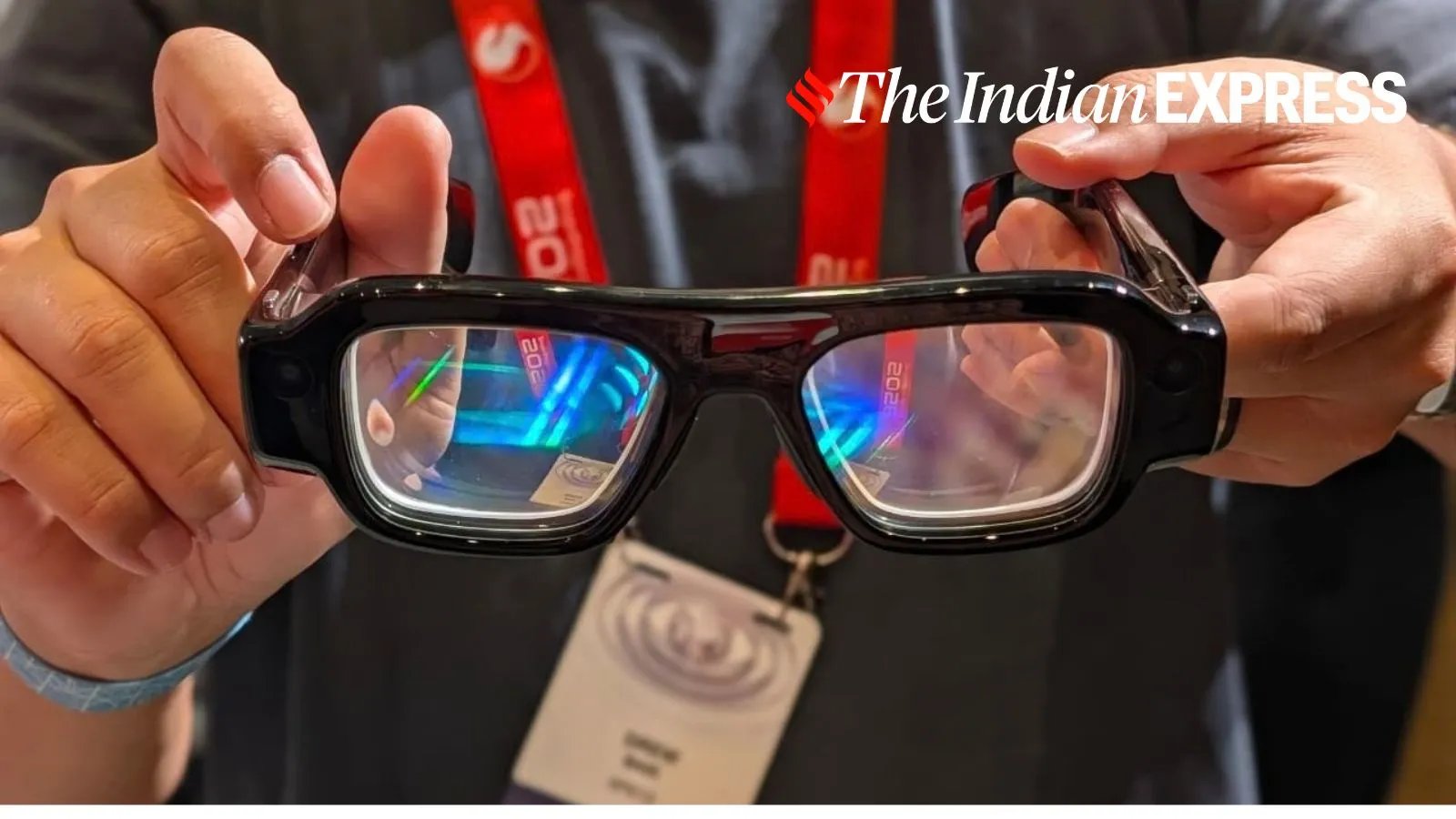
 Snap Specs feature chunky frames that house the processor, cameras, sensors, speakers and display technology. (Image: Anuj Bhatia/The Indian Express)
Compared with Meta Ray-Bans, perhaps the most popular smart glasses on the market, Specs can feel huge, with its thick temples. I am not defending Specs’ design, but logically speaking, there’s a lot going on inside these glasses: the processor, battery, communication hardware, speakers, and waveguide display technology. You have to accommodate the hardware and the chip somewhere within the glasses.
Story continues below this ad
 Snap Specs combine a conventional glasses-like form factor with a see-through AR display. (Image: Anuj Bhatia/The Indian Express)
However, once you wear Specs, the glasses don’t look as chunky as they appear. Sure, they are heavier than my Ray-Bans, but I appreciate that the balanced weight distribution makes Specs comfortable to wear for extended periods. There are two sizes: narrow at 47mm and wide at 52mm, although the maximum weight is just 136 grams.
 Snap Specs are noticeably larger than conventional glasses but are designed to function as a standalone spatial computer. (Image: Anuj Bhatia/The Indian Express)
Could Specs be less chunky and lighter? Absolutely. Who wouldn’t want to wear lighter glasses? At least Specs doesn’t make you look weird like those huge virtual reality headsets.
From another perspective, I found Specs to be somewhere between Ray-Ban smart glasses and Meta’s new VR glasses, which blend the form factor of regular smart glasses with the stereoscopic 3D and virtual reality capabilities of a Quest headset launched this week.
Specs glasses are basically a fully standalone spatial computer, with zero cables and no pocket puck. From a design perspective, that makes Specs pretty impressive. But as I said earlier, the bulk could make Specs less appealing to everyday users.
Story continues below this ad
Blending digital content and the physical world
When you wear Specs, you can see the real world around you. After all, the glasses are see-through, although, frankly, not quite as clear as a normal pair of spectacles. The see-through waveguide display sits at the core of the glasses, overlaying digital content directly onto your field of view.
While a virtual reality headset blocks your vision, Specs is designed to blend digital content with the physical world, creating the effect of a large virtual screen without isolating you from your surroundings. This is the best implementation of augmented reality I have ever seen, the closest you can possibly get in real life.
Perhaps the 51-degree window brings every experience closer to you. It’s tall, like portrait videos, but not wide. Think of it as a virtual screen right in front of you. After spending some time using Specs, I found that its narrow field of view doesn’t quite match the Vision Pro’s more immersive 100-degree FOV.
 Snap Specs alongside other pairs of smart glasses at the Snapdragon Summit in Maui, Hawaii. (Image: Anuj Bhatia/The Indian Express)
The biggest limitation is Specs’ 51-degree field of view, which is comparable to HoloLens 2. In fact, Specs can render and record a wider field of view than it can display, which means what you see in promotional marketing materials may look expansive but you don’t get to see that through the glasses in real life.
Story continues below this ad
I get that. It’s simply not possible today to build a glasses-sized AR device with a field of view much larger than this. But those who buy Specs with high expectations may be disappointed.
Display and field of view: The concerns
Watching videos and playing games felt fine to me, but the lack of crisp images worried me. In fact, the quality of the experience on Specs’ virtual screen appears to be closer to HD (720p) than 4K. It lacks the clarity and uniformity you would expect from a higher-resolution display. I will say that some experiences are genuinely interesting and clearly designed around Specs’ limited field of view, while others look a bit unpolished.
What really worked for me is the interface, and within seconds, I was introduced to the home screen. To interact with the menu, you bring your index finger and thumb together, which turns your hand into a cursor. Instead of traditional gesture controls, Specs uses intuitive hand tracking, allowing you to operate everything with your hands. A menu appears on your palm when you hold it up, and you can use a finger to tap the buttons that appear. I really liked Specs’ control method; it’s simple and easy to use. Voice commands are another way to interact with Specs, although I didn’t try them.
As with Snapchat, you primarily use Lenses, which are essentially apps that you interact with. The quality of the Lenses varies, and during my 30-minute demo, I tried several, from playing games and watching YouTube videos to exploring different immersive experiences, including a Harry Potter one.
Story continues below this ad
The best thing about Specs is that the glasses understand your world. That’s where I became immediately interested in computer vision and AR technology, and how the two can blend to create an experience you can’t get on a phone or any other device. It almost feels like magic.
 A closer look at the thick temples of Snap Specs, which pack the glasses’ computing hardware. (Image: Anuj Bhatia/The Indian Express)
In fact, Specs goes beyond the display, as I said. It interprets what you are seeing and shows relevant information on the screen. All of this requires a sophisticated system that combines RGB cameras, infrared sensors, computer vision, real-time spatial awareness and a Qualcomm chip inside. I think this is where a device like Specs becomes interesting. When we use a phone, we interact with the device itself, but with glasses, we interact with our surroundings through augmented reality technology.
What’s impressive about Specs is that even in low light, with many people coming and going in the busy demo zone, the glasses’ hand tracking remained rock solid. I also liked Specs’ operating system, with relatively fast loading times for both the interface and apps. It never felt sluggish, despite the glasses not supporting a high refresh rate.
Snap is pushing Specs as a portable screen for watching videos and even for working. While the Snap representative told me he was already using Specs as a computer, I am not convinced. The lack of display crispness and the limited field of view make it less convincing as a serious productivity device. I think VR headsets are better suited to productivity tasks, thanks to their wider field of view and clearer images.
Story continues below this ad
Early impressions
Specs has potential, and is already among the first AR glasses that work independently without requiring any external hardware. That’s impressive. However, it’s a bit too early to call it a smartphone replacement. The problem is that the smartphone form factor is already so well suited to the things we use a phone for. I get that Snap’s pitch with Specs is that the company wants to replace smartphones with AR glasses, but for that to happen, we need a new type of experience that is still missing.
Sure, navigation and maps may seem like interesting applications, but regular consumers will expect something they can’t get on a phone; experiences that would actually make them want to ditch their phone. We are not there yet. Even the battery life on Specs won’t go beyond three to four hours and is clearly not designed to last a full day.
Despite these limitations, Specs is already among the first AR glasses that work independently without requiring any external hardware. That’s impressive. However, the biggest hurdles for Snap in making Specs a success are the high price and the social awkwardness of wearing such bold frames in public. That being said, Specs is interesting, and Snap has done a good job of implementing as much as it could to make it a commercial AR product. However, I still feel AR is a tough technology to crack, and wonder whether anyone will make the fundamental technology truly functional for everyday use.