

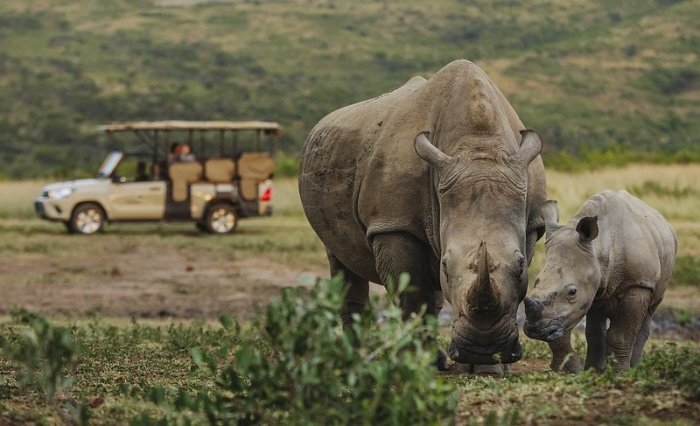


As Hluhluwe-iMfolozi Park records a landmark 52% reduction in rhino poaching this year, Rhino Ridge Safari Lodge offers travellers a front-row seat to one of Africa’s greatest environmental turnarounds. Set inside the reserve where every southern white rhino traces its lineage, the lodge operates at the intersection of luxury tourism and high-impact protection. Here, guests’ stays directly fund the ranger patrols, smart-fencing technology, and community partnerships driving the park’s historic anti-poaching success.
For the team, Hluhluwe-iMfolozi is not simply the backdrop to a safari, it is one of the great living conservation stories of our time. Staff describe a sense of responsibility that comes with working here, knowing the ridges, valleys and thornveld around them are part of the reason the species still exists. Many of the lodge’s staff are drawn from the neighbouring Mpembeni community, and the lodge operates through a partnership model that connects conservation, community and tourism directly, rather than treating any one of the three as separate from the others.
Hluhluwe-iMfolozi’s conservation work is expanding. The park has partnered with the WWF Black Rhino Range Expansion Project, which addresses one of the species’ biggest long-term challenges: space. The project works to create viable breeding populations, diversify genetics and increase population growth, identifying large blocks of suitable habitat and establishing new populations through managed translocations.
Black rhinos present a different conservation challenge to their white counterparts. White rhinos are grazers, often seen in more open terrain, while black rhinos are browsers that favour thicker, denser vegetation, making them harder to see, monitor and protect. Their scarcity adds to the risk, as the loss of even a small number of individuals can have serious consequences for a local population. On the ground, protection is intensely practical, with ranger patrols, monitoring, aerial-assisted surveillance, horseback patrols and specialist canine teams all forming part of the response to poaching pressure.
Because Rhino Ridge Safari Lodge sits inside the park rather than outside it, guests experience conservation from within the landscape itself, not looking in from a distance. Daily game drives, guided game walks and community tours let guests engage with the wildlife and the history behind it.
Rhino sightings are treated with particular care. The animal’s wellbeing and the safety of guests come first, so encounters stay quiet, calm and slow. Only once the moment settles do guides share the story behind what guests are seeing: the historic decline of the southern white rhino, the vision of Dr Ian Player and the Natal Parks Board, the significance of Operation Rhino, and the work still underway today for both white and black rhino.
The lodge’s architecture was built around the same principle guiding the park itself, presence without intrusion. The lodge is designed and operated as a respectful window into the reserve rather than an interruption of it, and to maximise views and guest privacy, some rooms sit as far as 200 metres from the main lodge facility.
Dr Ian Player, the conservationist behind Operation Rhino, once said conservation is a continuous battle. At Rhino Ridge Safari Lodge, that battle is funded in part by every guest who stays. Guests pay park entrance fees to Ezemvelo KZN Wildlife, a significant proportion of which goes directly to conservation initiatives, and contribute through the Isibindi Foundation levy, which funds community and conservation projects in partnership with the lodge.
“When guests stay with us, their visit supports much more than a lodge bed and a game drive,” the team says. “It helps fund conservation infrastructure, ranger support, anti-poaching capacity, community employment and the long-term protection of one of Africa’s most important rhino landscapes.”
For more information, visit Isibindi.co.za or contact the reservations team at [email protected] / +27 (0)35 474 1473.