


There are airports that simply move people from one place to another. And then there are airports that become part of the identity of the city they serve.
Hong Kong International Airport belongs firmly in the second category.
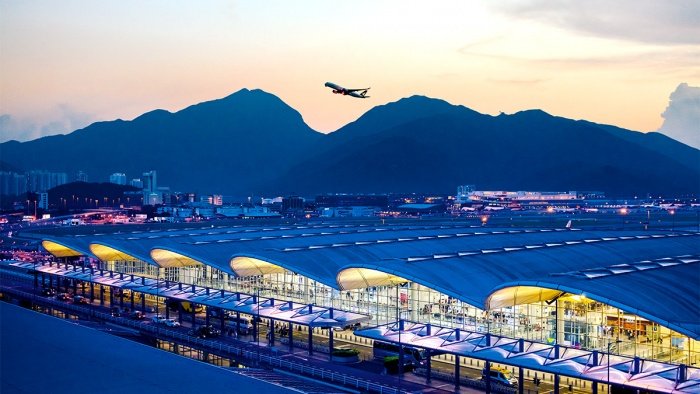
Set on the island of Chek Lap Kok, on the edge of the South China Sea, Hong Kong International Airport is more than a gateway to one of Asia’s most compelling cities. It is a vast piece of infrastructure, a meeting point for cultures and continents, and an increasingly sophisticated destination in its own right.
In 2026, that role has once again been recognised on the international stage. Hong Kong International Airport was named Asia’s Leading Airport 2026 at the World Travel Awards Asia, Oceania & Indian Ocean Gala Ceremony, held in the Maldives. The accolade recognises an airport whose evolution has increasingly centred on technology, connectivity, passenger experience and the creation of an airport environment capable of matching Hong Kong’s status as a global city.
For travellers, however, the real achievement is felt in something rather simpler: the experience of moving through the airport.
The first glimpse of Hong Kong
Arrival at Hong Kong International Airport is one of those travel moments in which geography and architecture seem to work together.
The aircraft comes in over the water, with the dramatic landscape of Lantau Island providing the backdrop. Beyond the airport lies Hong Kong itself — a city of skyscrapers, mountains, harbour views, neon streets and some of the world’s most sophisticated hotels and restaurants.
The airport acts as the threshold.
And that threshold has been designed to make the transition remarkably smooth.
From immigration and baggage collection to onward connections, rail links, road transport and the extensive retail and dining offer, HKIA has long placed emphasis on making the airport experience as intuitive as possible.
That philosophy is becoming even more important as Hong Kong’s aviation infrastructure enters a new era.
An airport built for the future
The most visible expression of that transformation is the Three-Runway System, one of the most significant infrastructure projects in the airport’s history.
The development has expanded the airport’s aviation capacity and forms part of a much wider vision for Hong Kong International Airport as an Airport City — a destination incorporating aviation, retail, entertainment, business, logistics and new forms of transportation.
The airport’s long-term development programme envisages the ability to handle up to 120 million passengers and 10 million tonnes of cargo annually, while the wider Airport City concept is designed to strengthen connections between Hong Kong, the Greater Bay Area and the rest of the world.
For a traveller, those numbers can seem almost abstract.
What matters is what they enable: more connections, greater choice and an airport designed to accommodate the continuing growth of international travel through Hong Kong.
Technology that disappears into the experience
The best airport technology is often the technology passengers barely notice.
At Hong Kong International Airport, digital innovation has increasingly been woven into the journey, helping to streamline processes while allowing travellers to spend less time waiting and more time enjoying the airport.
Automated and biometric-enabled processes, digital services and increasingly sophisticated passenger systems are part of an ongoing programme to make movement through the terminal more seamless.
The airport has also invested in private 5G infrastructure, which has been recognised internationally for its potential to improve terminal efficiency, security and infrastructure monitoring.
There is a certain elegance to this kind of technology.
It does not compete with the architecture or announce itself at every turn. Instead, it quietly removes friction from the journey.
Shopping, dining and the art of the layover
For passengers with time between flights, Hong Kong International Airport offers another reason not to rush towards the departure gate.
The airport has developed an extensive retail and dining environment, reflecting the city’s reputation as one of Asia’s great shopping and culinary capitals.
Hong Kong’s influence can be found in the food, from local favourites to international cuisine, while the retail experience brings together luxury brands, contemporary design and travel essentials.
A long connection therefore need not feel like dead time.
It can become an opportunity for dim sum, a coffee, a little shopping or simply a chance to sit back and watch the choreography of one of Asia’s great international gateways.
That is an increasingly important part of modern airport design. The airport is no longer simply somewhere to endure before the flight; it has become part of the journey itself.
Sky Bridge and a new sense of scale
Among HKIA’s more striking passenger features is the Sky Bridge, the world’s longest airside footbridge when it opened, connecting Terminal 1 with the nearby SkyCity and North Satellite Concourse area.
The bridge is more than a piece of infrastructure. It offers passengers an unusual perspective on the airport operation, with aircraft and the airfield becoming part of the experience rather than something hidden behind walls.
It captures something of the character of Hong Kong itself: engineering on an ambitious scale, but delivered with a distinctly human focus.
The airport is constantly moving, yet the passenger experience remains surprisingly calm.
The Airport City
Perhaps the most intriguing part of Hong Kong International Airport’s future is the idea that travellers will increasingly visit the airport not simply because they have a flight.
The development of SKYCITY is central to that ambition.
The wider Airport City vision brings together retail, dining, entertainment, business and transportation, creating an ecosystem around the airport that extends far beyond conventional terminal functions. Earlier development plans have positioned SKYCITY as a major integrated retail, dining and entertainment complex, alongside the expansion of AsiaWorld-Expo.
It is a concept increasingly being adopted by major international hubs: if an airport is going to serve millions of people, why should its role end at the departure lounge?
In Hong Kong, the answer is particularly compelling.
The airport sits at the meeting point of aviation, commerce and tourism, with the potential to become one of the region’s major destinations in its own right.
Gateway to the Greater Bay Area
Hong Kong’s geographical position gives the airport another defining advantage.
It is not simply serving the city itself. It functions as an international gateway into a much wider economic and cultural region.
Improved multimodal connections are making it increasingly possible for travellers to combine Hong Kong with destinations across the Greater Bay Area, while the airport’s expanding international network continues to connect the region with cities across Asia, Europe, North America and beyond.
For international visitors, this creates an appealing possibility: Hong Kong can be both destination and gateway.
A traveller can arrive for a few nights amid the skyscrapers of Central, continue into the wider region, and return through the airport on the way home.
More than an airport
There is a temptation, when discussing major aviation hubs, to focus on statistics — passenger numbers, runways, destinations and cargo volumes.
But airports are ultimately judged by something much more personal.
How does it feel to arrive?
How easy is it to find your way?
Can you eat well, rest comfortably, shop, work or simply enjoy the surroundings?
And, most importantly, does the airport leave you with a positive first impression of the destination beyond it?
Hong Kong International Airport has spent years refining those details.
The result is an airport that manages to combine immense scale with a surprisingly polished sense of hospitality.
A gateway for a new generation of travellers
The modern traveller expects more from an airport than a place to board an aircraft.
They expect connectivity. They expect speed. They expect digital convenience. They expect good food, comfortable spaces and increasingly, something memorable.
HKIA’s continuing evolution reflects those changing expectations.
Its three-runway system is expanding capacity. Its technology is transforming the passenger journey. Its retail and dining offer is becoming a destination in itself. Its Airport City ambitions are broadening the role of the airport. And its continued investment in passenger facilities demonstrates an understanding that infrastructure and hospitality are no longer separate disciplines.
That combination lies at the heart of its latest World Travel Awards recognition.
Being named Asia’s Leading Airport 2026 is not simply a celebration of runways and terminals. It is recognition of an airport that understands the importance of the moments around the flight — the first welcome, the final farewell, the unexpected meal between connections and the feeling of stepping into a city that has been waiting beyond the terminal.
Hong Kong has always been a city of movement.
At its airport, that movement has become an art form.
And for travellers arriving in Asia, Hong Kong International Airport remains one of the most compelling places for the journey to begin.