
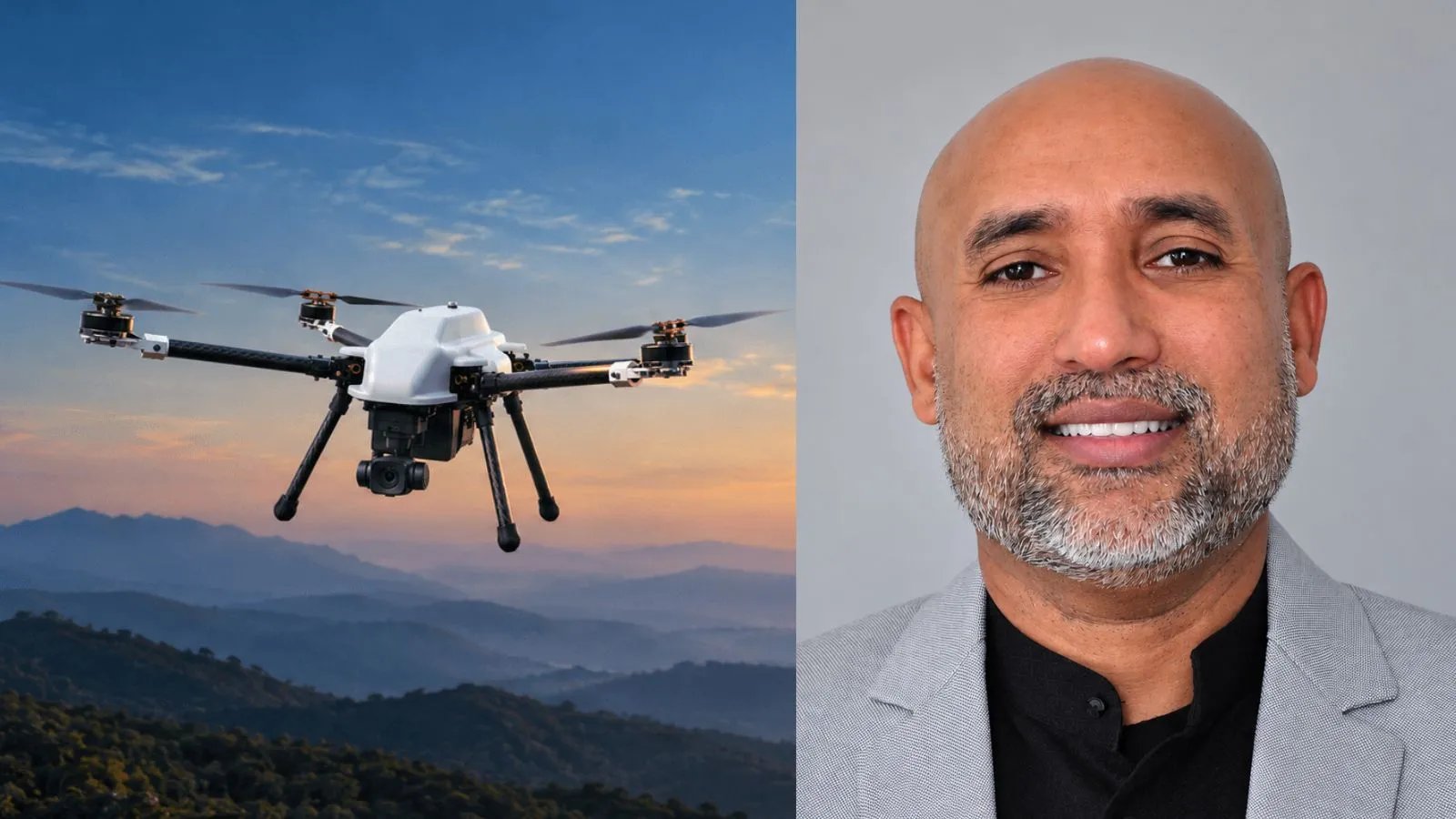

“About 15 years ago, three people sat in a corner of someone else’s office,” recalled Joe Kuncharia. “When we started, we didn’t even have a place.” Today, his company employs over 150 people, builds drones with the Indian Army, and even runs radio frequency identification (RFID)-based checkout systems at New York’s Madison Square Garden.
When one thinks of India’s tech story, it usually starts in Bengaluru or Pune. AXL Systems, however, began in Kerala, with no office to call its own. The company makes two distinct products: a long-range surveillance drone co-developed with the Indian Army and RFID checkout systems.
Rather than opting for a tech hub, the founders went wherever they could find space to work together. “We just asked where we could all sit together,” Kuncharia said. From a handful of people sharing a desk in their hometown, the firm grew until it eventually had an office of its own in Kochi.
AXL began as a consulting company around 2013 with a handful of customers in Europe and the US before becoming a public limited company in 2015. The company’s early growth came from integration work for large independent software vendors. “Developing is actually the easier part. The challenge is maintaining it,” said Kuncharia.
When asked about their Kerala base, Kuncharia admitted that it had its pros and cons. Most staff commute in under 30 minutes, which he said helps create an atmosphere that is “very conducive” to teamwork. But logistics and hiring are a pain. “In the US, when we need a part, it comes the next day,” he said. In India, particularly Kerala, overseas shipments often arrive no closer than Bengaluru, Mumbai or Chennai.
Hiring is slower too. An engineer might take a couple of weeks to find in Bangalore, but in Kerala it can take “two to three months”, he said. “When we want five people, it can take at least eight months to find them.”
The solution is to stay lean. “We are not a services organisation. We are an R&D organisation,” he said, adding that when the right person turns up, they tend to be a better fit than anyone found elsewhere.
Story continues below this ad
Hardware innovation, using Indian components
When it came to hardware, Kuncharia said that innovation happened through customers. Existing clients asked whether AXL could solve electronics problems, and the company reached its own conclusion: “If the hardware worked differently, our software would also be better.”
The RFID business grew out of a US software partnership of about four years. Kuncharia said that AXL’s proprietary RFID technology was deployed at Madison Square Garden in New York, powering autonomous merchandise checkout stations for New York Knicks fans.
Drones followed a similar logic. Kuncharia shared that there was no eureka moment. Bridge inspections and area surveillance relied on fixed or two-dimensional viewpoints, such as a security camera or a vehicle. “We thought a three-dimensional approach would solve this better,” he said.
The bigger problem, however, was longevity. Off-the-shelf drones, he said, were often “collecting dust”. Building one that lasts meant making motors, controllers, avionics, communications and power systems that work as one. “It’s like building a very large building. You need to get the architecture right, the material right, the interior right.”
Story continues below this ad
The CEO admitted that a push to use Indian-made components shaped the product. Finding parts that were not made in China was difficult. “But that was a good problem for us,” said another AXL executive, George Kanatt. It pushed the company to build its own power distribution boards, GPS modules, flight controllers, remote controls and batteries.
On AXL’s work with the Indian Army, Kuncharia offered a measured response, choosing not to talk about the firm’s growing relationship with the armed forces. AXL approached the Indian Army and learned about its unit requirements through public portals. The company later ended up in what he described as joint development, with the drones carrying both AXL’s and the Army’s names.
RFID is another one of AXL’s businesses. According to Kuncharia, AXL’s standard RFID setup can read up to 300 tags per second.
At arenas or stadiums, speed matters. Before a game, fans rush to buy merchandise, and a shopper who doesn’t buy a jersey in the moment may never come back. Many vendors send tag data to the cloud and wait for a response. AXL’s readers plug straight into the point-of-sale system by USB. “We increase that speed exponentially because of the local hardware technology,” Kuncharia explained.
Story continues below this ad
The same technology guards the exit. If an alarm goes off on a shopper carrying 20 items, RFID can pinpoint which one triggered it. AXL is piloting the system in India, but past failures are a hurdle. “We are working against the notion that these technologies have failed before,” he said.
Divergence on the cards
When asked about the inclusion of artificial intelligence (AI) in their innovations, Kuncharia shared that it is integral. When it comes to use cases, drones are used to identify people, vehicles and objects, with applications in industrial safety, wildlife management and spotting illegal mining across forest areas up to 300 kilometres wide. In retail, analytics track who shops, when and for how long.
Looking ahead, Kuncharia sees divergence. “In about five years, we will probably completely separate these two areas,” he said. Drones will head toward autonomy, AI-driven analysis and GPS-denied environments. RFID will grow as its own ecosystem, including US deployments, which he said, are a first in the world.
When asked about his advice for founders, Kuncharia is cautious. “I don’t suggest anybody try to do three different things.” AXL was lucky, he said: an existing customer arrived with a problem and a promise to buy. Even then, the company chose the long road of building its own technology, with benefits visible only after four or five years.