

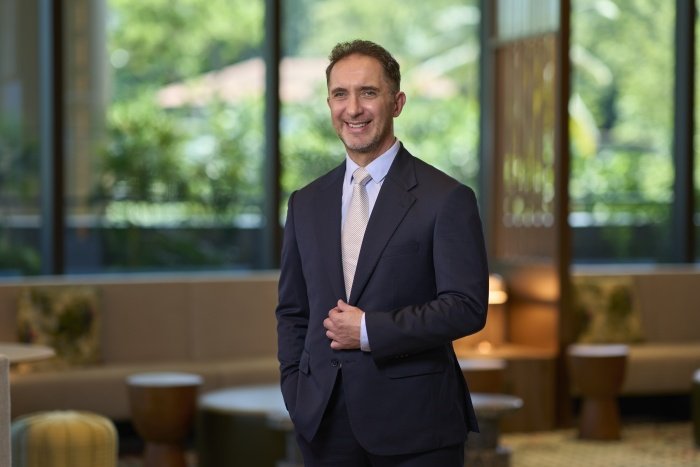


Vincent Miccolis is a seasoned hospitality executive with more than 25 years of international industry experience and currently serves as Managing Director, Middle East, Africa & Türkiye at The Ascott Limited, one of the world’s leading international lodging operators. BTN caught up with him to find out the changes taking place in hospitality today!
Vincent is entrusted with the task of overseeing Ascott’s operational portfolio’s business growth and strategically expanding Ascott’s footprint in key cities throughout the MEAT region. His pivotal responsibilities encompass nurturing and fostering relationships with property owners, collaborating with industry stakeholders, and engaging with government entities to support the broader tourism sector.
Since Ascott’s entry into the MEAT region in 2014, Vincent has been at the helm of the brand’s remarkable expansion. As of today, Ascott boasts 44 properties and over 6,438 keys in operation or under development across the MEAT region, with a regional presence spanning the United Arab Emirates, Qatar, Oman, Saudi Arabia, Morocco, Kenya, Kazakhstan and Turkey.
Vincent embarked on his Ascott journey in London and subsequently assumed senior positions in Brussels, Marseille, and Paris before his move to Dubai.
1. What is the biggest change taking place in hospitality today that the industry is still underestimating?
There is no doubt that AI is heavily impacting how the hospitality industry operates and how guests choose their accommodation. However, an equally important change is the fact that guests no longer define a stay simply as a hotel, serviced residence, or extended stay. It has become more than ‘just a place to sleep’. The lines between accommodation, lifestyle and community are increasingly blurring, with guests choosing environments that support how they want to live, work and connect. As the market evolves, so do guest preferences, and they are choosing accommodation based on how well it fits their purpose and the duration of their trip. We therefore need to shift the mindset from transactional hospitality to highly personalised hospitality, to ensure we attract and retain guests.
These shifting behaviours and preferences are creating greater demand for more adaptable hospitality models that can serve different traveller profiles. Hospitality operators and owners must invest resources in understanding these changing needs, ensuring the right product is positioned to the right audience.
2. Which region or destination presents the greatest hospitality opportunity over the next five years, and why?
The Middle East has been one of the most promising growth markets in recent years. The region’s long-term tourism ambitions, evolving hospitality landscape and economic diversification continue to reinforce its leading position in the global hospitality sector. This is further supported by significant government investment in infrastructure, aviation, airport connectivity and tourism, strengthening the region’s long-term fundamentals for both travellers and investors.
What makes the region particularly exciting is the diversity of demand – from leisure and business travel to religious tourism, solo travel and extended stays – its inventory of legacy and new residential hospitality models suits a variety of traveller needs. This creates opportunities across multiple segments, and our diversified business model enables us to serve these demand drivers while remaining agile in response to changing travel patterns and conditions.
3. Within the Middle East, where do you see the strongest opportunities beyond the most prominent projects and destinations?
The region’s strong focus on safety, connectivity and innovation provides an important foundation for attracting international travellers and investment. Countries such as the United Arab Emirates and the Kingdom of Saudi Arabia are making significant strides in technologies and automation to enhance visitor and guest experiences as well as the wider economy.
We are also seeing opportunities develop beyond the region’s traditional hospitality hubs. In the UAE, Ras Al Khaimah continues to grow as a tourism destination, while emerging cities across Saudi Arabia are creating new sources of hospitality demand. Abha, for example, is benefiting from the continued development of Aseer as a tourism destination, while Al Khobar is supported by strong corporate and energy-sector activity.
In Saudi Arabia, we are looking forward to the opening of Ascott Villas Riyadh in Q4 2026 – our first villa community in the Kingdom, which will cater to demand for larger-format accommodation. We also see considerable growth potential in Kuwait as a source market due to rising demand from regional and business travellers. This led to our entry into the market with Citadines Sharq Kuwait, offering flexible hospitality for both short and extended stays.
4. What is the most important change you are seeing in customer behaviour?
Today’s traveller knows exactly what he or she wants. They demand greater flexibility, convenience and personalisation, as well as living spaces that respond to the way they live, work and travel. These factors are heavily influencing the hospitality experiences guests seek, empowering them to choose accommodation that meets their individual needs.
We are seeing a rapid shift in technology playing a much greater role in how these decisions are made, with travellers turning to digital platforms, online reviews and AI-driven recommendations when researching and booking their stays. For hospitality operators, this means that they need to shift away from a one-size-fits-all approach and offer greater choice across different traveller profiles and lengths of stay.
What are guests increasingly willing to pay more for, and what do they no longer value?
Guests are placing greater value on space, flexibility and accommodation that complements the way they live and travel. As work and leisure become more fluid, they are seeking spaces that support different needs throughout their stay. They are also prepared to spend more when this translates into greater convenience, more generous living spaces and an experience that feels genuinely personalised to them. This means value is becoming less about a standard hospitality offering and more about having the choice to shape the stay around individual needs. At the same time, standard or traditional experiences that offer little personalisation are becoming less appealing. Operators need to focus on providing experiences that have a clear purpose and add meaningful impact to the guest journey.
5. Which hospitality trend has genuine staying power?
The combination of hotel and residential living has genuine staying power. Guests want the comfort, space and privacy associated with living at home, while gaining the service excellence and convenience of a hotel. This reflects a wider change in how people want to experience hospitality in the region, particularly as family travel and trips combining business and leisure become more prominent. The continued demand for extended stays further strengthens the need for this unique hospitality model. This creates opportunities for owners and operators to develop dynamic hospitality models that appeal to different guest profiles and lengths of stay.
6. What is the biggest challenge facing the hospitality industry, and where is the corresponding opportunity?
Navigating and adapting to change in an environment where volatility is constant, is probably one of the biggest challenges facing the industry at the moment. Operators need to become more agile in how they respond to unprecedented market conditions. As we have seen this year, geopolitical and economic uncertainty can quickly influence travel patterns and demand.
However, this also presents an opportunity to embed greater resilience into hospitality operations. Diversifying demand across different traveller segments and developing adaptable operating models can help maintain more consistent performance for operators and investors. Resilience is becoming just as important as growth when considering the long-term performance of an asset in the sector.
7. How are talent shortages affecting the industry, particularly in rapidly growing markets such as the Middle East?
The pace of hospitality growth in the Middle East is creating significant demand for experienced talent across operational and leadership roles. As new destinations and hospitality concepts enter the market, the industry needs to ensure that talent development keeps pace with this growth. It is about attracting the right talent into hospitality and creating an environment where they can develop their skills, progress in their careers and see a long-term future in the industry.
The UAE is a good example, with initiatives such as Emiratisation helping to strengthen national talent across key sectors. Investing in people is essential to maintaining service standards and supporting the sector’s continued growth. Technology and AI can play an important role in improving productivity and supporting teams, but they cannot replace the people and human connections that are at the heart of delivering exceptional hospitality experiences.
8. What skills will hospitality businesses need most over the next five years?
The hospitality industry is evolving quickly, and businesses need to be comfortable responding to changing guest expectations, market conditions and new ways of working. Digital and data literacy is very important as technology is playing a greater role in guests’ decision-making.
The core fundamentals of hospitality should not be overlooked in the process. Strong communication, cultural awareness, problem-solving and the ability to build genuine human connections will remain essential. The strongest talent will be those who can combine these human skills with an understanding of technology and commercial performance.
9. How must training and career development change to attract, develop and retain the next generation of hospitality talent?
Training and career development need to become more flexible and personalised as the sector continues to change. Our future leaders need opportunities to learn through experience and exposure to different aspects of the industry. Throughout my own career, I have benefited from people who trusted me with opportunities and empowered me to take on new challenges. This has allowed me to continuously learn, experience different cultures and build relationships across the industry.
Creating an environment where the next generation is given similar opportunities to learn, grow and adapt will be important in developing future hospitality leaders.
10. What is one specific way your business is using AI today, and what measurable difference has it made?
At Ascott, we are leveraging AI across several commercial and operational functions, including guest engagement, marketing, revenue management and loyalty. One of our most visible applications is Cubby, our AI-powered digital concierge, which has handled more than 900,000 guest enquiries since its launch. By automating routine interactions and supporting booking-related enquiries, Cubby has enabled faster response times for guests, while allowing our teams to focus on more personalised and high-value interactions.
11. What is the most promising AI application you are exploring next?
One of the most exciting opportunities we see is the rise of AI agents playing a greater role in how travellers discover, plan and book their journeys. Ascott is investing in AI-ready infrastructure and collaborating with partners such as Accenture and Amadeus to ensure our brands, properties and inventory can be seamlessly accessed and recommended within AI-driven travel ecosystems.
We are also evolving Cubby beyond a digital concierge towards a more intelligent travel assistant that can support guests throughout their travel journey. While AI will help drive greater personalisation and convenience, we believe the human touch will remain central to delivering memorable hospitality experiences.
12. What are you most excited about in hospitality over the next 12 months?
There is a lot to be excited about over the next 12 months as we continue to grow The Ascott Limited’s presence across the region.
In Saudi Arabia, we are looking forward to opening our first villa community in Q4 of this year. Ascott Villas Riyadh will introduce a new offering in the Kingdom and wider region, enabling us to cater to the needs of families and guests seeking extended stays. We are also entering Kuwait with Citadines Sharq Kuwait, responding to growing demand for flexible serviced accommodation in the country.
Looking ahead, we have a clear vision for our growth in the region. We are focused on expanding our presence across the Middle East, Africa and Türkiye, with a target of reaching 15,000 units by 2030. As part of this growth, we are also looking beyond established markets to secondary cities and emerging destinations where we see strong opportunities to expand our portfolio.
13. What first attracted you to hospitality, and what has made you stay in the industry?
I often joke that I was probably predestined for hospitality, but in reality, I was given an opportunity while living in London by someone who trusted me. Looking back, that trust changed the course of my career. It taught me an important lesson that still holds true today: success is often about people, opportunities and having the passion to embrace what you do. That experience also shaped my belief that hospitality is, above all, a people business, where trust and strong relationships remain fundamental to success.
What has kept me in the industry is the incredible diversity of hospitality. No two days are ever the same. You are constantly learning, meeting new people, working across cultures and creating meaningful connections. Throughout my career, I have also been fortunate to work for an organisation like Ascott that has trusted and empowered me, giving me opportunities to grow and take on new challenges.
For me, hospitality is much more than a career. It has allowed me to learn continuously, achieve meaningful goals and experience different cultures. Even after all these years, I still find it as inspiring, rewarding and as exciting as the day I started.
14. What is the one issue hospitality leaders should be discussing at Future Hospitality Summit – FHS World in Dubai?
Hospitality leaders should be discussing how we build greater resilience across the industry. The focus needs to be on ensuring growth is sustainable and supported by a clear understanding of what is driving demand in each market. Technology, talent and sustainability all have an important role to play in this. Technology can help improve efficiency and how we respond to changing demand, but this needs to be supported by skilled people who can deliver the guest experience. At the same time, sustainability needs to be considered as part of how we develop and operate hospitality assets for the long term. Bringing these areas together will be important in building a more resilient industry. This requires investors, owners, operators and industry stakeholders to collaborate and take a long-term view of how hospitality assets are developed and operated.
We have also seen strong commitment from governments and leadership across the region in supporting the continued development of the hospitality and tourism sector. This has given the industry a strong foundation to continue evolving and adapting for the future. Resilience is about building on this foundation and ensuring the sector is well positioned for long-term growth.