

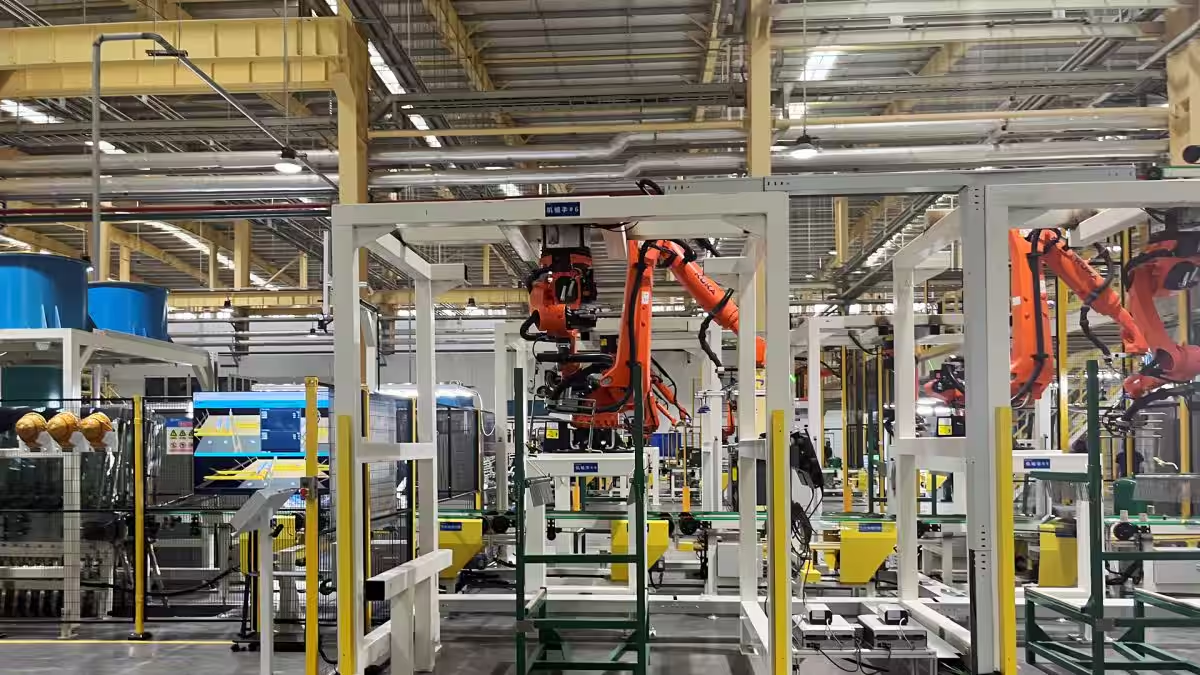

China’s industrial profits rose 4.2 per cent in August, slowing sharply from July as weak domestic demand and excess capacity put pressure on companies despite an AI-led surge in technology manufacturing
China’s industrial profit growth slowed sharply in August as weak domestic demand and excess capacity offset strong gains in technology manufacturing linked to the artificial intelligence boom.
Profits at China’s industrial firms rose 4.2 per cent year on year in August, down from an 11.2 per cent increase in July, according to data released by the National Bureau of Statistics on Monday. Profit growth for the first eight months of 2026 also eased to 15.7 per cent from 17.6 per cent in the January-July period.
The figures point to a growing imbalance in China’s industrial economy. Manufacturers are continuing to produce at a strong pace, but weak consumer demand is making it harder for companies to raise prices and protect margins.
That is particularly important for an economy that has increasingly turned to exports to absorb excess industrial capacity.
AI boom lifts technology profits
Technology manufacturing remained one of the strongest parts of the industrial economy.
Profits in the computer, communications equipment and other electronic equipment manufacturing sector jumped 110 per cent in the first eight months from a year earlier, according to the NBS data.
The gains reflect strong demand for products linked to the global technology and AI investment cycle.
 More from Business
But the strength of high-tech manufacturing has not been broad enough to offset weakness elsewhere in the economy.
Profits in the wine, beverages and refined tea manufacturing sector fell 34.7 per cent in the first eight months, highlighting the pressure facing industries more closely tied to domestic consumption.
China’s industrial production itself remained relatively firm in August. Industrial output rose 5.2 per cent year on year, accelerating from 4.5 per cent in July. Manufacturing output increased 6.1 per cent, while production of computers, communications equipment and other electronic equipment rose 17.2 per cent.
Weak demand remains a problem
China has struggled for several years with subdued household demand, a property downturn and pressure on corporate balance sheets.
The latest profit data suggest that the problem has not been resolved even as some newer industries expand rapidly.
A senior adviser to China’s central bank, Huang Yiping, warned earlier this month that the spread of AI could actually deepen the country’s imbalance between strong supply and weak demand.
Huang said the AI boom could boost exports while domestic demand remains weak. He called for policies to increase household incomes and consumption and to repair the balance sheets of local governments, financial institutions and companies.
That creates a difficult policy challenge for Beijing.
Investment in technology and manufacturing can support growth and productivity. But if production capacity expands faster than domestic demand, companies can face falling prices and weaker margins.
Export dependence raises trade tensions
Chinese manufacturers have increasingly looked overseas for demand and better returns.
That strategy can help companies compensate for weak sales at home, but it also increases China’s dependence on exports at a time when its trade surplus is facing greater scrutiny from major trading partners.
The European Central Bank recently warned that China’s growing strength in high-value and technology-intensive manufacturing is putting pressure on European producers, particularly German manufacturers.
China’s ability to sell more manufactured goods overseas is also becoming a bigger geopolitical issue as countries seek to protect domestic industries and reduce dependence on Chinese supply chains.