

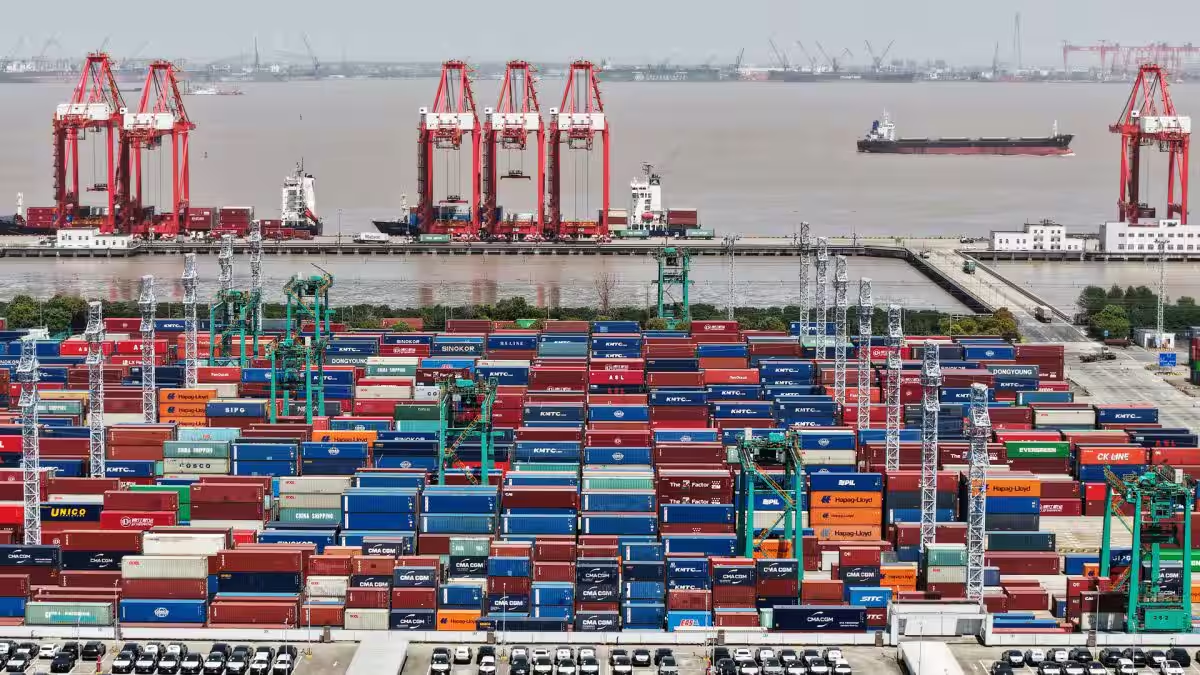

AI-driven exports support China’s growth, but weak consumer spending, a property slump and rising trade tensions threaten its economic recovery
China’s economy grew by 4.5 per cent in the third quarter of 2026, recovering from a three-year low in the previous quarter as demand for artificial intelligence (AI) hardware supported exports. However, weak consumer spending, a prolonged property downturn and rising trade tensions continue to challenge Beijing’s efforts to sustain growth.
Gross domestic product (GDP) expanded by 4.5 per cent year on year in the July-September period, compared with 4.3 per cent in the previous quarter and 5 per cent in the January-March period, according to data released by China’s National Bureau of Statistics (NBS) on Monday.
Growth was above the 4.41 per cent forecast by economists surveyed by Chinese financial data provider Wind. However, the latest expansion places China at the lower end of its annual growth target of 4.5 to 5 per cent, which is less ambitious than the approximately 5 per cent target set in previous years.
China’s economy grew by 4.6 per cent in the first nine months of 2026. While the latest figures suggest that Beijing remains broadly on track to meet its annual target, the recovery continues to depend heavily on exports rather than a sustained revival in domestic consumption and investment.
How AI is supporting China’s economic growth
Demand for computer chips and other components used in AI data centres has emerged as an important source of support for China’s manufacturing and export sectors.
Chinese exporters have benefited from global technology spending even as households remain cautious about consumption. Exports surged 36.3 per cent year on year in September, exceeding market expectations and reflecting strong demand for technology products.
 More from Business
Industrial production also strengthened, rising 5.5 per cent in September compared with 5.2 per cent in August.
The strength of exports has helped cushion the impact of sluggish domestic demand and supported economic activity despite persistent weakness in the property sector.
China’s trade surplus, which measures the value of its exports relative to imports, is also on course to surpass the record $1.2 trillion recorded last year, according to the additional report details. The widening surplus highlights the growing importance of external demand to China’s economic performance.
Weak consumption and property slump remain concerns
Despite stronger exports and industrial output, domestic demand remains a major weakness.
Retail sales, a key indicator of consumer spending, increased 1.1 per cent year on year in September, beating the 0.7 per cent forecast by economists surveyed by Wind. The figure also improved from August’s 0.4 per cent growth.
However, the modest recovery suggests that stronger industrial activity has yet to translate into a broad-based improvement in household spending.
A prolonged property market downturn, weak wage growth and concerns over employment prospects have weighed on consumer confidence. High youth unemployment has added to the pressure on households, encouraging caution over major purchases.
Property investment fell 20.6 per cent year on year in the first nine months of 2026, compared with a 19.9 per cent decline in the January-August period, according to the NBS.
Overall fixed-asset investment, which includes spending on infrastructure, manufacturing and property construction, declined 7.2 per cent year on year in the first nine months of the year.
China’s urban unemployment rate stood at 5.2 per cent in September, down from 5.3 per cent in August.
Beijing steps up support as trade tensions grow
Chinese authorities have introduced a series of measures to support economic activity, including lower interest rates for some businesses, mortgage subsidies for homebuyers, faster bond issuance and plans for major infrastructure projects.
The measures are intended to encourage investment, support the property market and strengthen domestic demand. However, the latest data suggest that the recovery remains uneven and that further policy support may be needed.
At a press conference on Monday, Mao Shengyong, deputy director of the NBS, said China’s economy had continued to advance through innovation-led and high-quality development despite mounting pressure.
He also acknowledged that the international environment remained volatile and domestic demand was insufficient.
Beijing faces another challenge in the form of growing trade friction with Western economies, including the United States and the European Union. Manufacturers in these markets have raised concerns about competition from Chinese goods, particularly as the country’s export strength and large manufacturing capacity put pressure on producers elsewhere.
Can the AI boom sustain China’s growth?
The technology sector has helped China offset weakness elsewhere in the economy, but its ability to sustain growth will depend partly on whether global demand for AI-related products continues to expand.
Companies worldwide are spending billions of dollars on AI infrastructure, including data centres and the chips needed to operate them. However, questions remain over whether the investments will generate the profits expected, creating uncertainty about the durability of the current technology spending cycle.
Any slowdown in AI infrastructure investment could affect demand for Chinese technology components and weaken one of the economy’s key growth drivers.
For Beijing, the challenge is to turn export strength into a more durable recovery led by domestic consumption and investment while managing trade tensions and the property downturn.
China’s 4.5 per cent growth in the third quarter keeps it within reach of its annual target. But the contrast between a booming export sector and weak domestic demand shows why meeting that target may not be enough to resolve the economy’s deeper structural challeng.