

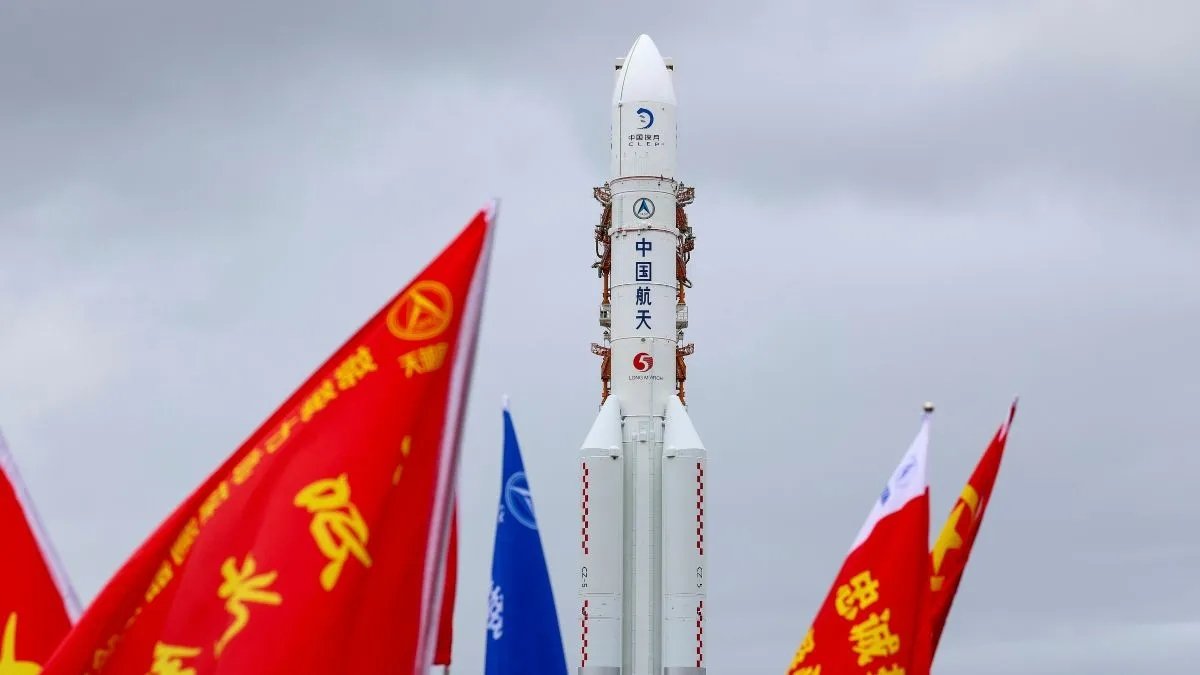

China on Sunday (August 23) postponed the launch of its ambitious Chang’e-7 lunar mission, which was aimed at exploring the Moon’s south pole and searching for water ice. The spacecraft was scheduled to launch in the coming days from the Wenchang Space Launch Site on Hainan Island in southern China. However, the China Manned Space Agency said the mission did not meet the required launch conditions and “cannot take place during the planned window this year.”
Comprehensive assessment done before taking decision
The decision was made following a “comprehensive assessment,” the agency added, and was based on the principles of “prudence, reliability and absolute mission success.” It did not further elaborate on the reasons behind the decision.
Preparations have been carried out at the Wenchang launch site for the Chang’e-7 mission over the past weeks, the seventh in the Chang’e moon exploration program. It aimed at making breakthroughs in key technologies, the official Xinhua news agency previously reported.
The mission was expected to play an important role in China’s efforts to study the Moon’s water resources, particularly the possibility of water ice in permanently shadowed regions.
The Chang’e programme is named after Chang’e, a Chinese lunar goddess. In 2024, China’s Chang’e-6 mission made history by returning rock and soil samples from the Moon’s far side—the first mission in the world to accomplish the feat.
China builds ‘Artificial Sun’
Earlier, China hit a huge milestone in its push to build an ‘artificial sun’. They have just finished and tested the world’s largest superconducting fusion magnet, a key step on the path to generating clean, practically endless energy from nuclear fusion.
The Institute of Plasma Physics at the Chinese Academy of Sciences developed this massive superconducting magnet. It’s not just a technical triumph, as it is one of the main pieces you need for a future fusion reactor, and it fits right into China’s roadmap for moving fusion power from the lab to real life.
‘Artificial Sun’ a nuclear fusion reactor that works by mimicking the process that keeps our Sun burning. Instead of burning coal or gas, fusion smashes hydrogen atoms together at more than 100 million degrees Celsius. This unleashes huge amounts of energy—and no carbon dioxide. Scientists see fusion energy as the holy grail: a clean, safe, basically limitless power source to help reach global carbon neutrality.
(With AP inputs)
Also Read
‘Partners of choice, but…’: Carney explains why Canada-US trade deal collapsed
27-year-old Indian shot dead by unidentified assailant in New York City