
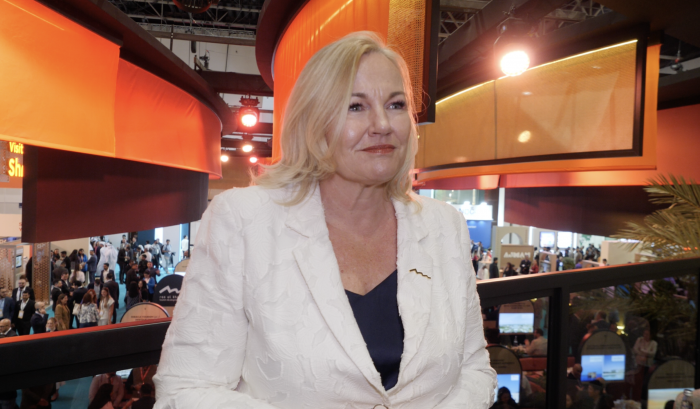


Phillpa Harrison, CEO, Ras Al Khaimah Tourism Development Authority, talks to Breaking Travel News at ATM
Following Arabian Travel Market 2026, Breaking Travel News looks at how Ras Al Khaimah is positioning itself for its next phase of growth, responding to wider tourism trends towards nature-led experiences, short breaks and more intimate luxury while scaling up infrastructure and visitor numbers.See more in-depth interviews with tourism leaders here
Ras Al Khaimah is investing heavily in the infrastructure needed for its next phase of tourism growth, from new hotels and mountain lodges to beachfront developments and an expanded airport experience.
A new partnership with Emirates also underlines the role of connectivity in RAK’s growth strategy. Under a memorandum of understanding signed at ATM 2026, RAKTDA and Emirates will explore joint marketing and advertising
campaigns across selected markets, alongside trade and media familiarisation programmes, bespoke products and packages, and incentives for tour operators. RAKTDA will support curated ground experiences and share marketing costs for multi-market campaigns, while both parties will use traveller insights to help identify priority segments. With Emirates serving close to 140 destinations, the agreement gives RAK access to a broad international network as the emirate works towards its target of more than 3.5 million annual visitors by 2030.
Yet the emirate’s tourism leadership is clear about what it believes should remain at the centre of the proposition: nature.
Phillipa Harrison, CEO of Ras Al Khaimah Tourism Development Authority, told Breaking Travel News at Arabian Travel Market 2026 that domestic visitation had grown 47% over the previous six months, while the emirate recorded its strongest first half for arrivals.
“We’re going to double our room keys. We’re going to triple our visitation in the next five years,” Harrison said.
The ambition comes alongside a substantial development programme. Marjan Island remains a major component of the destination’s tourism landscape, while Marjan Beach adds a new beachfront community combining residential and tourism uses.
The emirate is also developing its mountain offer. Harrison highlighted the opening of a first mountain lodge, with 70 villas positioned directly on the mountain, alongside a new Rotana property at the mangroves adding 258 rooms. A new VIP terminal at Ras Al Khaimah International Airport and further infrastructure are also being developed to support incoming visitors.
The question is what differentiates RAK as that infrastructure expands. Harrison’s answer is straightforward. “We’re going to do that by remaining true to who we are, which is a place where you can experience incredible nature and have a beautiful barefoot luxury experience.”
That gives Ras Al Khaimah a proposition built around the combination of coast and mountains, rather than relying on the scale and density associated with the UAE’s larger tourism hubs.
The emirate is also seeing an emerging short-break market. “We’re seeing a real emergence of the short stay,” Harrison said. “People are no longer just looking at the block of summer holidays. They’re thinking about ways to get away throughout the year.” For RAK, the short-stay market fits naturally with its geography and product mix: a mountain escape, a coastal resort, outdoor activities or a weekend combining several of them.
The destination’s wider development is also beginning to create a more diverse economic identity. Paul Dawalibi, CEO of Innovation City RAK, argued that the emirate’s appeal extends beyond tourism infrastructure. Describing RAK as an alternative to the intensity of Dubai for technology companies, he said: “If you want to build and focus on building, being out of that distraction, being out of that chaos, we think is a big advantage.”
He also pointed to RAK’s lower cost base and the ability to bring executives and technical teams into the same physical ecosystem, describing Innovation City as aspiring to become “the Silicon Valley of the Middle East.”
For tourism, the lesson is similar. Ras Al Khaimah does not need to replicate Dubai’s proposition to participate in the UAE’s wider growth.
Its opportunity lies in making the contrast part of the appeal: mountains alongside beaches, adventure alongside resort stays, mangroves alongside luxury hospitality, and short escapes alongside longer holidays.
Harrison’s phrase “barefoot luxury” may ultimately be the most useful shorthand for what the emirate is building. The infrastructure is expanding. The proposition remains close to the landscape.