
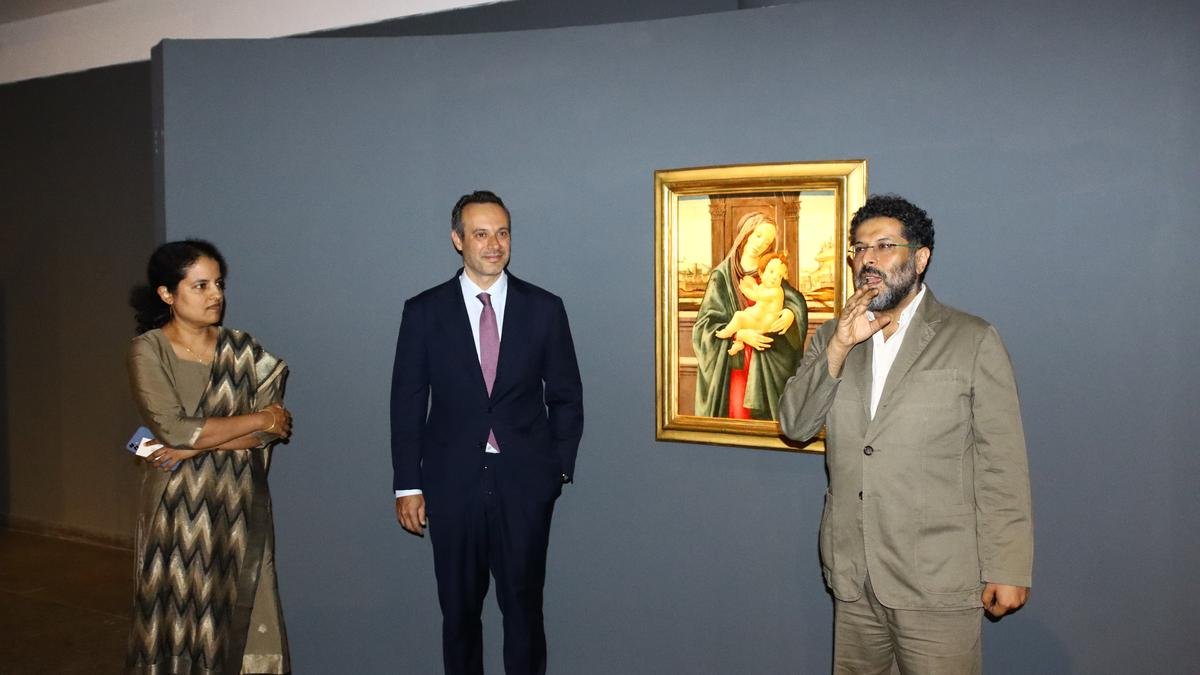

In the centre of a darkened gallery at the National Gallery of Modern Art (NGMA), Bengaluru, Sandro Botticelli’s Madonna and Child gleams within its gilded frame. The Virgin Mother, whose alabaster skin, high forehead, hooded eyes, elongated nose and jaw, and small but pronounced Cupid’s bow bear a striking resemblence to the women in the Italian Renaissance painter’s classic masterpieces, Primavera and The Birth of Venus, is dressed in colours which hint at Christian duality: her scarlet robe signifies her humanness and eventual sacrifice, while her blue mantle represents the cosmos, a nod to the divinity she has carried within her.

In her arms, she cradles a naked, chubby male child who looks away from her into the distance, her expression deeply melancholic. “She knows what is to come,” says art historian and academician Naman Ahuja, pointing out other details in the painting that foreshadow Christ’s crucifixion, death, and resurrection, such as the architectural framing of the background, which resembles a cross, and the stone gargoyles behind Mary, a visual warning.

Sandro Botticelli’s Madonna and Child g
| Photo Credit:
Special Arrangement
While Botticelli’s Madonna and Child, a 93 × 73 cm tempera and oil tempera on wood panel, is indeed a masterpiece, it is not the only one on display at this new exhibition, One Mother, Many Mother Tongues, co-curated by Naman and the director of the Italian Cultural Centre in India, Andrea Anastasio. The result of a collaboration between the Consulate General of Italy in Bengaluru, the National Gallery of Modern Art (NGMA) and the Ministry of Culture, it has been supported by the Prestige Group, with Rezwan Razack’s Museum of Indian Paper Money as cultural partner.

Some of the other artworks, which are part of the exhibition, include a tiny, 4500-year-old terracotta sculpture from Harappa, a delicate ivory carving of a mother balancing a girl (the only image, which depicts a female child) on her head from Bengal, statuesque stone effigies of ancient Indian goddesses like Chamunda, Skanda Mata, Matrika, Hariti and Jyeṣṭhā and a collection of Etruscan representations of Mater Matuta, an indigenous goddess of fertility, childbirth, and ripening grain, later co-opted and syncretised by the Romans.
These artefacts, spanning geography, cultures, media, and millennia, collectively dissect how a persistent visual motif—mother and child—migrates across borders, changing identity according to region, religion, language, and culture, as the exhibition release states. “Through these images, it explores how birth represents not only the creation of physical life, but also the emergence of ideas, beliefs, and cultural identities,” it states.
It also notes that the exhibition examines how images shape and reinforce ideas within societies, inviting reflection on other questions that remain relevant today: Is motherhood the primary framework through which the feminine is granted agency? How have societies defined parenthood and gender roles through visual culture? Do ancient representations of the feminine always need to be understood through the lens of the Mother Goddess?
Genesis and more

Mater Matuta, the indigenous goddess of fertility, childbirth, and ripening grain
| Photo Credit:
Special Arrangement
The idea for the exhibition emerged out of a casual conversation between the two curators. Andrea, says Naman, had read a paper he had published some years ago, also titled One Mother, Many Mother Tongues, and “wanted me to expand it into an exhibition, because he had the opportunity to bring a Botticelli to India, and knew that for it to speak to people here, it might actually need to be complemented with other images that have the history and story of the mother in India.”

Curator Naman Ahuja and Giandomenico Milano, Consul General of Italy in
Bengaluru, at a recent press meeting in Bengaluru
| Photo Credit:
Ravichandran N
After all, the Botticelli is, as Naman points out, the inheritor of a very long past, “with many ideas of cultural continuity carrying on into the mother and child in Christianity.” Even though the church would not have wanted to give Mary such importance, “every town and village in Europe had their patron goddesses, and when Christianity rose, those goddesses were subsumed by Mary,” he says.
And, yes, this past also includes a long, shared history between India and Europe. While intercontinental trade has existed for millennia, by around 200 CE, as large, powerful empires like the Romans, Kushans and Satavahanas began to flourish, “it gets really intensified.” Maritime trade has exploded because they’ve just discovered how to use the monsoon to their advantage, and ships between India and Egypt are plying constantly, while the Silk Road is really active, he says. “Roman goods were coming to India, and vice versa.”

It was not just precious metal, spices, textiles, ivory, gemstones, and ceramics travelling across continents, but also tremendous cultural and religious exchange that enriched these ancient worlds without flattening them. “Through 26 masterpieces, it tells of this complex, shared history between the Mediterranean and India, and this dialogue carries on across the gallery,” says Naman, who believes that while the concept of the mother is a universal one, once it is teased open, “you will see the extraordinary diversity that is lying encapsulated within that concept of one mother, where many mother tongues are speaking their own languages through that same image. There is great unity, but if you look deeper into it, you will also see the extraordinary pluralism that we are able to maintain.”

A Hariti made from red-mottled sandstone from Tayapur, Mathura, now at Government Museum in Mathura
| Photo Credit:
Special Arrangement
Politically speaking, this is an important discussion in our times, where people often worry that globalisation results in cultural homogenisation, believes Naman. “An exhibition like this gives us the confidence to know that throughout history, every culture has managed to keep its own identity, even though there are extraordinary forces of homogenisation and globalisation around us,” he says. “I wish more people would recognise the fact that while there is a constant flow of ideas and culture, and these things will continue to flow, there has always been power in society to be able to hold onto your culture, regardless of whatever forces there may be around you, to try and alter that.”
One Mother, Many Mother Tongues will be on view from August 20 to September 20 at the National Gallery of Modern Art, Bengaluru.