
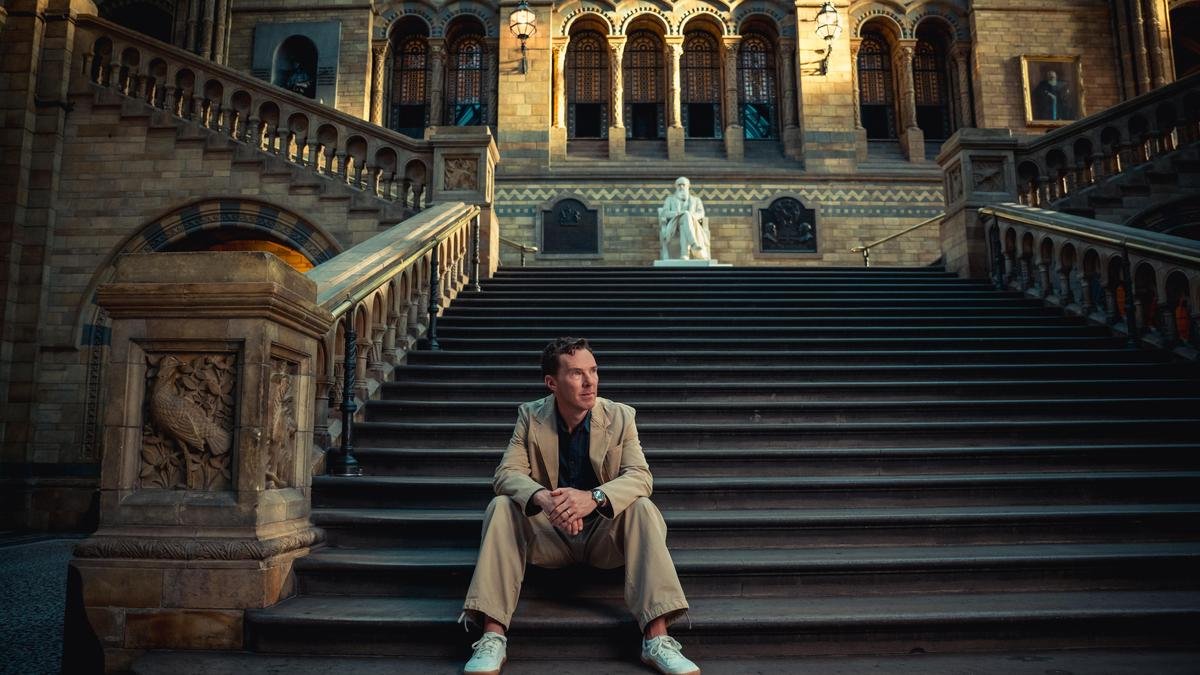

Benedict Cumberbatch is possibly the only person who can get away with using a word like “trepidatious” in conversation. The actor, who captured our collective imagination as Sherlock, and has gone on to comfortably inhabit the MCU, as well as smaller films, used the word when talking about presenting How to Live on Earth.
The Open Planet documentary premiered on YouTube on September 20. Speaking over a video call from London, Benedict says the question, ‘How to live on Earth?’, fascinated him. “I wanted to find out. I’d worked with Fredi (Devas, director) before on a documentary about the Antarctic, (remember penwing, penling?) which I did the voiceover for in New Zealand during the lockdown in 2020.”
It was when he read the script that Benedict felt “slightly trepidatious because there is really only one presenter of natural history documentaries, Sir David Attenborough. I was keen not to tread on those heels or be lost in trying to be that person.”

Three-pillared approach
How to Live on Earth is a very different flavour and character, the Dr Strange actor says. “It drew me in with its humour, and also the revelations of the three-pillared approach that subtitled the film, which is ‘How to Feed the Future’, ‘How to Value Nature’ and ‘How to be Human’.”
Executive producer Jonnie Hughes says Benedict was the right choice because they wanted to take a different tone with the story. “It needed to reach into people’s hearts and minds. Benedict’s back catalogue is perfect in terms of global reach. He has the air of a storyteller with an intellectual argument.”
Walk the talk
The documentary’s use of experts include wildlife filmmaker and explorer, Dan O’Neill, climate justice activist, Xiye Bastida, and former White House chef and senior policy advisor on nutrition, Sam Kass, who helped Benedict present with authority.

Dan O’Neill filming in Calakmul Biosphere Reserve – Mexico – for ‘How to Live on Earth’
| Photo Credit:
Open Planet Studios
“They are extraordinary and I felt bolstered for the part that I play. That’s what I like to do in my advocacy. I’m not a policy expert, a scientist or a biologist. I’m not part of an indigenous people with ancestralism. These are experts that I am in awe of, who have lived the talk, who have walked the talk. It’s key to me that I feel what I’m saying is backed up by those in the know.”
A variation of self
From mathematician Alan Turing to the coarse rancher in The Power of the Dog, Benedict has inhabited complex characters. Stepping into the role of guide was a different skin to occupy, the Academy Award-nominated actor says “It’s a variation of myself. I have a natural curiosity about the world and how we ought to be living on it. I’m invested in the idea of doing better, both personally, and as a society.”
Coming soon
Apart from returning as Dr. Stephen Strange in Anthony and Joe Russo’s Avengers: Doomsday, scheduled for release in December 2026, Benedict Cumberbatch stars alongside Rosamund Pike and Anthony Hopkins in Guy Ritchie’s Wife & Dog. The revenge thriller is set for release on February 19, 2027.
In 2027, he also stars in an adaptation of Jo Nesbø’s 2014 novel, Blood on Snow. Directed by Cary Joji Fukunaga, who helmed the final Daniel Craig James Bond film, No Time to Die, the film, adapted by Nesbø and Ben Power, also stars Aaron Taylor-Johnson, Eva Green, Emma Laird and Ben Mendelsohn.
The makers and Benedict refined both the voiceover and the piece to camera. “It wasn’t too off the beaten track for my personality. There was a quirk to it, yes, but it wasn’t a forced humour or an over-earnest tub thumping tone.”
Not wanting it to look like a performance, Benedict wished for the narration to be grounded. “There’s a presentational aspect to it. You have to hear and understand what I’m saying, the phrasing has to be weighted in the correct way, and you have to want to look at my face every now and again because I’m in it (smiles). But apart from that, it’s got to come from an authentic place.”

Xiye Bastida filming in Time Square – New York City – for ‘How to Live on Earth’
| Photo Credit:
Open Planet Studios
Changed the relationship
Making the film changed Benedict’s relationship with the natural world. “It turbocharged my understanding of it. For example, I know that interacting with Nature is good for mental health and for Nature, and seeing the prisoners interact with the turtles underlined it. I know that if you allow Nature to thrive, it comes back online with its own solutions.”
Seeing the emotion of the tribespeople on the removal of the dams on the Klamath River in southern Oregon and northern California and the return of the salmon was particularly moving, Benedict says. “Every time I’ve watched that sequence, I’ve cried. The emotion is so transparent and potent, that it reaffirms my hope and belief that we do have enough humanity amongst us to make a difference.”

Lessons lost
We are a part of Nature and not apart from it, Benedict says. “The lesson has been lost, in rapid urbanisation, 200 years of capitalism, the rapid increase of automation, the separation of you and I, Descartes’ I think therefore I am, I could go on and on and on.”
It has become useful, Benedict says to think of ourselves as units in a factory. “It’s all about a drive to productivity and unsustainable growth. We’re now putting the brakes on. What is valuable goes into the bigger picture of who we are as human beings.”
Set the controls
The earth, Benedict says, is a spaceship. “It’s got a biosphere that supports carbon-based life forms, and the bodies we inhabit are the spacesuits. We don’t really need to go to Mars to prove that we’re already in space. Thank you very much. So let’s make this work.”

Sam Kass filming in the Bahamas for ‘How to Live on Earth’
| Photo Credit:
Open Planet Studios
A lot of modern inventions, Benedicts allows, have been helpful. “We’re not to deny the advances in medicine, education and communication. It has, however, come at a cost, but we’re clawing our way back.”
“Our civilisation has almost given us permission to detach from Nature,” Jonnie adds. “A lot of people are spiritually connected to Nature, as I know they are in India. This connection has been around much longer than the atomisation and separation from Nature. We’ve got to get back on track and rejoin Nature.”
“There is a reason indigenous peoples have been the spirit of Nature,” says Benedict. “Those messages have been coming across in the last few decades of environmental advocacy. How to cohabit and be a part of Nature, not apart from it, is deep-seated in a humanity that has practised sustainability. It’s no small surprise that some of the lessons that we’re learning now are very old.”

Making How to Live on Earth free to watch was a conscious choice according to Benedict. “It’s a completely democratic, open-source piece of material to inspire, provoke and call people to action. It’s very rare that you’re not worried about box office revenue. The philanthropic support through the Villars Institute Foundation and Silvania has created this amazingly impactful, funny, at times moving, and important bit of storytelling for free.”
The film, Benedict says, could be re-constituted for educators, policy forums, political and social outreach. “That is something a normal cinematic or streamer release with its paywall wouldn’t facilitate. It’s a hugely attractive thing to be a part of and the film is revolutionary in its ambition.”
How to Live on Earth is streaming on YouTube