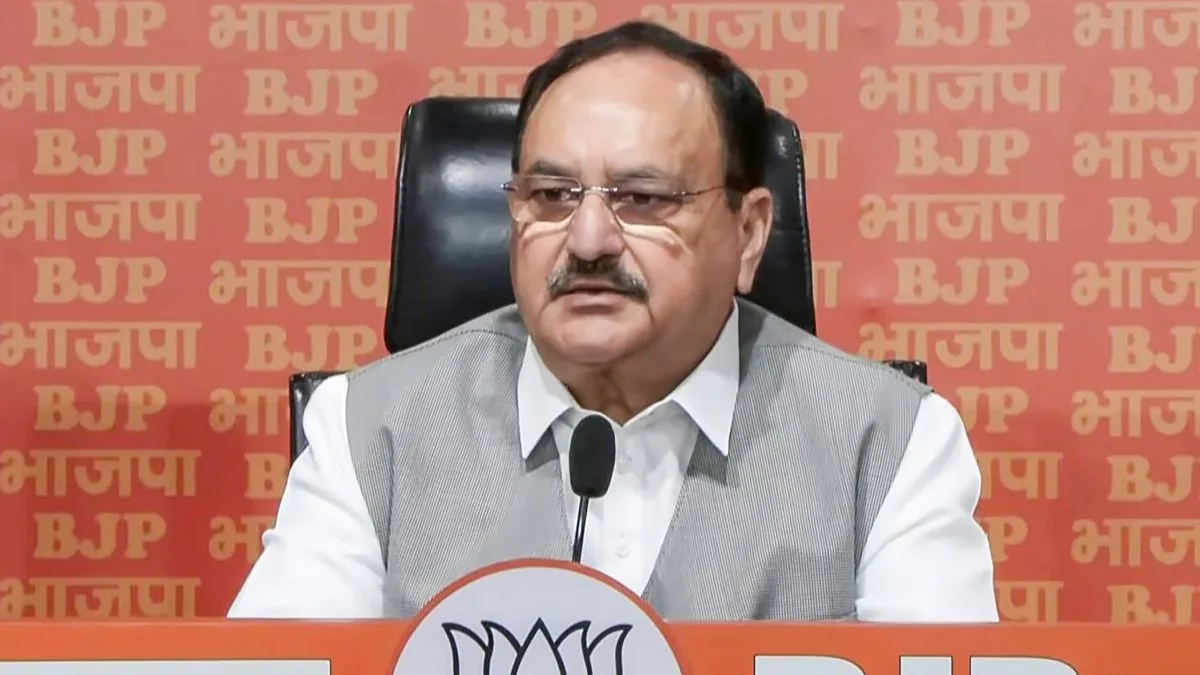

As Nitin Nabin, the BJP’s acting president, gets ready to submit his nomination on Monday at 2:00 PM in a contest that is generally anticipated to be uncontested, the party is subtly ending the tenure of JP Nadda, one of its most modest but structurally important national presidents. Nadda served for three years before receiving a one-year extension until January 2024, and he remained president until his successor was elected.
From the beginning, Nadda’s presidency was unique. He was the first president of the BJP to serve out his whole tenure virtually fully in the midst of a crisis. The Covid-19 outbreak disrupted traditional politics just weeks after becoming office, forcing the party to give up on large-scale mobilization and demonstrations. Nadda didn’t have much time to adjust after taking over on January 20, 2020. Under Nadda, the BJP eschewed the customary electoral spectacle in favor of crisis management, governance coordination, and organizational control. They led the Bihar election with hybrid rallies, upheld social distancing rules, and made use of the party’s IT assistance.
Nadda managed the party primarily from the “war room” as opposed to rally stages, in contrast to his predecessors. Public-facing politics were deliberately downplayed in his style. According to insiders, he prioritized internal reporting, feedback loops, and data flow over attention-grabbing measures. This was in stark contrast to previous presidents, like as his predecessor, interior minister Amit Shah, who frequently served as the party’s most public political or ideological face. He functions more like a CEO than a BJP president, according to many general secretaries.
The subtle institutionalization of performance audits was one of Nadda’s less obvious but long-lasting innovations. Internal report cards covering electoral results, organizational health, and welfare outreach were used to evaluate state presidents and organization general secretaries, however these assessments were rarely made public.
Additionally, Nadda oversaw the BJP’s structural shift from a primarily cadre-driven organization to one that is increasingly influenced by beneficiary-heavy politics. Welfare delivery indicators, which were connected to central government programs, began to have the same weight as conventional booth-level mobilization under his leadership. According to BJP insiders, party officials were increasingly evaluated not only on cadre strength but also on how well government perks translated into political consolidation.
In order to reduce exaggerated enrollments, Nadda implemented stronger verification standards, like as digital checks and mobile-generated OTPs, despite the BJP announcing massive membership campaigns during his term. Compared to previous campaigns that put scale ahead of inspection, this was a significant change.
The encouraging of non-political professionals to join party institutions was another subtle change. The BJP’s shift to a more technocratic organizational model was strengthened by the active integration of data analysts, legal experts, policy scholars, and social media specialists into party cells.
Nadda purposefully kept a low profile in the media despite being the leader of the party. Senior officials claim that the choice was deliberate—to steer clear of personality-centric narratives and maintain the focus on PM Modi-led government rather than party leadership.
In order to control factionalism in politically delicate states like West Bengal and Karnataka, Nadda chose to maintain the status quo and maintain balance, defying calls for significant leadership changes. The strategy put internal balance ahead of band-aid solutions.
Ideological restraint was perhaps the most notable change from previous BJP leaders. In contrast to Rajnath Singh, Amit Shah, or LK Advani, Nadda hardly ever openly intervened in ideological disputes. Unusually for a party known for strong ideological signaling, he viewed the BJP president’s position as primarily organizational and electoral rather than an ideological pulpit.
Nadda’s legacy stands out as Nitin Nabin advances toward what is anticipated to be a smooth, uncontested elevation—not for dramatic moments or scathing rhetoric, but for institution-building in silence—a tenure characterized less by speeches and more by establishing a system that demands corporate accountability in a political setup.