

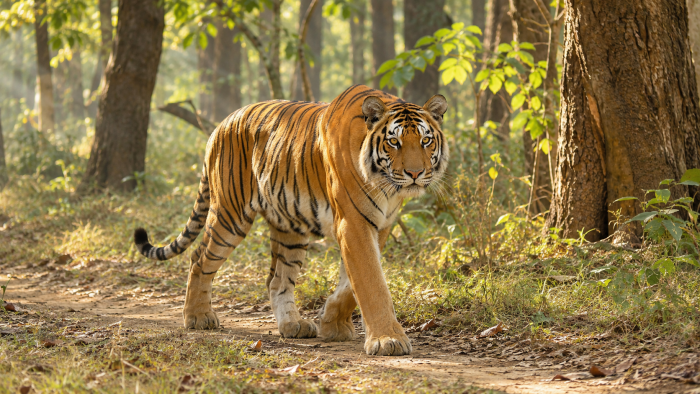


From a remarkable revival in Assam to a reserve that rebuilt its population from zero, India’s tiger recovery is giving wildlife travellers plenty to celebrate. But what do the numbers reveal about where to go—and what you might see?
In 2009, Panna’s tiger population had fallen to zero. A reserve dedicated to protecting one of India’s most celebrated animals had lost its defining species.
Today, its story offers a powerful reason for optimism. A reintroduction programme helped restore a breeding population, and the 2022 national assessment estimated 55 tigers within the reserve. Across the forests, grasslands and river valleys of India, other reserves have been recording recoveries of their own. The National Tiger Conservation Authority
documents Panna’s turnaround
, while its
census reports chart the wider recovery
.
Nationally, India’s estimated tiger population rose from 1,411 in 2006 to 3,682 in 2022—more than doubling in 16 years. Those
Government of India figures
represent a substantial conservation achievement, even as protecting habitat and managing encounters between people and wildlife remain continuing challenges.
For travellers, that recovery brings fresh interest in the places where it is happening. Beyond the familiar safari names, a new analysis highlights reserves whose populations have grown sharply, sometimes from precariously low starting points.
Travel specialist
Pettitts Travel
examined census data covering 53 Indian tiger reserves as part of a wider study that also included Nepal. Using historical figures, it projected populations to 2030 and ranked reserves by their percentage growth over the period from 2014.
Its leading Indian reserves are:
| Tiger reserve | State | 2014 estimate | 2022 estimate | 2030 projection | Projected increase, 2014–2030 |
|---|---|---|---|---|---|
| Manas | Assam | 11 | 58 | 104 | 845% |
| Kali | Karnataka | 5 | 17 | 27 | 440% |
| Panna | Madhya Pradesh | 17 | 55 | 89 | 424% |
| Pilibhit | Uttar Pradesh | 25 | 63 | 105 | 320% |
| Valmiki | Bihar | 22 | 54 | 84 | 282% |
Figures from
Pettitts Travel’s study
. The 2030 numbers are statistical forecasts, rather than census results or guaranteed conservation outcomes.
Manas, in Assam, leads the projected growth ranking. The figures used in the analysis show its population rising from 11 in 2014 to 58 in 2022, with the model suggesting it could reach 104 by 2030.
The history behind those numbers makes the recovery especially compelling. Years of insurgency weakened protection, while poaching and habitat damage devastated wildlife. A
US$2.35 million rehabilitation plan drawn up in 1997
formed part of the long effort to rebuild the landscape. Improved security and cooperation with surrounding communities helped create the conditions for recovery.
In 2011,
UNESCO removed Manas Wildlife Sanctuary from its List of World Heritage in Danger
—a significant milestone for a landscape that had suffered so heavily.
For visitors, Manas offers a setting worthy of that story:
alluvial grasslands, forests and rivers beneath the Bhutan foothills
, supporting wildlife that includes elephants, rhinos and tigers. Its appeal extends across the whole landscape, with the tiger’s return adding another dimension to the experience.
Panna provides an equally striking example of recovery through sustained intervention. Its reintroduction programme began in 2009, rebuilding a population after local extinction. The census figures used by Pettitts show an increase from 17 tigers in 2014 to 55 in 2022; its model projects 89 by 2030. That history gives a safari here particular resonance: visitors are entering a landscape where an absent predator has become established again.
Kali, Pilibhit and Valmiki broaden the picture beyond those two headline stories. Their inclusion shows how recovery is unfolding across different parts of India. The percentages also need perspective: a reserve starting with five tigers can record a huge proportional increase while still supporting a relatively small population.
For anyone planning a safari, there is another essential distinction. Population growth and tiger sightings measure different things.
Density—the estimated number of tigers per 100 square kilometres—helps describe how concentrated a population is. It cannot establish the likelihood of seeing one from a particular safari route. Vegetation, terrain, accessible zones, timing and an animal’s movements all influence an encounter. A reserve’s position in a growth table should therefore be one consideration when choosing a trip.
Established destinations remain part of that decision. Pettitts’
safari guide
highlights Bandhavgarh, Kanha, Ranthambore and Corbett among India’s principal wildlife destinations. Choosing between them involves the wider experience too: the landscape, other wildlife and how the reserve fits into an itinerary.
Interest in India’s reserves is already strong. Dudhwa and Pilibhit together welcomed
more than 133,000 visitors during the 2025–26 tourism season
, according to a report citing reserve officials. That demand underlines the importance of managing tourism carefully as wildlife populations recover.
The forecasts offer an encouraging possibility, but continued growth depends on conditions on the ground: secure habitat, sufficient prey, connected forests and support for people living alongside wildlife.
For travellers, understanding that work adds depth to the anticipation of a sighting. A tiger crossing a forest track may be visible for only seconds. In places such as Manas and Panna, the recovery behind that moment has taken decades.