

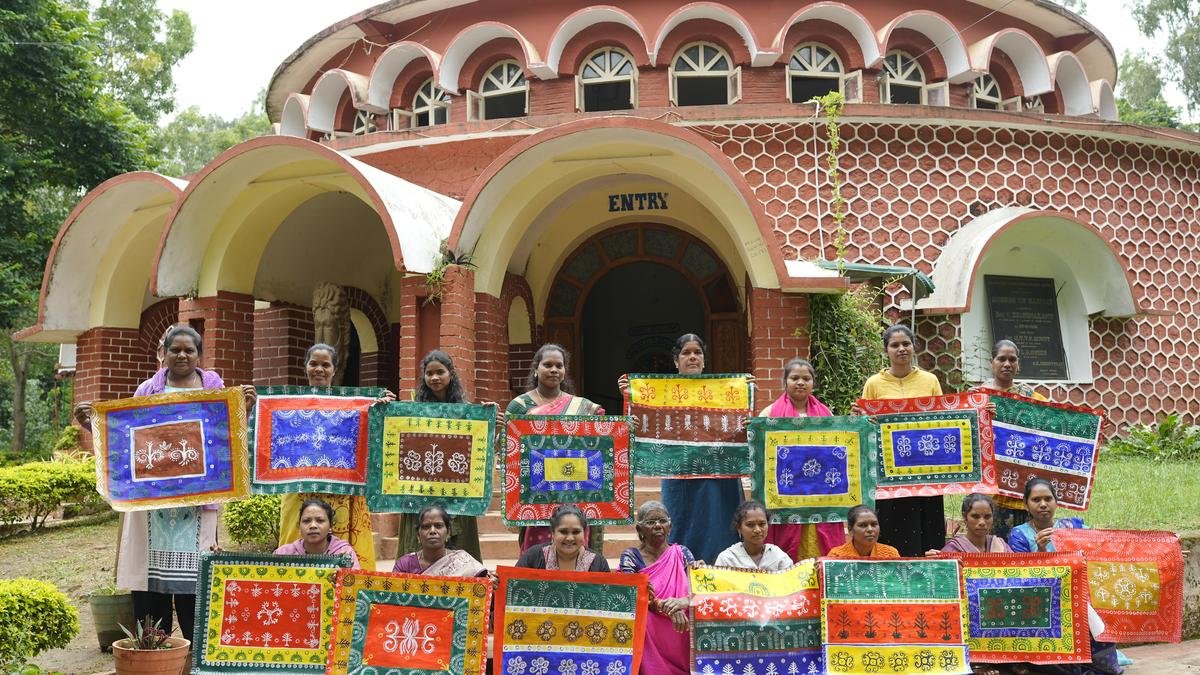


Tribal artisans display their works during a hands-on workshop in Araku organised by the Tribal Cultural Research and Training Mission and ITDA, Paderu, in collaboration with the Ministry of Tribal Affairs.
| Photo Credit: SPECIAL ARRANGEMENT
At Musiriguda near Araku Valley, the day began with the soft rasp of bamboo being trimmed and split. Tribal artists watched as the craftsman from Chhattisgarh bent, tucked, and wove slender strips into shape, turning them into trays, flower holders and pen stands. The exercise was about discovering new forms and understanding how a familiar material could be given a contemporary expression.
A little away in Madagada, the morning workshop carried a different rhythm. Here, the earthy smell of clay and the steady movement of the potter’s wheel marked the start of another session. A traditional potters’ village, Madagada has long been home to artisans who shape cookware, water-storage pots, grain containers and ceremonial lamps using kick-wheels and hand-paddling tools. Here, the workshop focussed on sharpening a craft the participants already knew. Master craftspersons and trainers from Andhra Pradesh and Odisha worked alongside the potters to ideate on how traditional forms could be adapted for changing tastes.

Tribal artisans hone their traditional craft skills during a hands-on workshop in Araku, organised by the Tribal Cultural Research and Training Mission and ITDA, Paderu, in collaboration with the Ministry of Tribal Affairs.
| Photo Credit:
SPECIAL ARRANGEMENT
These hands-on exchanges were part of a series of six-day-long skill development workshops that recently concluded across three key sites in and around Araku Valley. The programme was organised jointly by the Tribal Cultural Research and Training Mission, Department of Tribal Welfare, Visakhapatnam, and ITDA (Integrated Tribal Development Agency), Paderu, in collaboration with the Ministry of Tribal Affairs, New Delhi. It brought together practitioners of crafts that have grown from the landscape, resources and cultural memory of tribal communities.
At another workshop venue, a brush moved in slow, deliberate strokes across the surface, bringing to life a painting tradition that has travelled through generations. Inside the Araku Tribal Museum, the concentration of the artists was broken only by the occasional exchange of instructions as they learnt lacquer handicrafts and bangle-making, traditional tribal painting and Savara painting. One of the most significant sessions was by Korra Buddu, a septuagenarian from the Valmiki tribe in Chompi village, who carried with her the rare knowledge of what people call ‘Buddu’ traditional painting. Regarded as its lone surviving practitioner, she was passing on a tradition that had gradually faded from everyday community practice.

Tribal artisans hone their traditional craft skills during a hands-on workshop in Araku, organised by the Tribal Cultural Research and Training Mission and ITDA, Paderu, in collaboration with the Ministry of Tribal Affairs.
| Photo Credit:
SPECIAL ARRANGEMENT
“Much of the knowledge associated with tribal art has traditionally been passed down orally and through practice, rather than through written records. These art forms carry within them stories of the community, its beliefs, ecology and relationship with the landscape. So, these workshops are a critical platform for documenting this knowledge and ensuring that it is passed on to the next generation,” says programme director Nagaraju Chikkala.
The workshops sought to strengthen the artisans’ existing skills while giving them room to experiment with new designs, diversify their products and work with materials found around them. “Lac, leaves, stones, flowers, fruits and bark can all become part of a creative vocabulary that comes from the landscape itself,” says associate professor K Srinivasa Varaprasad.
Published – September 25, 2026 01:23 pm IST