A water purifier designed as a statement piece features a dot-matrix display and promises a three-year, no-service filtration system. Meanwhile, a smart lock combines face unlock, a built-in camera, video calling, and remote access in a single device. What these two products have in common is that they are both made by an Indian company and designed in-house. The company behind them is Urban Company, the Indian tech startup best known for household services—from plumbing and home cleaning to massage therapy—through its consumer products brand, Native.
That’s not the kind of story one would typically expect from an Indian company: taking a design-led approach to bringing premium smart-home products to market. One of Urban Company’s defining characteristics is its inquisitive mindset, young team, and focus on solving India-first problems at its core through smart home products that behave like smartphones.
“I think making products, perhaps, is not difficult. Making products that are different from everything else out there and therefore more useful to consumers takes a fair amount of effort,” Varun Khaitan, co-founder and Chief Operating Officer of Urban Company, told indianexpress.com on the sidelines of the launch of the Native M3 and M3 Pro water purifiers and the Smart Lock Ultra in Delhi on Wednesday.
The smart home category has been one of the toughest to crack, and globally, only a handful of major tech brands have made a serious push into the segment: Amazon and Alphabet among them, with Apple rumoured to join soon. However, Native by Urban Company is not trying to address every aspect of the smart home. Instead, it is focusing on home access, security, and water purification products, with an emphasis on addressing the key needs of Indian consumers.
“The smart home concept is still in its early stages in India,” Khaitan said. But he’s clear that the brand does not want to enter every possible smart-home category. “Rather than thinking about the 10 things in the home that could potentially be smart, we want to focus on what we believe is the biggest problem that can actually be solved with a smart product,” he added.
 The Native M3 series is a modern take on traditional water purifiers found in Indian homes. (Image credit: Anuj Bhatia/Indian Express)
Better filter life, lesser servicing
Khaitan specifically points to water purifiers as a product category that hasn’t seen any major innovation in years. The new Native M3 series smart water purifiers are designed differently from traditional RO systems. The higher-end M3 Pro, priced at Rs 25,999, features a 10-stage purification system that combines RO, UV, alkaline purification, and a DualFlow Mineraliser with copper-charge technology. It also comes with a UV-equipped stainless steel water tank and a built-in dot-matrix display, inspired by a similar design concept introduced by London-based Nothing in its smartphones. The display can show live TDS readings, purification status, tank level, and the amount of water dispensed. The smart water purifier is app-compatible and also supports a built-in battery.
Perhaps the biggest motivation behind creating the new smart water purifier was to extend filter life without routine servicing—a common challenge for Indian users. The company claims that its new smart water purifier offers a filter life of up to three years and spent years developing a technology as an alternative to conventional RO systems, which require frequent servicing and filter changes.
“When we looked at water purifiers, we wanted to extend filter life to three years. We looked at what was happening in the rest of the world and found that India’s water conditions are far worse than anywhere else. So, no innovation elsewhere in the world and therefore no water purifier from elsewhere in the world could have solved our problem,” Khaitan said, adding that the company looked at the problem unique to the country and developed the Native M3 series, which not only extends filter life to three years but also addresses long-term maintenance costs associated with water purifiers.
Urban Company is also selling the standard M3 model, which does not include a built-in display, for Rs 22,999 but shares many similarities with the M3 Pro model.
In recent years, several startups in India have launched smart water purifiers with unique approaches to water purification technology. The market is increasingly divided between traditional RO purifiers and new-age brands that view smart water purifiers as design-first devices, similar to modern consumer electronics such as smartphones and other connected devices. Kent and Aquaguard lead India’s water purifier market.
“We had to develop a lot of internal capabilities from scratch around water science, water filtration, electronics, and also around how to create the right, impressive-looking product,” Khaitan explained.
The Lock Ultra uses facial recognition technology that allows users to unlock the door. (Image credit: Anuj Bhatia/Indian Express)
A lock that can be opened from anywhere
However, with the Native Smart Lock Ultra, Khaitan and his team are making an even bigger push into the smart-home category. The design-first principles extend to the smart lock, which has a sleek, handless appearance and does not resemble the smart locks currently available in the market.
Khaitan calls it a “personal doorman” for your home. Priced at Rs 24,999, the smart lock uses 3D face recognition, similar to Face ID on the iPhone, to unlock the door as you enter. The technology is not developed in-house but comes from a Swedish company. It also features a built-in camera with live video and two-way talk, allowing users to interact with visitors from anywhere through the Urban Company app. The lock also supports remote unlocking, allowing users to open the door anytime and from anywhere using the app, even from outside India.
Khaitan claimed that the live video feature is safe and secure and that the company does not store live video recordings. Instead, it only provides live streams during doorbell interactions. All other data is fully encrypted and stored securely on the company’s servers. The company commits to not using biometric or video data for any purpose beyond home security.
“Other information is 100 per cent encrypted and stored on our servers, making it inaccessible to anyone else. We don’t use this information for any other purpose, and we don’t intend to use it for anything other than ensuring the security of customers and their homes,” Khaitan said when asked about biometric privacy, a major concern among law enforcement agencies and users amid growing scrutiny over how companies collect and manage biometric data.
Amazon, which sells smart-home products under its Ring brand, was recently sued over its facial recognition technology and alleged privacy violations. The lawsuit focused on consent and the storage of biometric data. In the US, where smart doorbells with cameras have been available for years, laws have not always kept pace with new technologies—recording faces without consent could violate privacy rights. India, on the other hand, does not yet have specific laws in place to protect users’ privacy.
Native’s smart lock is Matter-compatible, supporting the smart-home standard that is becoming integral to smart-home integration due to its flexibility and ease of use. The open-source protocol ensures that smart home devices work seamlessly with one another.
Khaitan says the company worked on both the appearance and the technology behind the Smart Lock Ultra. (Image credit: Anuj Bhatia/Indian Express)
Higher costs justified in the longer run
While the smart home segment is still tiny in India, the global market is expected to grow, reaching $95.83 billion in 2026 and $139.24 billion by 2032, according to MarketsandMarkets.
Both new smart home products by Native reflect how India is becoming increasingly urbanised. As more people move to metros for jobs and choose to buy or rent apartments in suburbs, an ecosystem of services and smart devices is emerging to address consumers’ everyday needs. Urban Company wants to tap into this growing base of urban Indians, who are already paying for app-based services. “Urban Company services and our Native products are actually fairly synergistic because we are trying to serve the same consumer, but both have slightly different reaches,” Khaitan said.
Khaitan says that while Native products may seem on the higher side, he believes the price points at which the company is launching these products are justified in the long term. “Our aim is not to make premium products. That’s not where we started. We started by solving our consumers’ problems. Solving some of these difficult problems requires real investment in hardware to make the products better,” he said.
Khaitan adds that consumers are seeking better value and reliability rather than just lower prices, which is exactly why Native products are priced the way they are. “I think people in India are willing to pay more if the product is actually a cut above the rest and simplifies their lives. If you want to use a water purifier for 10 years, you can spend more if it is worth it. The same goes for the Lock Ultra and home security. It’s hard to put a price on peace of mind when it comes to home security. The door itself probably costs more than that,” he said.
“I don’t think it’s about premiumisation,” he added. “It’s about making products that are good and feel like an upgrade in my life. Do I want my life to be better?”
Khaitan also stressed that developing hardware from the ground up requires strong R&D capabilities, and the company is staying away from the white-label route. However, that requires access to world-class engineering and design talent—designing hardware in India is often seen as challenging due to a perceived lack of talent.
“I think we have enough and more very talented engineers. In fact, the best people often feel that there isn’t enough great work happening here, and that they have to look at opportunities outside India if they want to do meaningful R&D in engineering. We hope that will change in the times to come. As more great hardware companies emerge from India, it will create a positive ecosystem,” Khaitan said.
One of the advantages Amazon and Google have with their smart home products is that their devices are deeply integrated with their respective AI assistants, such as Alexa+ and Gemini. These assistants enable natural conversations and make smart home devices feel less dumb. However, the smart home race has been shifting away from hardware and voice assistants toward broader AI strategies as part of a generative AI overhaul.
“I don’t think we see a use case for that. Do we see a use case for people using their products with voice? Yes. But in the times to come, wherever we feel that’s relevant, we will build it ourselves,” Khaitan said.
Urban Company, which is a services company, has no plans to add a subscription layer or integrate new services into its Native smart home products for now. “We are focused on the one simple model right now where you buy the product, and then you get a certain promise,” he said.
Right now, Khaitan says the focus is on smart water purifiers and smart locks, and the company is not looking at broader smart home products. “We think this is the key area where a smart product can be useful. Once this reaches a few million homes, only then would it make sense to look at something else.”


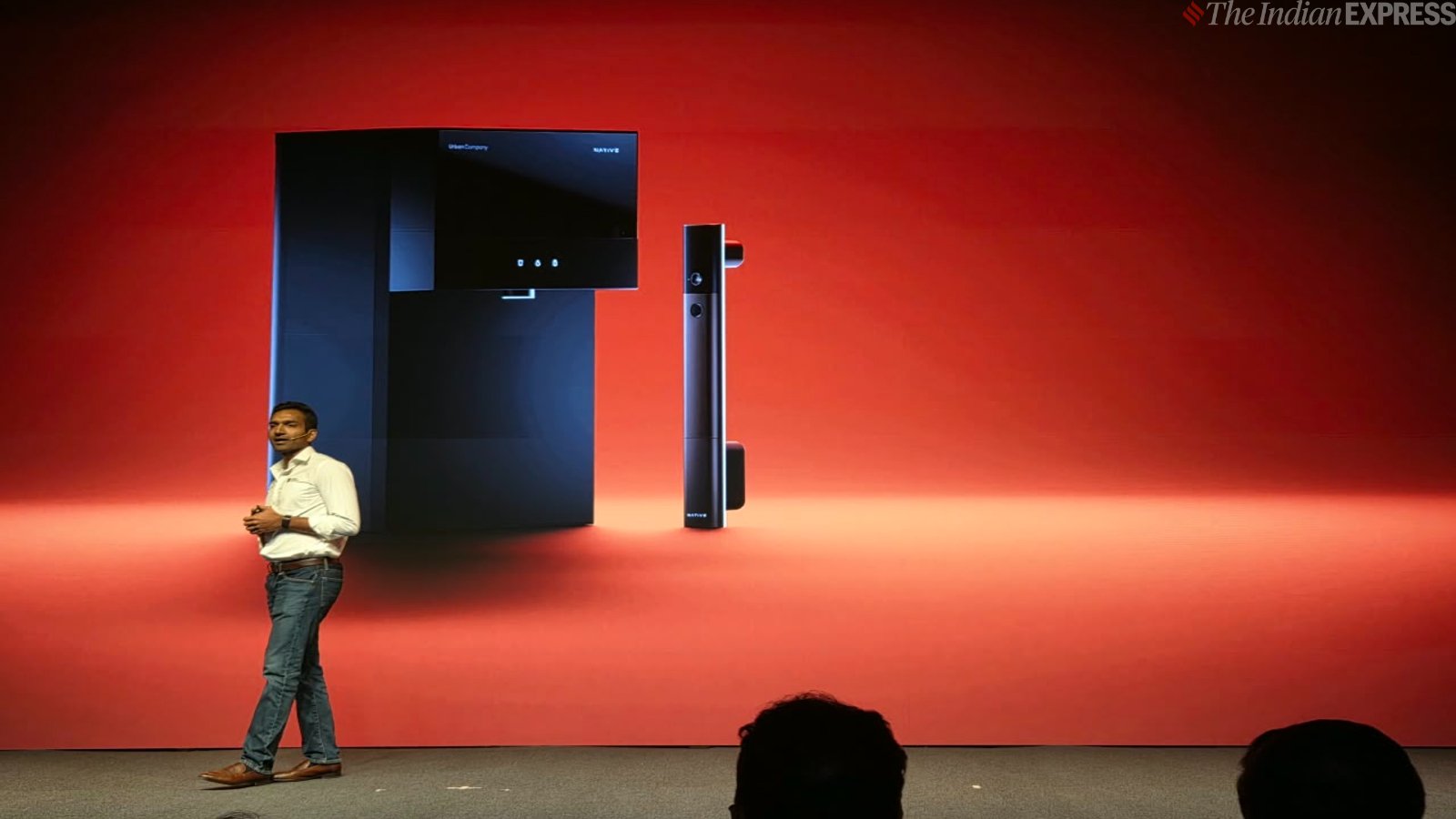

 The Native M3 series is a modern take on traditional water purifiers found in Indian homes. (Image credit: Anuj Bhatia/Indian Express)
 The Lock Ultra uses facial recognition technology that allows users to unlock the door. (Image credit: Anuj Bhatia/Indian Express)
 Khaitan says the company worked on both the appearance and the technology behind the Smart Lock Ultra. (Image credit: Anuj Bhatia/Indian Express)