

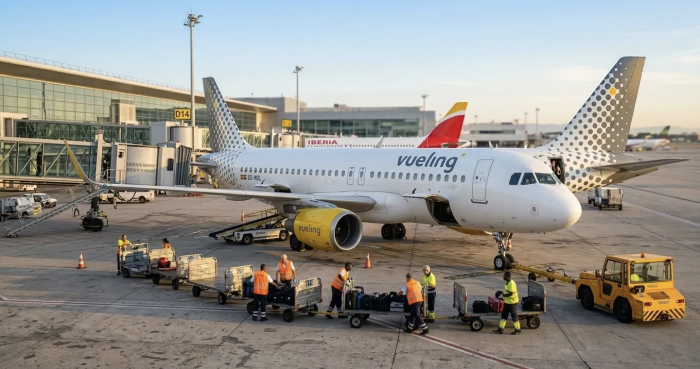


Holidaymakers travelling through Barcelona in the coming weeks are being warned to prepare for possible flight and baggage disruption as an indefinite ground handling strike at Barcelona-El Prat Airport continues with no announced end date.
Groundforce workers at Josep Tarradellas Barcelona-El Prat Airport began indefinite industrial action on 4 August. The company provides services including check-in, boarding, baggage handling and flight coordination for around 20 airlines at the airport.
New search analysis also shows how quickly concern around disruption in Spain has grown. According to search data analysed by Global Work & Travel shows, searches for “Spain airport strikes” have increased 727% over the past year, with approximately 2,000 searches in the past month alone.
The dispute is particularly relevant for travellers with September trips booked. Spain’s Ministry of Transport set minimum service requirements covering both August and September, while around 11,600 flights and close to two million passengers were estimated to be potentially exposed to the action across the two months if it continues.
As of the latest substantive update on 18 August, the strike remained unresolved, with the CGT union saying there had been no progress in negotiations. The union reported around 250 cancelled flights and 6,000 affected bags by that point.
Jürgen Himmelmann, Co-Founder of Global Work & Travel, is urging anyone with a late-August or September trip through Barcelona not to assume the disruption will be over by the time they travel.
Jürgen Himmelmann, Co-Founder of Global Work & Travel, said:
“The important thing for anyone with a Barcelona trip coming up is that this strike doesn’t currently have a fixed end date.
If you’re travelling in September, don’t assume that because your holiday is a few weeks away the issue will have been resolved by then.
That doesn’t mean your flight will be disrupted, but it does mean it’s worth preparing now. Check which airline you’re travelling with, keep monitoring your booking and think about what you’d need with you if your checked luggage was delayed.”
1. Pack your hand luggage for the first 24 hours of your trip
Baggage has been one of the most visible problems during the industrial action, with thousands of bags reportedly affected since the strike began.
Global Work & Travel recommends keeping essential medication, important documents, chargers and enough basic clothing and toiletries for the first day of a trip in hand luggage where airline and security restrictions allow.
Jürgen Himmelmann, Co-Founder of Global Work & Travel, said:
“Think about what you would actually need if you arrived in Barcelona but your suitcase didn’t.
Medication, chargers, documents and enough essentials to get you through your first day should ideally stay with you rather than in the hold.
I’d also photograph your suitcase before checking it in and make a note of anything distinctive about it. If you do need to report delayed baggage, having a recent photo can make describing and identifying it much easier.”
2. Check whether your airline uses Groundforce
The industrial action does not affect every airline operating at Barcelona-El Prat.
Groundforce provides services for around 20 carriers, including major international airlines such as Air Europa, Lufthansa, Air France, KLM, Qatar Airways and Turkish Airlines.
Passengers should check directly with their airline for the latest information rather than assuming all flights from Barcelona face the same level of disruption.
Jürgen Himmelmann, Co-Founder of Global Work & Travel, said:
“This isn’t a blanket shutdown of Barcelona Airport, which is an important distinction.
Different airlines can be affected differently depending on who provides their ground services, so your airline should always be your first source of information.
Keep notifications switched on and make sure the airline has your correct mobile number and email address so you’re not relying on finding out about a change when you arrive at the airport.”
3. Check your flight before leaving for the airport, then check it again
Anyone travelling while the strike remains active should monitor their flight status in the days leading up to departure and again before setting off for the airport.
Jürgen Himmelmann, Co-Founder of Global Work & Travel, said:
“Checking the night before isn’t enough when you’re travelling during ongoing industrial action.
Check when you wake up and again before leaving your hotel or accommodation. If your airline contacts you with new instructions, follow those rather than relying on general information about the airport.
Finding out about a change an hour earlier can give you valuable time to rearrange transfers, accommodation or onward travel.”
4. Don’t immediately buy another flight if yours is cancelled
A cancellation during the busy summer travel period can make passengers feel they need to buy another ticket immediately, particularly when alternative flights are filling up.
However, Global Work & Travel recommends contacting the airline first to establish what alternatives are being offered.
Under applicable passenger rights, travellers affected by cancellations can have the option of reimbursement or rerouting to their final destination.
Jürgen Himmelmann, Co-Founder of Global Work & Travel, said:
“Before spending hundreds on another flight, find out what your airline is offering.
You may have rerouting options available, so immediately making your own arrangements can leave you spending money unnecessarily.
If you do eventually need to make alternative arrangements yourself, document what you’ve been told and keep every relevant receipt.”
5. Keep receipts and screenshots if anything goes wrong
Travellers caught up in disruption should keep evidence from the moment their journey is affected.
That includes airline emails and notifications, screenshots showing delays or cancellations and receipts for reasonable additional expenses.
Jürgen Himmelmann, Co-Founder of Global Work & Travel, said:
“Create a folder on your phone and put everything in it as it happens.
Keep your original booking confirmation, screenshots of delays, messages from the airline and receipts for any relevant additional costs.
Trying to reconstruct an entire disrupted journey after you’ve returned home is much harder than documenting it at the time.”
6. Think beyond your Barcelona flight
The knock-on impact can be particularly significant for backpackers, working holiday travellers and people on multi-stop trips.
A flight delay of several hours could result in a traveller missing a separately booked train, transfer, tour, accommodation check-in or onward flight.
Jürgen Himmelmann, Co-Founder of Global Work & Travel, said:
“For longer trips, the flight itself might not actually be the biggest problem.
Look at everything you’ve booked immediately after you land. If you’ve got a separately booked train, transfer, hostel, tour or another flight, check the cancellation and amendment terms before you travel.
If disruption does happen, contact your next provider as soon as possible rather than waiting until you’ve already missed the booking.”
7. Check your travel insurance now, not after you’re disrupted
Travellers with trips booked for the coming weeks should also check their travel insurance terms before departure.
Cover for industrial action, delays, missed departures and consequential losses can vary considerably between policies and may depend on when the trip and insurance were purchased.
Jürgen Himmelmann, Co-Founder of Global Work & Travel, said:
“Don’t assume travel insurance automatically covers every cost caused by an airport strike.
Read the sections covering delays, cancellations, missed departures and industrial action before you travel.
If something isn’t clear, speak to your insurer now. It’s much better to know where you stand before you’re trying to make an expensive decision from an airport.”
What are passengers entitled to if their flight is affected?
Official guidance from the Catalan government states that passengers whose flights are cancelled can have the choice between reimbursement and alternative transport to their final destination.
Passengers experiencing qualifying delays can also have rights to assistance, including meals and refreshments and, where necessary, accommodation and transport between the airport and hotel.
Whether additional financial compensation is payable depends on the individual circumstances and cause of the disruption.
Jürgen Himmelmann, Co-Founder of Global Work & Travel, added:
“The strike doesn’t mean everyone travelling through Barcelona will face problems, and people shouldn’t panic or cancel trips unnecessarily.
The sensible approach is simply to prepare for the possibility of disruption while the action remains unresolved.
Keep your essentials with you, monitor your airline closely and know what other parts of your trip could be affected. A little preparation before you travel can make a major difference if something does go wrong.”