
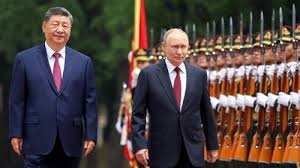

Following high-level discussions in Beijing, Russian President Vladimir Putin and Chinese President Xi Jinping announced a number of agreements pertaining to energy, trade, diplomacy, and technology, projecting unity, strategic coordination, and a joint challenge against Western dominance. The summit, which took place in Beijing’s Great Hall of the People a few days after Xi Jinping received US President Donald Trump, was closely watched for indications of how the cooperation between China and Russia is developing in the face of escalating geopolitical tensions.
The following are the meeting’s top five discoveries:
- A historic friendship treaty is extended between China and Russia
The expansion of the “China-Russia Treaty of Good-Neighborliness and Friendly Cooperation,” which was first signed 25 years ago, was the summit’s most symbolic result. The action strengthens the “highest level” strategic alliance between the two administrations. Vladimir Putin commended ties as being at a “unprecedentedly high level,” while Xi Jinping stated that the two nations must work together to combat “unilateral bullying” and promote a more “multipolar world order.”
- Energy Cooperation Approaches Growth
Both parties verified progress on increasing energy cooperation, particularly with regard to the much-discussed Power of Siberia 2 gas pipeline, even though no definitive agreement was made public. Moscow’s power to divert energy exports away from Europe would be strengthened by the proposed pipeline, which would carry up to 50 billion cubic meters of Russian natural gas to China each year via Mongolia. Xi Jinping stressed ongoing cooperation in coal, oil, and gas, while Vladimir Putin referred to Russia as a “reliable energy supplier” amid world uncertainty.
- Coordinated Resistance to Western Trade and Military Pressure
Beijing and Moscow denounced what seemed to be recent US military deployments and economic pressure campaigns in a sharply worded joint statement. The declaration denounced “military adventurism,” “regime change,” and meddling in international supply chains and shipping without specifically mentioning Washington.
- Russia and China Strengthen Scientific and Technological Relations
Numerous agreements pertaining to technology, scientific research, intellectual property, and industrial cooperation were reached at the summit. The agreements imply Beijing and Moscow are stepping up efforts to lessen reliance on Western financial and technological systems, while specifics are still scarce. Following years of Western sanctions, Russia is increasingly depending on China for advanced manufacturing, electronics, and industrial support.
- Xi Presents China as a Global Intermediary
Xi Jinping’s remarks regarding the intensifying Iranian issue were one of the most important diplomatic developments. Xi Jinping positioned China as a voice for de-escalation in the Middle East by calling additional hostilities “inadvisable” and stating that a comprehensive ceasefire was “of utmost urgency.”