
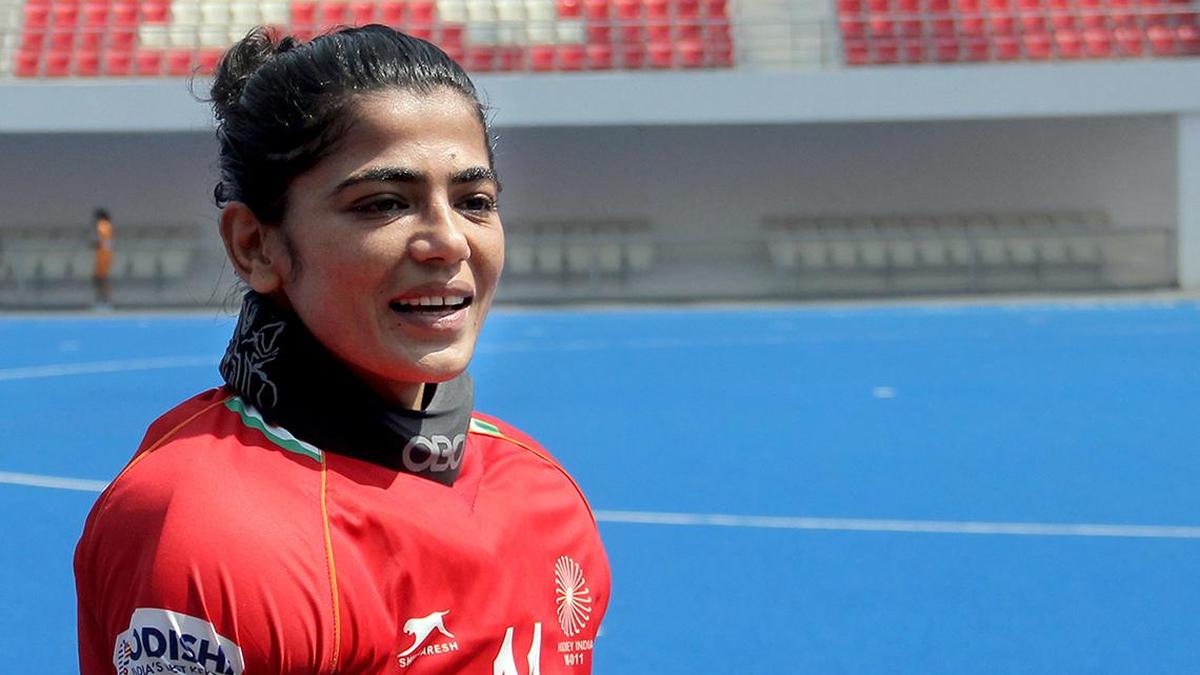

Savita Punia, the goalkeeper for the Indian women’s hockey team, views the Padma Shri as more than just a medal; it is the silent result of years of perseverance, selflessness, and unwavering faith—both her own and that of her family, who supported her through all of life’s ups and downs.
It is an honor that symbolizes a journey based on perseverance rather than praise, fortitude rather than acknowledgment, and unwavering trust even when benefits took longer to materialize.
The government finally called Savita’s father to confirm that his daughter had gotten the Padma Shri. The goalie explained that although her father’s phone was always on mute, it wasn’t on that particular day.
Certain emotions are difficult to convey in a single moment, which is why it was so emotional. I was at a loss for words. My father and I were both experiencing the same feelings while we were on the phone. It was my father who told me. My brother submitted the application, my husband completed it, and my father’s phone number was provided, therefore the call went to him,” Savita explains.
My dad’s phone is always on mute. Later, I made a joke about how he even answered the phone. She continues, “He told me he had not kept it quiet that day because he had total faith that the call would come.”
For her, it is a series of memories bound together by tenacity, pride, and purpose rather than a single moment captured in time. The Tokyo Olympics quarterfinal is at the top of the list if Savita had to pick just one. Savita didn’t give up a single goal as India upset Australia, the favorites.
However, even that historic accomplishment is only a small portion of a much longer path. She especially remembers 2015, when India made it to the Rio Olympics for the first time following a pivotal match against Japan.
Savita made her debut on the continental scene two years prior, in 2013, when India defeated China in a close shootout in the Asia Cup, making history as the first goalkeeper to earn Best Goalkeeper.
There were yet more significant events to come. Even against strong opponents like Spain, Savita won the Best Goalkeeper title once more as India advanced to the Pro League at the National Cup.
She also has a special place in her heart for the 2022 Commonwealth Games because she ended a 17-year medal drought, overcame the disappointment of losing in the semi-finals, and then defeated New Zealand in a shootout to return to the podium.
However, medals and game-winning saves are not the most significant accomplishments for Savita. It began when she made the decision to give hockey her all and received her maiden call-up to the Indian national team.
Her grandfather, Mahinder Singh, who had never attended school, vowed to learn to read after seeing her name in the newspaper so he could read about his grandchild.
“My granddad saw an article about me in the media when I first joined the Indian team. Although he was illiterate, he promised me that he would begin reading that day in order to read the paper himself a year later because his name was listed as my grandfather,” Savita adds.
I remembered that moment. It helped me realize that I had to do my best and that I never wanted to quit up. I remember my family’s support whenever I’m having a hard time,” Savita continues.
The Padma Shri took an additional eight years to arrive after receiving the Arjuna Award in 2018 following silver medals at the Asian Games in Jakarta and the Asian Champions Trophy.
Savita, meantime, won gold at the FIH Nations Cup, bronze at the Birmingham Commonwealth Games, the Hangzhou Asian Games, and the Muscat Asia Cup in 2022. Savita was also a member of the Indian squad that took home gold medals at the Asian Champions Trophy in 2023 and 2024.
But does an athlete lose motivation if they don’t receive recognition like the national awards? Savita doesn’t hesitate to accept it, even though she acknowledges that she too applied for the Khel Ratna but was unsuccessful. The final hockey player to get India’s highest athletic honor was Harmanpreet Singh, captain of the men’s squad.
Savita acknowledges that many athletes deal with the emotional struggle she went through.
“Not everyone is fortunate, and I was aware that athletes before me had experienced this. Because of this, Savita recalls, “I always avoided receiving awards and instead concentrated on my goalkeeping, my performances, and my game.”
Her family’s pride took precedence over public acknowledgment for a considerable amount of time. She claims that when she was invited to the India camp for the first time and put on the national jersey, they were their best moments rather than awards or ceremonies. She can vividly recall their celebration of those achievements.
However, when I watched the parents of other sportsmen accepting medals on social media, I imagined that moment for my own parents as well. I hope to be able to show them that someday,” Savita says.
The Arjuna Award made that ambition a reality. Her journey had led her parents to that point, so it was a moment of pride on both a personal and professional level.
“This is my first significant prize since I did not earn any major honors after my marriage. “My mother has asked me to bring my father-in-law and mother-in-law to this event,” Savita says, grinning broadly.
However, the disappointment was severe when her name was left off of the Khel Ratna recommendations. She claims that because parents always view their children as deserving, it had an even greater impact on her family.
She felt as though she had failed to provide them with another moment of pride. After marriage, when obligations increase and sacrifices become more difficult for both the athlete and those who support her, she briefly considered giving up the sport.
From a different perspective, I believe that we shouldn’t concentrate too much on these issues because eventually you will receive what is rightfully yours. When hard work is not recognized, it’s normal to feel disappointed, but Savita asserts that quitting up is never an option.
Nevertheless, 2026 is a significant year for Indian women’s hockey despite all the accolades and acclaim. Eight countries, including India, will compete for three berths in the FIH Hockey World Cup qualifiers, which will take place in Hyderabad on Sunday, March 8.
Later this year, India will compete in the Asian Games with the goal of winning gold, just like they did in 1982. Sjoerd Marijne, who was on the team when India advanced to the Olympic quarterfinals in Tokyo, is leading the charge.
Savita thinks the team’s recent adjustments have been crucial. She claims that Marijne and Wayne Lombard’s comeback has made them a significant source of strength for the team once more.
They then determined that fitness was our top priority, which is why we are putting so much effort into it. This year is very critical, but the next 1.5 years are significant, according to Savita.
She believes that the next nine months will be crucial, with the first six months being particularly significant due to the approaching World Cup Qualifiers, Asian Cup, and Asian Games.
“I think the coach’s arrival, his inspiration for the club, and the optimism that this team may succeed are what motivate you to give your best effort. I also mentioned to Marijne that I received both the Padma Shri and the Arjuna Award after his arrival in 2017, so perhaps he is fortunate for me,” Savita laughs.
In the field, Savita values the coaches’ high expectations for personal responsibility the most. Regardless of seniority or position, players are encouraged to learn from one another, and expectations are outlined according to each player’s duties.
“Hockey-wise, we are calmer than before, and the players are becoming more responsible. The game has evolved significantly over the past four years. Since Marijne is from the Netherlands, he watches elite hockey there and applies those techniques to our squad, according to Savita.
She continues, “The training sessions have been enjoyable, and the team’s apparent happiness has restored confidence that the side is moving in the right direction.”
“As a senior, I told the team, along with a few other players, that the difficult times in women’s hockey are over and that we need to accomplish something amazing going forward,” Savita adds.
She believes that the side’s combined effort and the Padma Shri are linked. Along with the new coaching staff and increased interest in women’s hockey, she feels the notoriety has given the squad an extra lift.
“I earned Padma Shri today, and someone else will tomorrow. Thus, it’s a good beginning. We will definitely try our hardest to improve women’s hockey in 2026,” adds Padma Shri Savita Punia.