
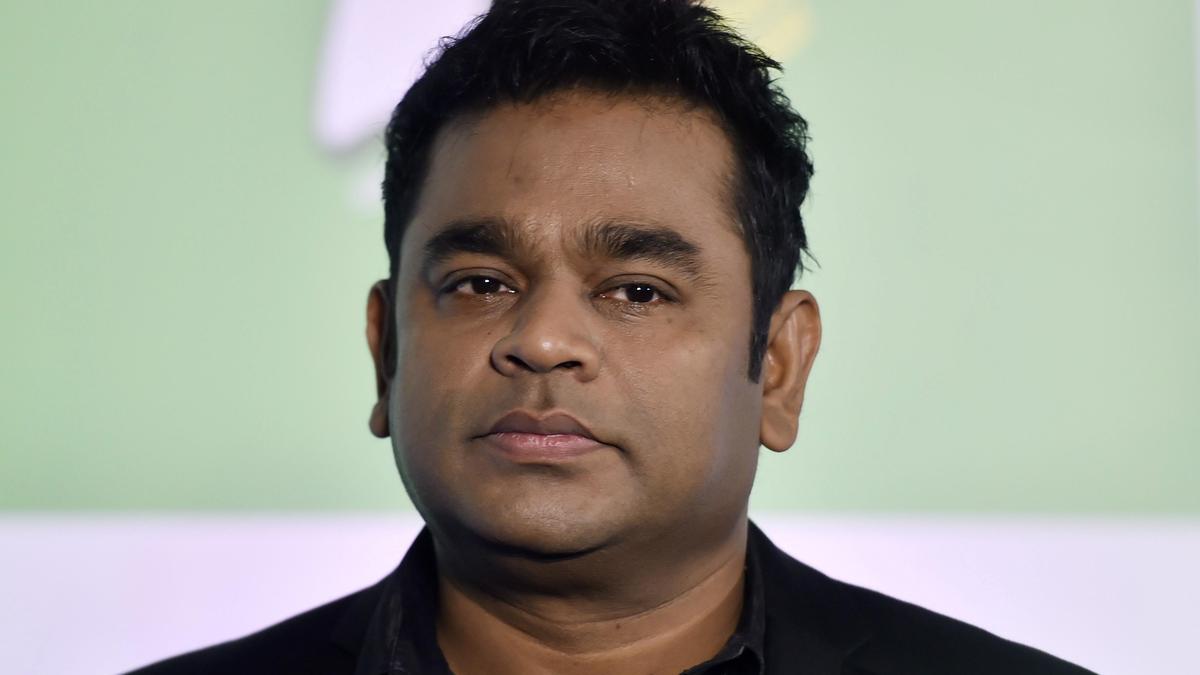

Oscar-winning composer A.R. Rahman claimed that his career prospects in the Hindi cinema industry had stalled in recent years due to changing power dynamics and perhaps what he called a “communal thing.” The BJP denied these claims on Friday. In response to Rahman’s statements, BJP leaders and ministers insisted that the film business still operates on the basis of skill and merit rather than religion and said that his accusations were untrue.
Union Minister Ramdas Athawale stated that he disagreed with Rahman’s accusations, pointing out that a number of well-known Muslim musicians are still well-liked and successful nationwide. “I think A.R. Rahman’s accusations are untrue. Many Muslim actors in the Hindi film business, such as Salman Khan, Shah Rukh Khan, and Aamir Khan, are adored by Maharashtra residents and people throughout India, Athawale told IANS.
According to BJP MLA Jitendra Kumar Gothwal, the film industry’s operations have recently become more open. “I believe that transparent work is being done within the current circumstances, even though this subject relates to the film business. In the past, employment was frequently obtained through referrals from specific leaders. Instead of using manipulation, work is now assigned based on talent,” he stated. He went on to say that these changes might make Rahman uneasy.
Syed Bhasha, the president of the BJP Minority Morcha, also rejected Rahman’s assertions, claiming they were untrue. It is untrue that A.R. Rahman claimed he has not been given opportunities by the BJP government. He remarked, “Since 1992, he has produced hits like Slumdog Millionaire and Madras Cafe and has won awards, including the 2025 National Award for Best Music, purely on merit.”
He went on to say that possibilities in the film industry are determined by public reaction and project success rather than the political party in power. “Rahman’s talent is undeniable, and recognition will follow as long as he continues to create great music,” he continued.
Opposition party leaders, however, voiced alarm over Rahman’s comments and urged careful consideration of the matter. Waris Pathan, the leader of AIMIM, stated he wouldn’t respond until he had a complete grasp of Rahman’s remarks. “I don’t know exactly what he said. I won’t be able to respond appropriately until I hear his exact words and comprehend the context and motivation behind them,” Pathan stated.
Husain Dalwai, a Congressman, described the situation as regrettable and extremely worrisome. “A.R. Rahman is a world-renowned musician and Oscar winner. It is terrible and wrong if he is having problems because he is a Muslim. Dalwai stated, “It is a loss for the nation and the film industry to marginalize someone of his caliber.”
Tariq Anwar, a Congress MP, also called on the administration to acknowledge the issue. “It is quite troubling if he is saying this. It is regrettable when artists face discrimination after gaining international prominence. People will only become more hateful if discrimination is increased, he claimed.
Similar thoughts were expressed by Congress MP Imran Masood, who described the problem as serious. “This should be taken seriously if an Oscar-winning artist says it. It is really concerning to be refused employment in one’s own nation due to one’s religious beliefs, he stated.
There are instances of prejudice, according to former Delhi Lieutenant Governor Najeeb Jung. Indeed, a large number of Muslims are unemployed due to their faith. This is undeniable, and it shouldn’t be concealed. We are attempting to address and rectify this issue because of this,” Jung stated.
According to Maulana Yasoob Abbas, General Secretary of the All India Shia Personal Law Board, there should be no discrimination based on a person’s religion in any area. “No one should experience prejudice based on their community, whether in the film industry or any other area. However, Rahman Sahab is the only one who can adequately explain the issues he is dealing with and their causes,” he stated.
Oscar-winning composer A.R. Rahman has influenced Indian film over the years with some of its most memorable musical compositions and is still a major player in the business. Rahman has talked openly about how shifting power dynamics in the Hindi film industry have affected the amount of work he gets in an interview with BBC Asian Network.
Looking back on his early career in Bollywood, Rahman revealed that even with the popularity of movies like “Roja,” “Bombay,” and “Dil Se,” he still felt alienated as a Tamil composer working in a mostly Hindi-speaking sector.
He didn’t experience a greater sense of acceptance till after Subhash Ghai’s “Taal.” Rahman claims that the record crossed geographical barriers and permeated North Indian daily life. He pointed out that the music’s blend of Punjabi, Hindi, and folk influences made it impossible for many people to even fathom that it was written by a Tamil-speaking musician.
Rahman also recalled a pivotal point in his career development when Subhash Ghai, a filmmaker, suggested that he learn Hindi. Since Urdu was the primary language of Hindi film music in the 1960s and 1970s, Rahman decided to learn it instead. His linguistic research did not end there. He finally adopted Punjabi after working with singer Sukhwinder Singh, and he later studied Arabic because of its phonetic resemblance to Urdu.
Rahman responded that he never felt specifically left out during the 1990s when asked if he had encountered prejudice in the Hindi film industry or discrimination against South Indian artists.
But he noted that things have changed during the past eight years. Opportunities might have been impacted by a change in power toward people who lack creative sensibility, he said, adding that communal considerations might also be involved, albeit indirectly.
Rahman clarified that he frequently learns indirectly about projects in which he was first considered but subsequently replaced because of internal choices made by record labels.
Rahman claimed he is still unfazed and pessimistic about the circumstances in spite of these developments. He emphasized that he likes to concentrate on his family and personal time rather than aggressively seeking employment. For him, important possibilities are eventually brought about by sincerity and a commitment to his craft. He feels that there is no need to pursue or compromise because whatever is destined for him will come to him organically.