

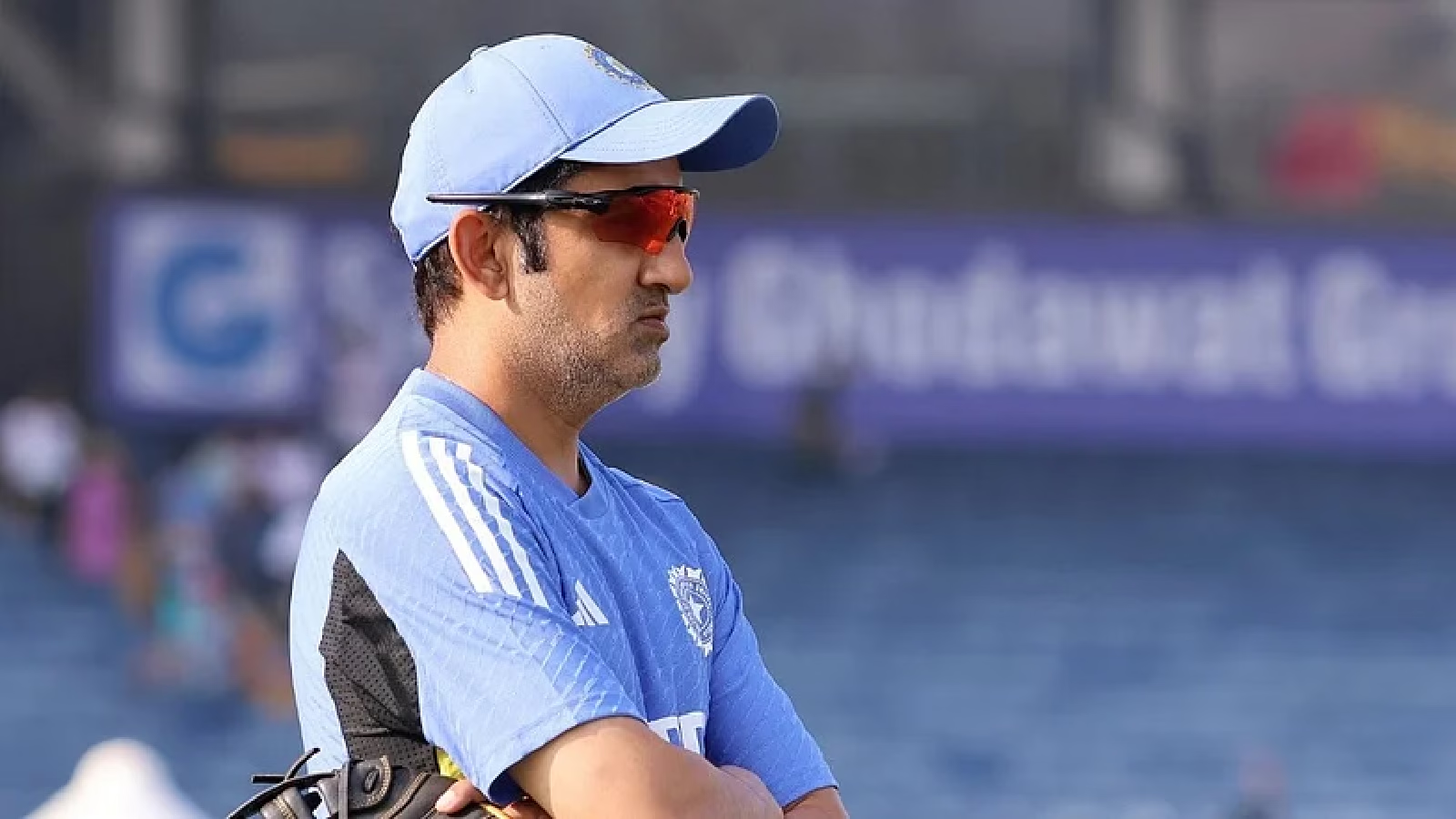

Following India’s 2-1 victory over Australia in the T20I series, head coach Gautam Gambhir stated that his team wasn’t fully prepared for the T20 World Cup the following year. Before the World Cup in early 2026, India still has ten Twenty20 Internationals to play—five against South Africa and five more against New Zealand.
“After three months, we’re still not where we want to be. Because the World Cup, not just the series, is the greater picture. Gambhir told BCCI.TV, “So hopefully, by the time the World Cup comes, I think we are in that space where we want to be before the World Cup.”
Gambhir highlighted his expectations for the team and emphasized the value of fitness. “From a fitness perspective, I believe we are still not where we want to be for the T20 World Cup, and we have discussed this with the boys as well. Our goal is to be really sharp.
“We wish to be healthy. We wish to proceed more quickly. We want to be physically and mentally stronger, thus the more fit we are, the more resilient we will be in stressful situations and games. I hope that guys understand the value of staying in shape. Thus, we still have three months to reach our goals,” he stated.
India continued to prioritize flexibility over consistency in their batting order during the series against Australia. “You see, it has been the philosophy since the beginning. Gambhir clarified, “Look, that has been the ideology from day one.”
“Obviously, there are two permanent openers. Rest, I believe that in T20 cricket, it doesn’t matter how many runs are scored. What counts is the impact. Additionally, people can make mistakes in their calculations or fail to distinguish between the impact, runs, and batting order. You see, impact and runs are different. Impact is everything in Twenty20 cricket. There are 120 balls. Every ball is an occasion. Every ball must have the greatest possible impact.
And for that reason, I believe the batting order has been somewhat flexible since day one. And we want to play this game that way. He continued, “We don’t want to play a game thinking about averages, strike rates, and all that stuff.”
Gambhir also discussed the idea behind Jasprit Bumrah bowling three overs during the PowerPlay and how it gives his team an advantage.
I believe that this T20 team’s aggressive batting lineup resonates with a lot of fans. In my opinion, it was even more aggressive to bowl Jasprit [Bumrah] for three overs in the opening six. We want to be known as an aggressive team overall, not just as a team with an aggressive batting order.
“I felt that the Asia Cup has been incredibly effective for us since we win the powerplay most of the time when we bowl simply Bumrah in the first three. Then, of course, Varun and Kuldeep gave us two possibilities for getting wickets in the middle. As a result, they have a lot of leverage to bowl freely during the middle period. We can also consistently take wickets. And that was among the causes. Therefore, I thought it was a pretty aggressive play with both the bat and the ball. We also want to play the game that way,” he stated.
Under Gambhir, Shivam Dube has had a bit of a comeback as a bowler and has been given several duties. He was trusted with the new ball in the Asia Cup final against Pakistan, and he performed admirably, giving up just 12 runs in the two overs he bowled during the PowerPlay. Dube took crucial wickets in the middle overs during the most recent tour of Australia.
It’s as easy as throwing guys into the deep sea. We also did the same with Shubman [Gill]. We had thrown him into the deep sea when he was named Test captain for an England series. He emerged as a legitimate professional swimmer. This also applied to Shivam [Dube]. You have to put them under tremendous pressure to see how these guys respond and what Shivam accomplished.
We would never have learned about his character or how much he has improved under pressure if he hadn’t been cast into that deep sea. Imagine bowling the first and third overs for twelve runs in the Asia Cup final versus Pakistan. After just two overs, just think of how much confidence he must have gained. With the ball in hand, he may not have ever succeeded in the past. People can therefore flourish when you push them in those circumstances.
I simply believed that Shivam has a lot to offer the squad from his perspective. Sometimes you just look at a player and say, “He can hit, he can be useful against a certain bowler, he can break open the game with the bat.” Gambhir stated, “I think it’s just about giving him confidence as well. He’s six feet tall, can bowl at a decent pace, has bounce, and has different variations.”
The freedom with which Abhishek Sharma bats has been credited with his crucial contributions at the top of the order. The entire team has been given the same license to play as Abshishek, according to Gambhir.
“It’s not only Abhishek. I believe that everyone has been granted freedom. I believe it will be unjust to me as head coach if I only discuss providing Abhishek leeway since his style works well for that type of play. However, I believe that everyone has the right to freedom. High danger, high return, too. In the end, you will never achieve great benefits if you don’t take chances. The fifteen individuals in the dressing room are free to express themselves and don’t worry about making a mistake.
“Because I’ve always been a firm believer that the more you worry about making a mistake, the more mistakes you will make. Dropping a catch is acceptable. It’s acceptable to bowl a poor ball. Playing a poor shot is acceptable. Errors are inevitable for humans. We will also allow them to fail. We will also allow them to make mistakes. Gambhir said, “Because the more we tell them not to make mistakes, the more mistakes they will make.”
Speaking with players who weren’t included in the starting lineup was, according to Gambhir, his hardest task as a coach. Due to the team’s horses-for-courses strategy and abundance of options, players like Kuldeep Yadav and Arshdeep Singh have been forced to sit out.
“It’s the hardest job I have. I am aware that there are a lot of talented players on the bench and that everyone should be in the starting lineup, but in the end, you can only choose the XI based on whatever combination will perform the best on that specific day.
However, I believe that communication and dialogue are the most crucial aspects. The conversation must be extremely honest and transparent. These are certainly difficult topics to have at times.
“Telling a player that he won’t be playing is probably the hardest thing a coach and a player can do because I know the guy would be angry if he should be in the starting lineup. However, I believe that some players do comprehend if you are upfront, honest, and realize that what you’re saying comes straight from your heart. Additionally, it’s a dialogue between a coach and a player,” Gambhir stated.