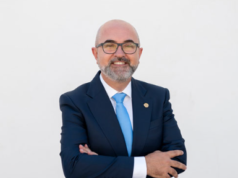

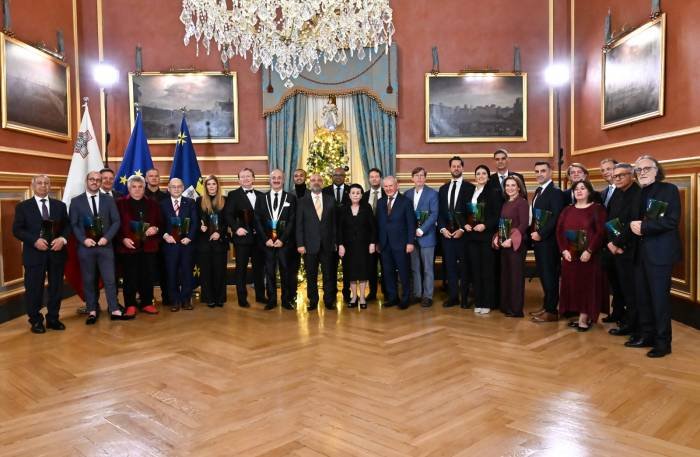


Jamaica’s Minister of Tourism, Edmund Bartlett, has received a lifetime achievement award from the Mediterranean Tourism Foundation in recognition of his global contribution to tourism resilience and thought leadership.
The honour was presented personally by Malta’s President, H.E. Myriam Spiteri Debono, at the Presidential Palace in Valletta, with Mediterranean Tourism Foundation president Anthony “Tony” Zahra present.
The recognition accompanied a call from Bartlett for closer cooperation between Caribbean and Mediterranean destinations, supported by a proposed resilience alliance, a new centre in Malta and a dedicated fund to help tourism communities prepare for and recover from crises.
In his address, “One Sun, Two Seas, One Responsibility”, prepared for the Mediterranean Tourism Forum on 27 November 2026, Bartlett outlined CARI-MED — the Twin Seas Resilience Alliance. The initiative would connect the two regions through shared research, training, early-warning systems and crisis financing.
The proposal reflects the three pillars of the forum’s Mediterranean SUN theme: stewardship, unity and net positive tourism. The 11th edition brings together tourism leaders and practitioners at Hilton Malta to examine how the industry can deliver lasting benefits for destinations and their communities. [Official forum programme].
“The Caribbean and the Mediterranean are not competitors. We are twins,” Bartlett said in the address.
“Two seas. Born of the same sun. Living from the same hospitality. Suffering the same storms. Surviving by the same courage.”
His central argument was that resilience must underpin tourism planning, connecting environmental protection and community wellbeing with the ability to withstand disruption.
“Without resilience, stewardship is a wish. Unity is a hope. Net Positive is a dream the next storm will wash away.”
Bartlett proposed establishing a Mediterranean centre of the Global Tourism Resilience and Crisis Management Centre in Malta, twinned with its Caribbean counterpart in Jamaica.
The proposed centre would coordinate an early-warning dashboard covering Mediterranean risks, provide training for ministers, mayors and tourism managers, and support the development of 100 young leaders each year. It would also serve as a permanent base for cooperation between destinations, businesses and public authorities.
Bartlett identified Malta’s central Mediterranean location, experience as an island destination and role in bringing tourism stakeholders together as reasons for locating the centre there.
Alongside the centre, he proposed a Malta-based Mediterranean Tourism Resilience Fund, with resources divided between preparation, emergency response and recovery.
Under the suggested model, 40 per cent would support preparedness before crises occur, 30 per cent would finance emergency response, and 30 per cent would help destinations rebuild with stronger infrastructure and environmental safeguards. The response element would aim to make emergency grants available within 72 hours.
Potential financing options included a €1 contribution per visitor night, airline ticket or cruise passenger. Using an illustrative calculation of 300 million €1 contributions, the address suggested that such a mechanism could generate €300 million annually. The levy and funding arrangements were presented as proposals for consideration.
The wider CARI-MED framework would connect the regions through twinned centres, cooperation between resilience funds, a common Tourism Resilience Index and a coordinated international voice at climate conferences and UN Tourism.
Bartlett argued that shared standards could help destinations and tourism businesses assess preparedness more consistently, while cooperation would allow lessons from Caribbean hurricanes and Mediterranean heatwaves to inform responses across both regions.
Environmental protection and cultural identity were central to his vision of stewardship. He urged tourism leaders to consider the long-term consequences of decisions affecting coastlines, communities and infrastructure, rather than measuring success solely through short-term returns.
“Culture is not decoration. Culture is resilience. A community that knows who it is — its food, its music, its story — will survive any crisis.”
His call for unity extended across countries, industries and generations. Tourism planning, he argued, should connect aviation, maritime transport, agriculture, culture, technology and education, while giving young people a meaningful role in decision-making.
On net positive tourism, Bartlett called for destinations to measure their contribution through improvements to communities and natural environments alongside visitor arrivals. Examples in the address included reef restoration, training local young people, purchasing from farmers and supporting community facilities through renewable energy.
“Net Positive means that when a visitor leaves, the destination is better than before they came. Not the same. Better.”
Closing the address, Bartlett made clear that his proposed declaration was an invitation to develop the ideas together, rather than an agreement already reached.
“It is not a treaty, and I am not asking anyone to sign it today. It is a proposal — an idea for us to consider together, a promise between the Twin Seas.”