

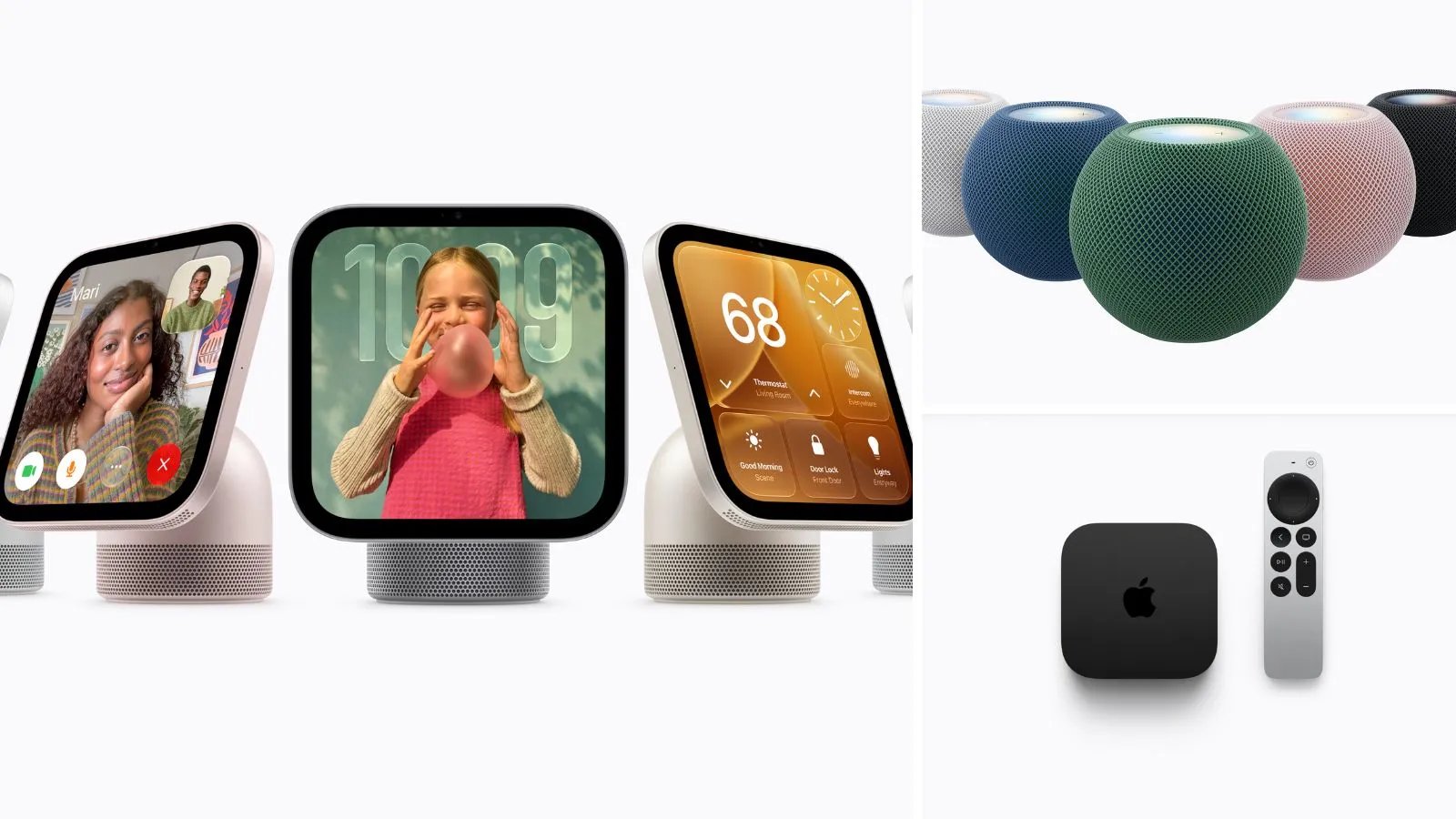

After much anticipation, Apple has unveiled its latest lineup of devices for the home. On Tuesday, October 13, the iPhone maker introduced HomeView, a seven-inch smart display powered by Siri AI. Designed to serve as a shared household screen, it becomes personalised the moment someone steps in front of it. Apple also announced the HomePod Mini 2, Apple TV 4K, and a range of smart home accessories called the Apple Home Collection.
Apple said the new products are built around three core principles: they must be intelligent, personal, and private.
HomeView is Apple’s latest home-focused device that has been built for entertainment, staying in touch with loved ones, and managing the smart home. It features a seven-inch Liquid Retina Display meant to be glanced at from anywhere in a room. It comes in silver, starlight, rose pink, and space grey colours. Further, users can customise the display with favourite photos, weather updates, and animations of their choice. The key feature here is how HomeView adapts to whoever is using it. The device recognises people by face and switches from a shared household view to a personalised one, showing calendars, messages, and reminders. Apple said that the data is not stored on HomeView; rather, it is pulled from the user’s iPhone and vanishes from the screen the moment the person walks away, ensuring that the next user sees their own information.
 Apple HomeView
Siri AI is central to HomeView. It sits at the core of HomeView and draws on personal context from the user’s iPhone. A demo video showed a family using it to find a recipe a parent had texted, check the calendar, and manage a chaotic morning. The examples of everyday use included asking when to leave for a meeting or whether there is a Starbucks at the user’s airport terminal, with the device already aware of the flight details on the user’s phone. Apart from an array of intelligent features, the HomeView also plays music, podcasts and TV. It supports FaceTime calls, shows recipes while users cook, and controls smart home accessories. Apple has also introduced a wall-mounted version with the same display and features, along with an audio experience that is tuned for wall placement.
 Apple HomeView wall-mounted version.
Apple said that FaceTime is a standout feature on HomeView. The device uses Centre Stage, which pairs an ultra-wide camera with on-device algorithms to track where a person’s torso is. This means if a user is cooking in the kitchen and moving around, the camera pans to keep them in frame. When more people join the call, it widens the shot to fit them. Apple said it put considerable thought into the FaceTime experience so it would work well on a device that stays in one place.
Apple emphasised that privacy is at the core of all its products, and HomeView was designed with privacy in mind. For HomeView specifically, the camera and microphone feeds are secured and processed within exclaves, which are compartmentalised, protected runtimes separate from the operating system. They can’t be accessed by anyone, including Apple. Consequently, to access personal content, a user needs to have been recognised by HomeView, have their iPhone on the same Wi-Fi network, and have recently unlocked it. In case HomeView determines that it cannot recognise a user for any reason, the user will get a confirmation on their phone.
Story continues below this ad
 Apple HomeView comes in silver, starlight, rose pink, and space grey colours.
HomeView is compatible with iPhones running on the latest iOS. Both the tabletop and wall-mounted models will be priced at Rs 39,900. Pre-orders will begin on October 13 with availability from November 1 in eight countries: Australia, Canada, India, New Zealand, the UK, and the US. The device will ship with English as the primary language for now, but more languages will be added soon.
HomePod Mini 2 with Siri AI
Apple has introduced the new HomePod Mini 2 in blue, green, and pink alongside the existing white and midnight options. A notable addition to the new generation of HomePod Mini is a feature called Sound Glow that makes the light on the top of the speaker glow in colours similar to those of the album art of the song being played. The colours are soft and not meant to pop out, and users also have the option to disable it. Besides, the HomePod Mini 2 can also be connected to a Mac and serve as its audio output for everything from video calls to games. During the demo, Apple showed a HomePod Mini colour-matched to an iMac.
 The refreshed HomePod Mini 2 sports new colours and is backed by Siri AI.
Now, with Siri AI, the speaker can handle broader knowledge questions, offer greater music discovery, and use a paired iPhone for personal context, such as updating events to a shared family calendar for everyone to stay in sync. The new HomePod Mini 2 is priced at Rs 18,900, with pre-orders beginning on October 13 and sales starting on October 30 across regions where HomePod is currently sold. Meanwhile, Siri AI will come to the speaker in a future software update in the same eight countries in English.
Apple TV 4K with Siri AI
After nearly four years, Apple has finally introduced its latest generation of the Apple TV 4K. The new Apple TV 4K brings Siri AI to the living room. Now, users can ask for recommendations of shows and movies. Besides, the device also features far-field microphones that allow hands-free voice control. With personal context from the iPhone, users can simply play a song their friend texted them or ask for a show a friend recommended, and it starts playing. Another interesting feature is that users can now ask Siri where the remote is, and Siri Remote will play a sound. It also supports Find My with Precision Finding. Apple said that users can connect up to four compatible HomePod speakers to the new Apple TV 4K to experience surround sound that automatically calibrates to the room. According to Apple, this is one of the easiest ways to set up a home theatre.
Story continues below this ad
 Apple TV 4K.
Apple TV 4K’s far-field microphones allow users to sit comfortably and talk directly to Siri without the need to get up and fetch the remote. Users can ask queries about the shows, movies, and sports playing on the screen, and Siri AI responds with a non-obstructive text bubble in real time. Exclusive to this device, the Apple TV 4K comes with the ability to have a home theatre surround sound experience. During the demo, Apple TV 4K was paired with four HomePod speakers – two in front and two at the back – and the device delivered high-quality sound. The device automatically calibrated the audio levels to perfectly tune according to the ambience.
The new Apple TV 4K is priced at Rs 39,900, with pre-orders starting from October 13 and availability from November 13 in regions where Apple TV is sold. Siri AI will arrive on Apple TV in beta in the same countries – Australia, Canada, India, New Zealand, the UK, and the US, in English to start.
Apple Home Collection
Apple has also introduced the Apple Home Collection, a range of accessories built by LG Electronics and Schneider Electric and designed in collaboration with Apple. The lineup includes an indoor camera, an outdoor camera, video doorbell, door lock, thermostat and sensors. The indoor camera tilts down automatically when the user arrives home, for added privacy, while the outdoor camera offers an optional floodlight that brightens gradually when motion is detected. While the video doorbell recognises who is at the door, the door lock unlocks automatically as the user approaches by sensing an iPhone or Apple Watch. Meanwhile, the thermostats and sensors adjust through the day to balance comfort and energy savings.
Story continues below this ad
The cameras are HomeKit video cameras that spot familiar faces, packages and pets, with video history stored in iCloud. Setup for these devices happens through the iPhone, with no extra apps or new accounts, and all communication is end-to-end encrypted.
The cameras will be available in the US, Canada and the UK. The thermostats and door lock, designed to North American standards, will launch in the US and Canada. Availability begins in December. Apple said this collection will not launch in the regions where Home View is available, so it is likely irrelevant to buyers there.
The author is in New York at the invitation of Apple.