

India exports much of its mica to China, but an expert says the country risks losing value from a strategic mineral used across electrical, energy and defence applications
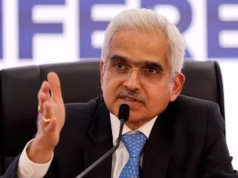
India is exporting a large share of its mica to China while a bigger part of the value-added industry has developed outside the country, according to Raoul Prem Menon, a scientific mica expert associated with the Bureau of Indian Standards’ ETD 02 committee.
Menon recently published an advertisement in The Times of India appealing to Prime Minister Narendra Modi to “save Indian mica” and draw greater attention to the mineral’s strategic importance.
Menon has also urged the government to examine whether mica should be included in India’s critical-mineral framework. He has called for measures such as an export duty or minimum export price to discourage the low-value export of the mineral and use the proceeds to build a domestic mica industry.
“I would call that electric gold,” Menon told Firstpost’s Dheeraj Kumar in an exclusive interview, referring to mica’s importance in electrical and energy-related industries.
Menon said he has been working on the issue for about seven years with the electrical industry and the Ministry of Mines. The campaign gained urgency, he said, after China introduced export controls on rare earth metals and magnets, highlighting the importance of controlling strategic materials used in the energy transition.
 More from Business
“India is looking for such a mineral,” Menon said. “Mica is one of India’s strongest minerals, and you can’t talk about rare earth metals working inside an electric vehicle or any wind turbine without Indian mica protecting it.”
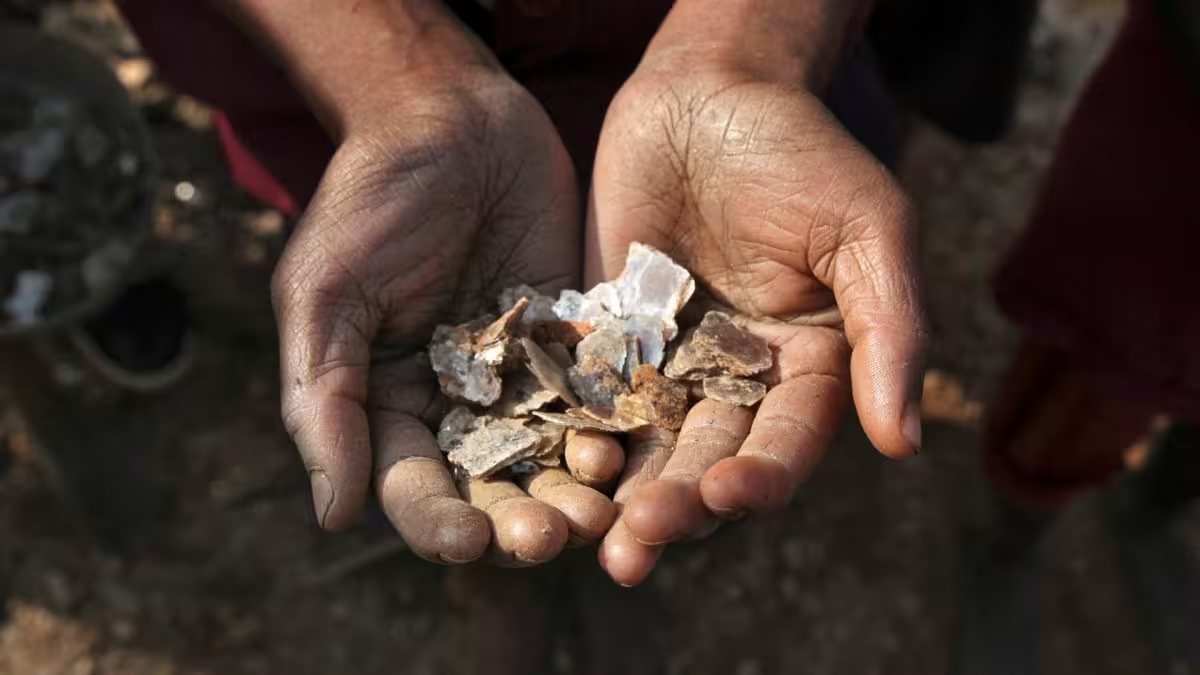
Mica is a silicate-based mineral found in states including Andhra Pradesh, Rajasthan, Jharkhand and Bihar. It is valued for its electrical insulation, heat resistance and durability and is used in electrical equipment, thermal protection systems and industrial applications.
Menon argues that India has not captured enough value from the resource.
“We have this very valuable resource, but we are exporting it at the price which is less than a packet of chips,” he said.
China is the biggest destination
India’s trade data shows that China accounts for a substantial share of Indian mica exports.
India exported $17.9 million worth of crude mica and mica rifted into sheets or split in 2024, with China accounting for $12 million, or about 67 per cent.
India also exported $42 million worth of mica powder during the year, of which $30.9 million went to China, or nearly 74 per cent.
The figures relate to specific customs categories and do not establish how much of the material exported was electrical-grade mica.
Menon said the broader flow of mica to China has remained heavily concentrated. He estimated that between 65 per cent and 70 per cent of India’s total mica exports go to China, based on the data available to him.
“For this year’s data, I do not have,” Menon said. “But what we do have is for the previous year, for 24-25, and we are still seeing that the rough value was about between 87 million US dollars.”
He estimated the volume of material leaving India at more than 100 million kg based on the prices he cited.
Menon also alleged that China is buying mica not only for immediate consumption but also to build stocks.
“I would say maybe 10 per cent of that is the annual consumption of the world’s mica requirements, in terms of their finished products, and the other 80, 90 per cent they are stockpiling,” he said.
Firstpost could not independently verify Menon’s claim about the scale of mica stockpiling in China.
He said China has built a much larger global industry around finished mica products, while India remains focused largely on extraction and exports.
“China is actually procuring most of the raw material from India,” he said. “They have built a 40 to 50 billion industry worldwide in terms of the mica finished products using an Indian resource.”
The figure refers to Menon’s estimate of the global mica finished-products industry and is not a measure of China’s mica exports alone.
Government changed mica’s status
The government has already taken a step that changes how mica is regulated.
In February 2025, the Ministry of Mines shifted mica, along with barytes, felspar and quartz, from the category of minor minerals to major minerals.
The decision followed the Union Cabinet’s approval of the National Critical Mineral Mission in January 2025. The Ministry of Mines said the reclassification was intended to encourage greater exploration and scientific mining.
There is an important distinction, however. Mica itself was not added to India’s list of 30 critical minerals.
The Ministry of Mines said quartz, felspar and mica occur in pegmatite rocks, which are an important source of several critical minerals, including lithium, beryllium, niobium, tantalum, molybdenum, tin, titanium and tungsten.
The ministry said that when these minerals were mined under minor-mineral leases, operators primarily focused on their use in construction, glass and ceramics. Associated critical minerals were therefore not necessarily identified, extracted or reported.
The government said the shift to major-mineral status would encourage more systematic exploration and scientific mining of these deposits.
Menon believes mica deserves a separate examination because of its role in electrical and energy systems.
“The whole point is, we’re trying to create awareness that we are sitting on what I call electric gold,” he said.
He said that India has some of the world’s best electrical-grade mica resources and said a large share is located in Jharkhand, where mining has been affected by restrictions linked to forest and environmental regulations.
His campaign, he said, is not aimed at shutting down the existing mining economy.
“I don’t want to, let’s say, stop or arrest the people in Jharkhand and Bihar who do earn their living wage off of this,” Menon said. “What I’m trying to do is support the miners in that industry in order to improve their daily wage conditions, their living conditions, and legalize the mining in those areas.”
Why Menon wants an export duty
Menon’s proposed solution begins with changing the economics of mica exports.
He wants the government to impose a minimum export price or export duty on mica and use part of the additional revenue to develop domestic processing.
“The smartest thing would be to increase the price of the export mica,” he said. “That would be put a minimum export price, and whatever the difference in between the actual cost and the export tax, that should be split between the government and developing the mica industry within India.”
The idea, according to Menon, is not simply to stop exports. Instead, a higher export price would encourage greater value addition in India while generating revenue that could be used to build the domestic industry.
He also wants mica producers and processors to gain access to government support available under the broader critical-mineral push.
“The first thing to do would be, okay, put an export duty. Realize what you have,” Menon said.
His argument is that India should develop domestic processing and manufacturing rather than exporting material that can later return as a higher-value finished product.
“If we are able to utilize this to our strength, India positions itself not only in the renewable supply chain,” he said. “This material goes into defence equipment.”
Menon said mica is used in systems that require electrical insulation and thermal protection, including equipment associated with renewable energy and defence.
He also pointed to everyday applications, including hair dryers, microwave ovens and televisions, as well as fire-resistant electrical cables used in buildings.
A defence and energy argument
Menon’s case goes beyond renewable energy. He said mica should be viewed as part of India’s broader strategic supply chain because of its use in electrical and thermal protection systems.
“This is not only renewables. It’s a defence question as well,” he said.
Menon argued that India could use its mica resources as part of negotiations with countries that control other strategic materials.
“India has mica, you need it, give us access to rare earth, sort of a barter system,” he said.
He sees the approach as a way of giving India greater leverage in discussions over critical minerals and other strategic resources.
China has established a dominant position in rare earth processing and has used that position to influence global supply chains. Menon believes India could develop a similar strategic advantage in mica if it builds a domestic value chain around the mineral.
“Mica is basically the stealth shield of every fighter jet or these heat-seeking missiles,” he said, referring to its role in electrical and thermal protection systems. “All that is dependent on electrical-grade Indian mica.”
Such applications vary by equipment and material specification, and Menon’s comments describe his assessment of the strategic importance of electrical-grade mica.
Illegal mining and the value gap
Menon also raised concerns about illegal mica mining in Jharkhand and Bihar.
He said discussions with the Ministry of Mines and customs data had highlighted a mismatch between the volume of mica leaving the country and the number of government-licensed mines that could legally account for that production.
He said the issue was discussed with officials on 3 September after he presented customs export data.
“They were able to see that, okay, we are losing a lot of tonnage of this material for a very small value, and how can that much mica be extracted from very few government-licensed mines?” Menon said.
His conclusion was that illegal mining may be contributing to the supply chain.
But he stressed that enforcement should not simply remove the livelihoods of people working in the sector.
“The whole idea is obviously there’s some illegal mining,” he said. “It’s not that we want to stop or arrest the people in Jharkhand and Bihar who do earn their living wage off of this.”
Instead, he wants those miners brought into a legal framework with better working conditions and wages.
The issue also raises a broader question about value addition. China exported $190.1 million worth of agglomerated or reconstituted mica plates, sheets and strips globally in 2024, while India imported about $10.7 million worth of such products from China.
No formal response yet
Menon’s appeal to Modi has not yet received a formal response, he said.
He said the campaign has, however, attracted interest from officials and that he expects to meet the power secretary in the coming weeks.
“At the moment, we’ve had no response yet,” Menon said. “We did have a couple of people from the power secretary’s office see my ad, and he was very intrigued, and he’s willing to have a conversation with me.”
Menon said the next stage would involve bringing more government agencies into the discussion, including the Directorate General of Foreign Trade and the Ministry of Commerce.
He said he is preparing a more detailed presentation covering possible tax measures, mining standards, legalisation of new mines and the development of a value-added mica economy.
“The whole point of the ad was it’s time to take this conversation seriously,” he said.
“We are sitting on what I call electric gold,” he said. “If we start the conversation now, maybe we might get somewhere to what China is doing with rare earths.”