

For an industry with such far-reaching influence, Telugu cinema has a relatively notorious track record when it comes to representing modern-day urban women in all their complexity. It is tempting to generalise that most films fail to get it right.
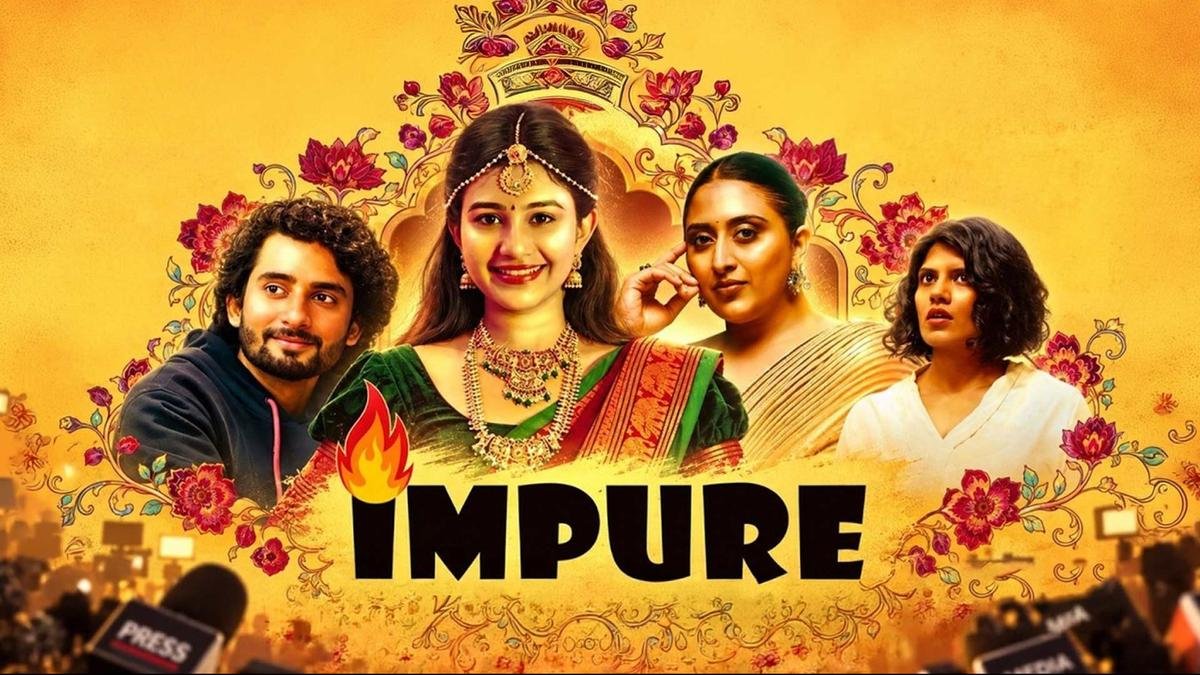
Impure, a Tenglish (a mix of English and Telugu) film marking Nishanti Evani’s feature debut, liberates its women from linearity and allows them to breathe. They are messy, frustrated, confused, lonely and lost all at once; they have desires and are finding their way through love and career.
The premise of two bickering cousins, Veera (Varahi Mallipamula) and Sandhya (Yashna Muthaluri), and their mutual male friend, Pranav (Sai Krishna), rediscovering themselves without falling prey to societal expectations is almost Jane Austen-esque. The film has the rebellious spirit of an Emma.

Veera, a US returnee, knows a thing or two about social media optics, but struggles to regain her mojo in life after a practically non-existent marriage. After the revelation of an encounter with an ex, her cousin Sandhya’s marriage is called off.
Impure (English and Telugu)
Director: Nishanti Evani
Cast: Yashna Muthuluri, Varahi Mallipamula
Runtime: 102 minutes
Storyline: Three confused protagonists rediscover themselves after multiple setbacks
Pranav is a popular child actor struggling to transition into adult roles, and his heart is hardly in it. The trio is all over the place, but all they have is each other. The film boils down to their self-actualisation and coming to terms with what they want from life.
The tale is set within an orthodox family in Visakhapatnam and has a privileged, anglophone gaze. The outsider view helps, given that the film is very much a social satire, exploring the contradictions of its world with a touch of wit, banter and exaggeration.
There is too much anxious energy and drama to absorb initially. Sandhya’s marriage falls apart. She and Veera spar over the social media ruckus surrounding it. After Sandhya resists the sexual advances of a slimy boss, she is jobless.

Veera tries to learn Kuchipudi from a traditional guru while making reels out of her classes. Sandhya’s mother performs a homam at home, makes the girl sit on a stone suggested by a godman, followed by regular temple visits.
The director throws too many things at the audience in one go, but as the story unravels, we understand that the chaos, both internal and external, was intentional. Just like the leads themselves, the film eventually figures its way out.
The family dynamics lend the film an unexpected texture. While the portrayal of Sandhya’s parents, desperate to get their daughter married, appears one-dimensional initially, we gradually realise their quirks, apprehensions and innate concerns.
As Sandhya asks her mother if she considers her impure, her mother’s prompt dismissal brings her true persona to the fore. Later, three generations of women in a family are besotted with a shirtless man in a temple, who happens to be Sandhya’s acquaintance.
There is a wonderful sequence with the masala of a mass film in the second half, when Bala, with whom Sandhya gets engaged, drags her to her home, questioning the upbringing of her parents. And the dad gives it back to him in style.
The mother-daughter exchange, externalised by the outpouring around them, is even better. All along, their quest was to raise a daughter who could stand up for herself, and they liberate her from their expectations once she does that.
Veera’s trajectory is equally interesting, for she is after a sense of belonging, wanting to be ‘somebody’s something’, and goes utterly haywire with her pursuit. Her dancing interests and the references to Shakti, representing the various dimensions of femininity, sum up the film’s essence succinctly.

The men in the film are not as layered as their female counterparts. Pranav’s tryst with cinema feels slightly underwritten. Sandhya’s multiple matches, like Tharun and Bala, portray men in a similar vein.
Nish (Abhijit Sreenath), the accepting, gentle yet non-committal entrepreneur and Sandhya’s romantic interest, though, compensates for that. The entire thread around the startup could have been more substantial, especially for their professional victory to feel sweeter.
The ending is apt, for love or a particular career choice does not define the journey of the protagonists. The last few lines of the film, loosely translating to ‘happiness is not a destination but a choice’, feel like a sophisticated WhatsApp forward, though.
A clear limitation of the film is its talky flavour, where character traits are revealed largely through dialogue rather than visuals. The English dialogues are crunchier, sharper and flow relatively better than the Telugu ones. The bilingual conversations are not always seamless.
Films work when a team is aware of what to say and how to put that across. Impure is quite clear about its intentions and its distinct storytelling style, even though the craft is shaky at times.
Yashna Muthuluri’s vibrant, spunky performance gives Sandhya wings to fly, embodying the rage within her while she’s humbled by the hypocrisy around her. Varahi Mallipamula (also the film’s writer) is refreshing as Veera, bringing believability to the emptiness within through otherworldly endeavours.
Abhijit Sreenath and Sai Krishna are handed distinct roles, and both actors get to showcase a more vulnerable side of the men beneath their tough exteriors. Kireeti, cast in a familiar role as a rejected match, leaves a mark in a brief appearance.
The minimalistic indie-ness of the cinematography gives the film and its intimate setting an unconventional visual character. That it comes from an established lensman like Gnanashekar V S makes it all the more striking.
The editing of the post-intermission sequence, which seamlessly juxtaposes Veera’s evolution as a dancer with Sandhya’s self-discovery, adds to the film’s allure, backed by the contributions of musicians Karan Pandav, Raja Kumari and Nirvan Athreya.
Impure is a sharp social satire disguised as a coming-of-age tale, with lively, flawed characters, snappy dialogue and a touch of humour. Nishanti Evani’s zany filmmaking energy and Varahi Mallipamula’s precise writing give the film a personality of its own.