
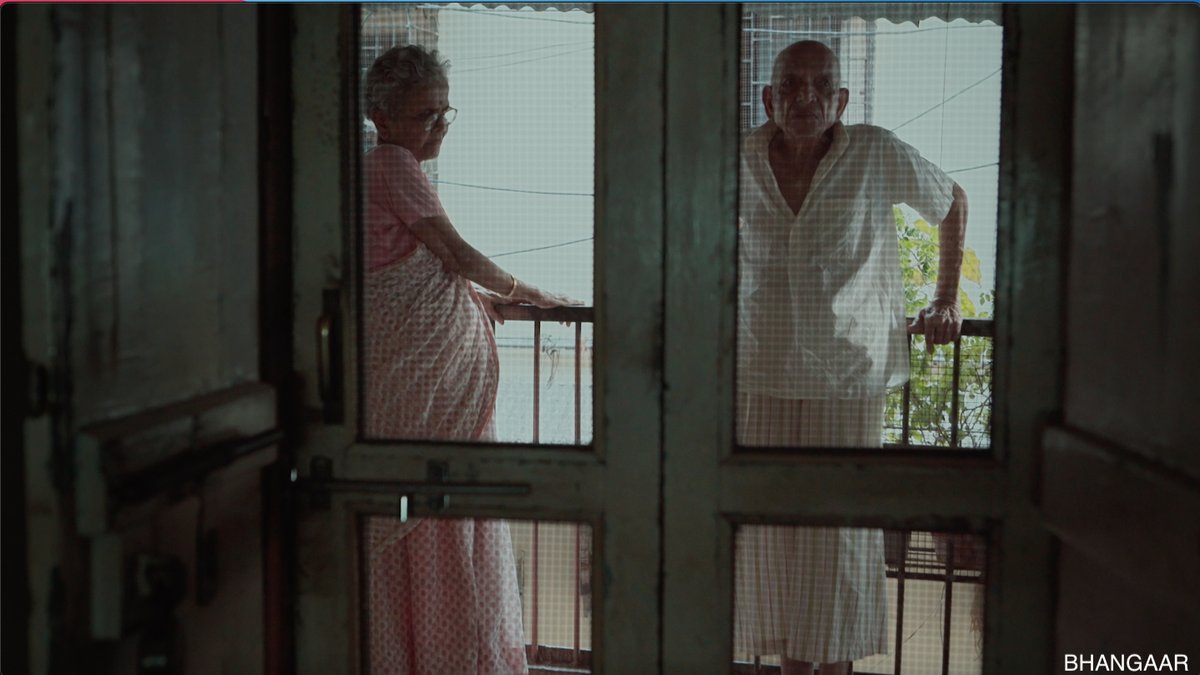

A decade ago, actor Deepika Padukone said in an ad campaign: ‘My body, My choice.’ But, in reality, when it comes to older people, society often wrests that agency from them. Last week, as the world observed both International Day of Older Persons (October 1) and Gandhi Jayanti (October 2), Mumbai-based Sumira Roy’s documentary film Bhangaar (Obsolete), raised the question of dignity in death and the right to die for the elderly.
The yet-to-release Marathi film, which won the National Film Award for Best Non-Feature Film last month, was screened by the Kriti Film Club in Delhi NCR.
Bhangaar trains the lens on Narayan and Iravati Lavate, an octogenarian Maharashtrian childless couple, who petitioned for active euthanasia in 2018. Iravati succumbed to cancer in 2023, Narayan lives in an old-age home. His eyesight and memory, too, have deserted him. After the news of the National Award came in, Roy wanted to share the moment with Narayan. She rang up Prakash Joshi, the brother of Iravati, who also appears in the film. Joshi told her that due to Narayan’s present old-age health and impediments there of, nothing would register with man.
While Nilesh Maniyar and Shonali Bose’s documentary A Fly on the Wall (2024) is also on the same subject and travels with Chika Kapadia to Switzerland for his last days, Roy’s documentary shows how only privilege can afford that right.
Monisha Advani, Bhangaar’s producer and partner, Emmay Entertainment, calls the film personal, “My late mother was a Maharashtrian and while growing up, the frugality of my maternal grandparents’ lives somewhere was mirrored in the Lavates. Sumira has given me the opportunity, in a private way, to pay tribute to my familial pedagogy.”
Excerpts from an interview with director Roy:

Director Sumira Roy.
| Photo Credit:
Special arrangement

Sumira Roy receiving the National Award from President Droupadi Murmu.
| Photo Credit:
Special arrangement


You are from an advertising background; how, when and why did you transition into filmmaking and documentary films at that?
Since I’ve been a student, I’ve been passionate about films and documentary films and had even sat for the FTII entrance examination. But the women in my family were against me going to Pune and feared the casting couch in the film industry. Years later, when I went to Japan for work, I did a postgraduate course in Japanese cinema, theatre and painting. I was just hooked on when I saw [films by Yasujirō] Ozu and all the greats there. So, I thought, there’s a roundabout way to do films through advertising films. There’s a great amount of discipline in ad films; you shoot minimally and you have only 30-40 seconds to tell your story. Ad films [at Ogilvy and JWT] also gave me a lot of exposure to a lot of things that you need in documentaries. For instance, understanding human behaviour. And then, in documentaries, I learnt how to listen… to people’s stories. I went on foreign location shoots and for post-production. All that’s helped me now. In 2011, I left advertising and started two agencies, mainly for production. I was a little bit jaded and cynical, trying to do these falsehoods to make people buy things they didn’t need.
Did the Central Board of Film Certification raise any objections in Bhangaar?
Only to the title. The censor board didn’t like the word bhangaar [obsolete] and called it insulting. I had to keep going back to explain to them that the word is what Narayan uses [in life and in the film]. It’s his, not mine. After some time, they agreed but asked me to carry a disclaimer in Marathi at the start of the film that this is the character’s interpretation of the title. That was fine by me.
There seems to be a thematic continuity between your documentaries Last DaysLast Shot (2017) and Bhangaar. Tell us about the earlier film.
I have an idea, and then I make a film. I don’t just go and make documentaries, because I’m not an activist or an investigative filmmaker. As Narayan says in the film [Bhangaar], the day you’re born is the beginning of death. He echoes the Myth of Sisyphus when he says there’s no purpose to life; it’s absurd. I am drawn to existentialism, and like diving into the interior of minds.
For my earlier film, I was interested in exploring the philosophy of moksha and nirvana. I went to Banaras [Hindu] University, and walked around in the gullies and ghats. People would pop out from the woods to say, ‘Come listen to my poem.’ There, I found a Bengali poet-artist who had gone to Japan and become famous. He returned to Varanasi with his Japanese wife [they ran the Kumiko Guest House]. By the time I shot him, he looked like Rabindranath Tagore. He was about 80 or 81. He told me his idea of moksha: to dissolve the ego. Then I met a 26-year-old Dom in Harishchandra Ghat cremation ground, who [told me he] hardly got a chance to light the fire, and couldn’t make money with it. So, he bought a camera and started shooting the relatives of the dead. He said from his experience that a good person’s corpse burns faster than a sinner’s.

Narayan and Iravati Lavate in a still from Bhangaar.
What drew you to Iravati and Narayan Lavate’s story?
It’s a personal reason. My long-widowed mother was quite active in life. She’d drive, have a social life, her body and mind intact. A year before she passed away, she started saying, ‘I want to die with dignity.’ I was a documentary filmmaker, but I never listened to her nor asked her what she meant. I was petrified of her dying. [After] she passed away, I was stricken with grief and regret. I came across the Lavates’ story in Mid-Day; they asked for the right to die together with dignity. That struck me, and I went to meet them in their 12×12 room in a Mumbai chawl, to get closure for what I hadn’t done with my mother. They taught me so much about Marathi literature and theatre. Narayan looked like Picasso to me. He knew the Constitution by heart. I asked, how could they want to die. He said, ‘It’s time to go.’
They had this fixed spiel they would rattle to the media/news channels. They would do the same during our initial days of shoot. I just told them not to look at the camera and go about their days. I had to be a fly on the wall and filmed them over four years. Afterwards, they forgot there’s a camera. My DOP is brilliant because it was a boot camp for her, with no lights, no space to set up the camera. The aerial shot of them playing cards was shot from atop a washing machine.

A behind-the-scenes still of Sumira Roy.
| Photo Credit:
Special arrangement
In India, the elderly population is growing rapidly even as the birth rate declines. What did your research throw up about ageing and caregiving?
The elderly are growing three times faster than the population of the youth. Palliative care exists only for the rich. There’s no geriatric care and no focus on what is going to happen to the elderly population. All of us are in some stage of caregiving. We are either watching our parents or grandparents.

A still from Bhangaar.

Gandhi spoke of self-rule. Swaraj is not just political self-rule but also the rule/autonomy over oneself. Does that idea of self-determination versus duty get complicated when it comes to an older person’s choice to die?
Loss of personhood and loss of autonomy, which older people fear, is exactly why they [Irawati and Narayan] asked for it [active euthanasia]. We do not connect with our families. Our conversations revolve around whether they have taken their medicines, if the oxygen tank is running low, if the nurse administered the injection. That’s our only conversation with them. The elderly feel like they are [outdated] machines. We have moved away from joint families to nuclear families. As a society, we have forgotten how to respect someone who has lived longer than expected. We keep talking about Gen Z and loneliness, but loneliness is far worse among the older generations. We hardly talk about it. Even our films don’t.
We’ve read about the Aruna Shanbaug case. This year, the Supreme Court gave its landmark judgment permitting passive euthanasia for Harish Rana who was in a vegetative state for over 13 years. What has been the impact of the Lavates’ petition?
Narayan and Iravati are the pioneers of this, at least in our country, or in South Asia. The courts are getting more and more petitions since. The press doesn’t cover many of these.

A still from Bhangaar.
Bhangaar (Obsolete) screens on October 1 at the India Habitat Centre, Delhi, and on October 4 at Museo Camera, Gurugram at 4.30 pm.
tanushree.ghosh@thehindu.co.in
Published – October 02, 2026 07:05 am IST