

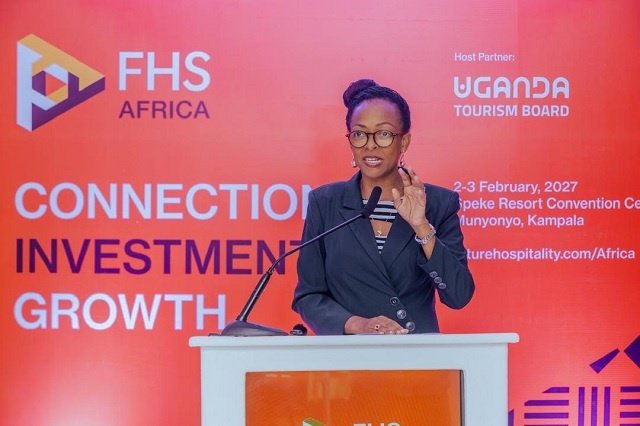


UTB Chief Executive Officer Juliana Kagwa
Uganda will host Future Hospitality Summit Africa for the first time in February 2027, bringing international investors, hotel developers, operators and tourism leaders to Kampala as the country accelerates its ambitions for tourism-led economic growth.
Uganda has secured one of Africa’s most influential hospitality investment gatherings, with FHS Africa set to take place at the Speke Resort Convention Centre in Munyonyo, Kampala, on February 2nd and 3rd, 2027.
The summit will bring together hotel owners, international brands, developers, private equity firms, lenders, government leaders and tourism authorities to examine investment opportunities across Uganda and the wider African hospitality market.
Its arrival in Kampala marks an important moment for a country determined to translate its considerable natural and cultural assets into new hotels, tourism infrastructure, employment and long-term economic value.
The event is being delivered through a partnership between the Uganda Tourism Board and The Bench, organiser of the Future Hospitality Summit series.
Roy Bannister, Head of Strategic Partnerships at FHS Africa, said: “FHS Africa’s coming to Uganda reflects something much bigger than a conference: it is a platform where capital meets opportunity.”
That distinction matters. Uganda does not simply want to host another international tourism gathering. It wants the summit to generate transactions, introduce local developers to international capital and provide hotel groups with a clearer view of the opportunities emerging across the country.
Uganda Tourism Board chief executive Juliana Kagwa has been equally direct about the intended outcome.
“By the time delegates gather in February 2027, we want to be signing contracts,” she said.
From destination potential to investable opportunity
Uganda has long possessed the foundations of a compelling tourism economy, from mountain gorilla trekking in Bwindi Impenetrable National Park and wildlife experiences in Queen Elizabeth National Park to the source of the Nile, the Rwenzori Mountains and an increasingly confident capital city.
The challenge has been converting that extraordinary tourism potential into sufficient accommodation, infrastructure, air access and internationally marketable experiences.
FHS Africa will place that investment requirement directly before the people capable of responding to it.
Opportunities extend beyond conventional city hotels. Uganda requires quality accommodation across safari gateways, national parks, regional centres and emerging tourism corridors, alongside branded residences, eco-lodges, resorts, restaurants, event venues and supporting services.
Kampala is likely to remain an important focus for international brands, business travel and meetings, incentives, conferences and exhibitions. However, some of Uganda’s most distinctive hospitality opportunities lie outside the capital, where carefully planned developments can respond to growing demand while protecting the natural environments upon which the visitor economy depends.
There is also scope for a broader range of hotel products. International luxury properties will remain important, particularly around globally recognised wildlife experiences, but Uganda’s expanding domestic and regional travel markets also create demand for well-operated midscale and upper-midscale accommodation.
For investors, the proposition is increasingly difficult to overlook. International arrivals have recovered to more than 1.6 million, while annual tourism earnings have risen to between US$1.6 billion and US$1.7 billion.
The government’s National Tourism Policy 2025 sets out an ambition to position Uganda among Africa’s five leading tourism destinations and increase annual sector earnings to at least US$4 billion.
Achieving that scale will require significant private investment, stronger destination development and closer cooperation between government agencies, local businesses and international operators.
Connectivity will be critical
Uganda’s ability to convert interest into sustained tourism growth will depend heavily on connectivity.
The expansion of Uganda Airlines, including the addition of Accra and Kigali to its network, strengthens regional access and supports Kampala’s development as a commercial and conference destination. Further international connectivity will be vital if Uganda is to grow higher-value leisure tourism, attract major events and persuade more international hotel groups to establish a presence.
The timing of FHS Africa is therefore significant. Uganda is also preparing to co-host the 2027 Africa Cup of Nations with Kenya and Tanzania, placing East Africa before a vast continental and international audience.
AFCON will create immediate demand for accommodation, transport, venues and visitor services, but its lasting value will depend on whether investment is directed towards infrastructure and hospitality assets capable of serving the country long after the final match.
FHS Africa arrives months before the tournament and offers Uganda an opportunity to put credible projects before international investors while momentum is building.
The wider tourism value chain will also be part of the conversation. Hotel development cannot succeed in isolation from aviation, tour operations, food production, skills, technology, destination management and financial services.
For local companies and entrepreneurs, the summit could provide access to international partners that would otherwise take years to identify and approach.
Uganda moves onto the investment map
Previous editions of FHS Africa have established the summit as a meeting place for the capital, brands and projects driving hotel development across the continent.
Bringing the event to Uganda acknowledges the country’s growing visibility within Africa’s investment landscape. It also places responsibility on the destination to arrive with well-defined projects, credible partners and an investment environment capable of turning introductions into agreements.
The greatest measure of success will not be the number of delegates attending or panels delivered, but the deals, developments and enduring partnerships that follow.
Uganda possesses the wildlife, landscapes, culture and hospitality required to become one of Africa’s defining tourism destinations. FHS Africa 2027 gives the country an opportunity to demonstrate that it also possesses the ambition and investment pipeline needed to deliver on that potential.
For two days in February, Kampala will become the meeting point between Uganda’s tourism vision and the international capital capable of helping to realise it.