

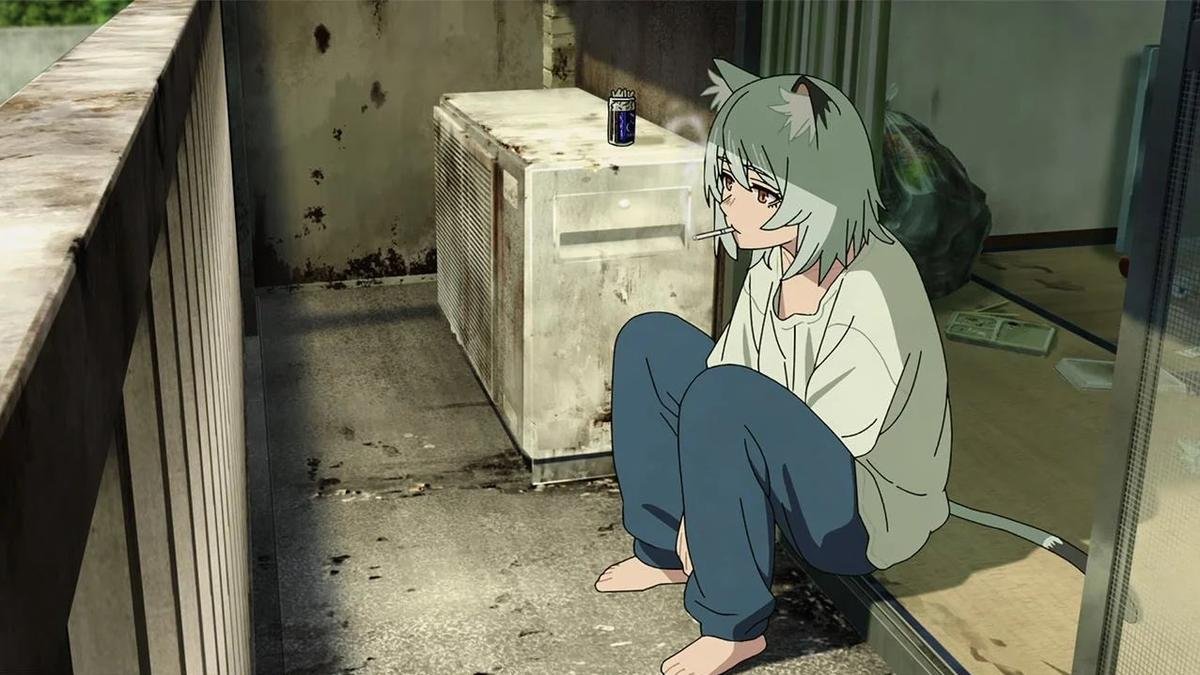

Cute or ‘kawaii’ characters are usually designed to make affection for them feel effortless. One look is usually all it takes to think, yes, I would probably buy a mug or a plushie with this adorable little idiot on it. NyanNyanFactory’s Chainsmoker Cat, adapted by Bibury Animation Studios, commits what can only be described as an unholy act of blasphemy against that particular psychology of instant fondness.

Yanineko is the titular nicotine-addicted 21-year-old catgirl. She is broke, chronically unemployed, constitutionally allergic to responsibility, and forever rummaging through pockets, ashtrays, garbage, literal dog faeces (the less you know, the better), and whatever other dubious receptacles might yield a stray cigarette. Her apartment seems to have reached an almost terminal stage of entropy. Rotting, decomposing, fetid, putrescent, rancid, mould-ridden, foul, cursed — these are few of the many adjectives woefully inadequate to describe its horrors.
Given that terribly unpromising introduction, you may reasonably be wondering how the hell that headline is supposed to make any sense. How could something so decidedly repulsive possibly rank among the year’s best anime?
Chainsmoker Cat (Japanese)
Director: Taku Kimura
Cast: Yūko Natsuyoshi, Tetsu Inada, Rina Honnizumi, Misato Matsuoka, Yurie Funato, Ayaka Shimizu, Shiori Izawa, Riko Akechi
Runtime: 12 episodes (25 minutes)
Storyline:
Chainsmoker Cat is not really about Yanineko or her chainsmoking exploits, at least not exclusively. She is the building’s principal agent of ruin. But the apartments around her are inhabited by an ecosystem of damaged little freaks, each with their own preferred method of making life substantially more difficult.
Yakuneko, her younger neighbour, is a recovering delinquent with a deeply questionable relationship to drugs; Hameko, or the misregistered “Easygoing Anal Angel,” is a gamer and e-girl streamer whose online persona is considerably more stable than her bladder; Kansaineko is a university student from Kansai who desperately wants to be funny despite possessing terrible comic timing; Aruko is a 24-year-old alcoholic whose body may legally be that of an adult but whose perpetual intoxication gives the impression that somebody left a primary-schooler unsupervised. There is also Mankasu, the chain-smoking human erotic-manga artist who lives among them; the well-meaning but perverted landlord who performs the thankless dual role of housekeeper and reluctant emergency-service provider; and the occasional cameo from Imoko, Yanineko’s younger sister, who has somehow been burdened with the impossible task of keeping her sister alive.
Judging by the sheer chemistry between this motley assortment of degenerates, you get the distinct impression that the voice cast must have had an absolute blast making it together; I’m almost jealous of whatever unhinged conversations were happening in those recording booths.

A still from ‘Chainsmoker Cat’
| Photo Credit:
Netflix
This makes the show less a conventional slice-of-life than an anthology of people hanging around the same building and periodically wreaking havoc on their own lives in each other’s vicinity. Over 12 episodes, the plot fractures into miniature stories, jumps between characters, and introduces some bizarre new corner of the beastfolk world before promptly returning to the apartment as though none of it ever happened. The pleasures are cumulative rather than plot-dependent. We follow along, waiting to discover what fresh and previously unimaginable form of nonsense the inhabitants have managed to manufacture this week.
And dear god, the variety is astonishing. Among the season’s many absurd highlights, the characters find themselves embroiled in situations so magnificently stupid that describing them out of context makes the show sound as if it was written by a committee of sleep-deprived, substance-abusing perverts. The season keeps lurching from one deranged little calamity to another, with each new episode finding some undiscovered way for these people to humiliate themselves, endanger themselves, or attract the attention of the police. There are sequences in this anime I am almost too embarrassed to describe, if only because having to type some of them out feels like a serious indictment of whatever chain of events led me to become a critic.

A still from ‘Chainsmoker Cat’
| Photo Credit:
Netflix
But what makes all of this considerably more than an elaborate excuse to put cat ears on a bunch of sickos is the show’s acute understanding of addiction. Chainsmoker Cat is determined to explore the difference between a bad habit and a life reorganised around it. Yanineko does not simply smoke a lot. Nicotine determines where she goes, how she spends money, what she thinks about when she wakes up, what constitutes an emergency, what she considers worth sacrificing, and how she measures the next few hours of her existence. When she runs out of cigarettes, the world has suddenly become structurally and categorically intolerable. Episode 1 establishes the cycle through withdrawal and poverty; Episode 2 turns cigarette acquisition into a conversation about freedom; Episode 6 reduces a failing lighter to a full-scale survival operation as Yanineko transfers a dying flame from cigarette to cigarette; Episode 7 then even literalises the pathology by giving nicotine a demonic body, only for that demon to recoil from the revolting material consequences of its own influence.

The anime seems to understand addiction as something more complicated than individual weakness. The cigarette is pharmacology, certainly, but it is also ritual, companionship, timekeeping and escape. Yanineko’s smoking gives shape to a life otherwise characterised by precarious employment, unstable finances and an almost theological commitment to avoiding responsibility. The series distributes this structure across the ensemble. Aruko has alcohol. Yakuneko has drugs. Hameko has the dopamine rushes of online attention, and so on. Their compulsions are different, but the underlying problem is recognisable: each character has found some mechanism through which an unpleasant existence can be made temporarily bearable.
There is also something deliciously antagonistic about how Yanineko’s femininity is constructed. Respectable young womanhood demands a certain degree of bodily management — of cleanliness, of self-control, of employability, of social grace, of sexual legibility without sexual vulgarity, and even the mere ability to move through public space without making everybody else uncomfortable.

A still from ‘Chainsmoker Cat’
| Photo Credit:
Netflix
Yanineko smokes openly. She smells. She wastes money. She neglects domestic work. She behaves badly in public. She is sexually objectified and sexually embarrassing in equal measure. She does not even possess the capacity to make her rebellion aesthetically attractive. All of this feels deliberately subversive. The act of smoking itself has been historically gendered in Japan. I have personally and vicariously witnessed tobacco advertising and regulation in the country often featuring cultural taboos around women smoking, with smoking traditionally associated with unfeminine behaviour and norms of feminine respectability. Yanineko stubs a cigarette on those expectations. Her smoking is not glamorous rebellion in the manner of a film noir heroine leaning against a bar counter while looking devastatingly bored. She is a nicotine-dependent slob rummaging through rubbish for half-smoked cigarettes. There is no elegant liberation fantasy here. She is not reclaiming the cigarette as an accessory, but is refusing, often stupidly and sometimes destructively, the demand that her body remain controlled, pleasant and socially reassuring.

The very existence of beastfolk also opens up the anime to even larger questions about social exclusion. It would be a mistake to read the catgirls as one-to-one allegories for any particular minority in Japan. The fictional history of the beastfolk world is not identical to the histories of the indigenous Ainu, Okinawans, Burakumin, Zainichi Koreans or other racialised groups in Japan, and the analogy should not be flattened into one. But Japan’s history contains numerous examples of social groups being differentiated, classified, and denied equal access to social or material resources, while contemporary research continues to document structural barriers in very fundamental areas such as housing and livelihood. Chainsmoker Cat is simply giving that preexisting systemic exclusion a pair of ears and a tail. Beastfolk are visibly different, and that visible difference becomes the basis for assumptions about where they belong, what work they can perform, and how respectable they are allowed to be. The clever Beastfolk Game of Life sequence is especially revealing for how casually it incorporates a history of occupational restrictions into the unassuming gag board game. These characters are essentially playing their way through a grim meta-lesson in social sorting and discrimination.

A still from ‘Chainsmoker Cat’
| Photo Credit:
Netflix
Even so, Chainsmoker Cat is still spectacularly unembarrassed about eroticising its beastfolk, repeatedly turning their bodies into sexual situations, fetishistic fantasies, and various forms of frankly shameless visual consumption. But where discrimination reduces a person to the traits that make them unwanted, fetishisation makes those very traits desirable. The anime makes full use of that nasty little overlap between shame and desire. It does not seem very interested in resolving the contradictions of these voyeuristic, Western wish-fulfilment fantasies in any dignified manner. Frankly, it is more interesting for leaving that mess as is.
It is the perceived ‘contamination’ of Japan’s ingrained politics of respectability and purity that gives the anime some of its best material. The toilet jokes, piss jokes, fart jokes, cigarette-butt jokes, filthy rooms, smells, bodily fluids, and other grotesqueries are what keep the serious ideas from floating off into a cloud of academic abstraction. It is just so funny that an anime this profoundly stupid manages to smuggle so many genuinely thought-provoking ideas and social commentaries into just twelve episodes.

There is also something so genuinely tender about this deranged little anime. These catgirls are embarrassing, selfish, vulgar, sexually promiscuous, chemically compromised, spectacularly ill-equipped for adulthood, and just such colossal pains in the arse. But they are also friends, sisters, neighbours and in their own deeply messed-up fashion, a family. Addiction has consequences, dysfunction is rarely pretty, and Yanineko and her friends may never get their lives together, but Chainsmoker Cat simply refuses to make a person’s worst habits the final verdict on their worth. I’ll never stop loving it for that.
Chainsmoker Cat is currently streaming on Netflix