


The Redmi Note series has traditionally been associated with affordable smartphones that aim to offer a balanced mix of features. The Redmi Note 17 takes a more focused approach, with a large OLED display and a high-capacity battery among its key highlights. At the same time, its performance, camera setup, and storage options are relatively modest compared with some smartphones in the same price range.
I used the Redmi Note 17 for about a month, and the phone offers a mix of strengths and limitations. At Rs 27,999 for the 6 GB RAM and 128 GB storage variant, it competes in a segment with several alternatives, making factors such as performance, camera capabilities, and storage particularly relevant when evaluating the overall package.

Design and display
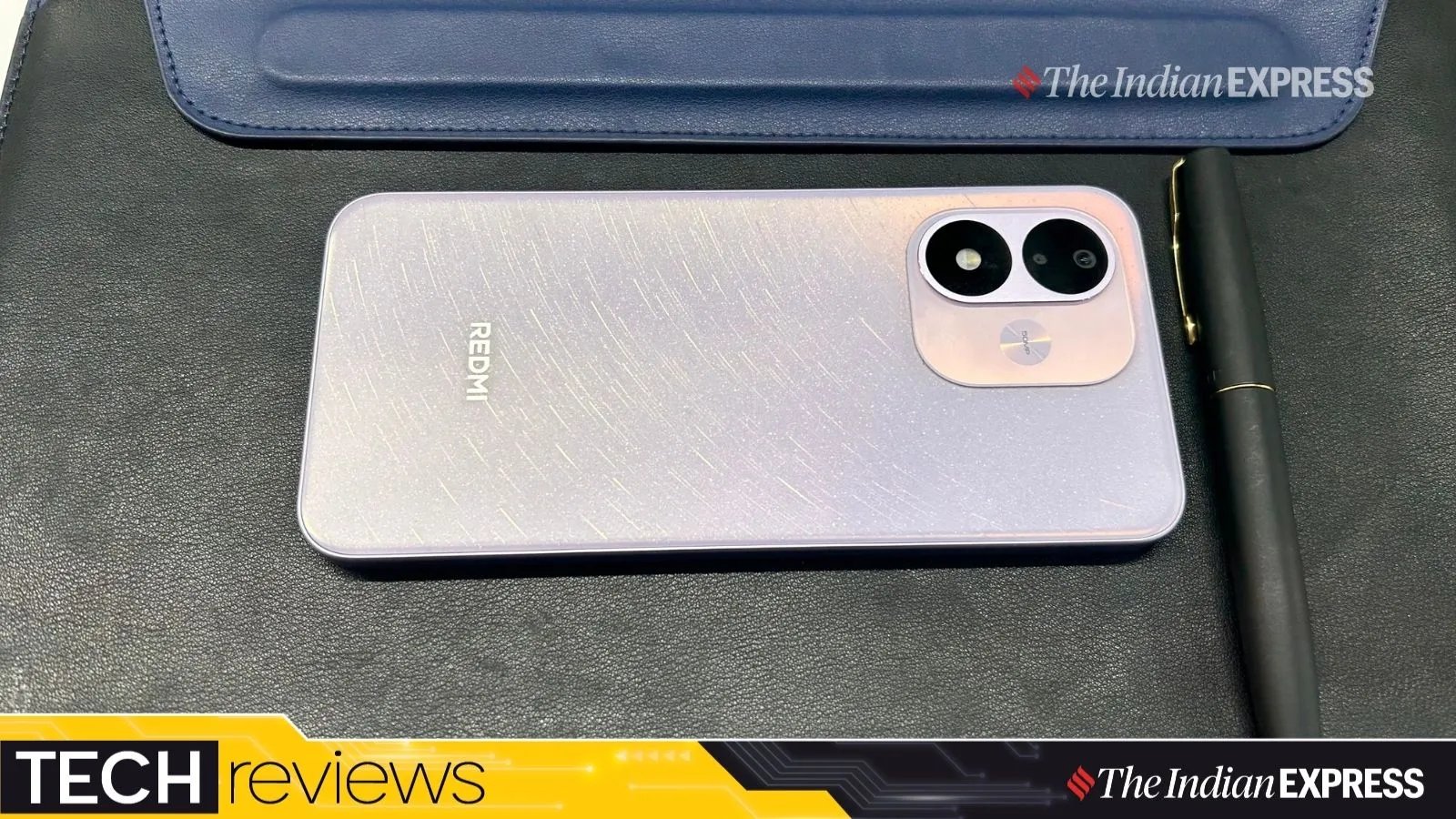
The Redmi Note 17 gets a noticeable design overhaul, moving away from its predecessor’s curved edges to a flatter design. The rear panel has a matte finish that resists fingerprints, while its textured appearance creates interesting effects from different angles.
However, the redesign does not necessarily translate into better everyday usability. At 225 grams, the phone feels heavy in the hand, and its larger dimensions make two-handed use more practical. The flat rear panel is also somewhat slippery, though the silicone case bundled with the phone addresses that.
 The pattern is visible when direct light is flashed over it, displaying a unique pattern. (Image: The Indian Express/ Ajay Hanje)
The phone’s durability rating has also gone down, from IP66 on the Redmi Note 15 to IP65 on the Note 17. That is not necessarily a deal-breaker, but it is an odd change for a newer model.
The display is one of the phone’s stronger aspects. It gets a larger Full HD+ OLED panel with punchy colours and deep blacks, making it suitable for watching videos and other content. Widevine L1 certification also means supported streaming services can play content in Full HD resolution.
The panel supports DC dimming and PWM, which helps in darker environments. However, brightness is only adequate outdoors, and the display becomes difficult to view comfortably under strong sunlight. Audio is another area where it feels like Xiaomi has cut corners. There is only a single bottom-firing speaker. It gets loud enough for calls and casual video watching, but lacks the immersion of stereo speakers. The sound is also quite treble-heavy and lacks bass.
Story continues below this ad
Software, storage and everyday performance
The Redmi Note 17 runs HyperOS 3, which offers plenty of customisation through Xiaomi’s Theme Store. The lock screen can be extensively customised, while the phone also includes basic AI features and Google’s Gemini tools.
The problem is the amount of unnecessary software. The phone comes with many third-party apps and games, most of which you can remove. Some Xiaomi apps, including Indus Store, Theme Store and Game Centre, also generate frequent notifications. You can disable these, but having to do so in the first place makes the software experience feel less clean. The File Manager app also includes advertisements.
 Redmi Note 17 features a large Full HD+ OLED display and a flat rear design. (Image: The Indian Express/ Ajay Hanje)
Storage is arguably a bigger concern. The Redmi Note 17 is available with only 128 GB of internal storage. Xiaomi offers a hybrid SIM slot that supports microSD cards up to 2 TB, but that means dual-SIM users must choose between a second SIM and expandable storage.
Around 20 GB of the internal storage is already occupied by the system, leaving considerably less usable space. At this price, 128 GB feels restrictive.
Story continues below this ad
The Snapdragon 4 Gen 4 chipset is another major compromise. It is an entry-level processor, and that shows during everyday use. While Xiaomi’s own apps generally run smoothly, you notice stuttering when browsing Google and third-party apps, especially when accessing the Google Discover feed.
Battery
The 8,000 mAh silicon-carbon battery is clearly the phone’s biggest hardware advantage. With casual usage, the Redmi Note 17 can comfortably stretch to two days, while heavier use can still deliver around a day and a half.
In the PCMark Work Battery Life test, the phone lasted 19 hours and 26 minutes. That is a strong result, though not class-leading, with several other smartphones crossing the 20-hour mark.
 The Redmi Note 17 has an 8,000mAh silicon-carbon battery and supports 45W charging. (Image: The Indian Express/ Ajay Hanje)
The bundled 45 W charger takes around 1 hour and 54 minutes to fully charge the battery, which is therefore not particularly fast considering the enormous capacity.
Story continues below this ad
Camera
The camera setup is perhaps the Redmi Note 17’s biggest weakness. It has a single usable rear camera, with the secondary sensor serving as a depth sensor.
The primary camera produces 12-megapixel binned images, but image quality is disappointing for a phone at this price. Daylight photos lack dynamic range, with details getting lost in shadows and brighter areas. Fine details are also limited, and focusing can feel slow.
Low-light photography is worse. Images lose detail and are not particularly usable, especially when compared with some cheaper smartphones.
Portrait mode also struggles with dynamic range. Brighter backgrounds can blow out, while subjects look somewhat washed out. Selfies are similarly underwhelming, with limited detail and dynamic range in daylight and soft, flat results in low light.
Story continues below this ad
 Camera Sample (Image: The Indian Express/ Ajay Hanje)
 Camera Sample 2 (Image: The Indian Express/ Ajay Hanje)
 Camera Sample 3 (Image: The Indian Express/ Ajay Hanje)
 Camera Sample 4 (Image: The Indian Express/ Ajay Hanje)
 Camera Sample 5 (Image: The Indian Express/ Ajay Hanje)
 Camera Sample 6 (Image: The Indian Express/ Ajay Hanje)
Verdict
At Rs 27,999, the Redmi Note 17 offers a large OLED display and an 8,000 mAh battery, but several compromises make the overall package less convincing for its price. The Snapdragon 4 Gen 4 may feel limited for performance-focused users, while the cameras struggle with low-light photography, dynamic range and video recording.
The 128 GB base storage is also restrictive, with microSD expansion requiring the second SIM slot. Overall, the phone is better suited to buyers who prioritise battery life and display size, but its performance, camera and storage limitations make it harder to justify as a well-rounded mid-range option.