

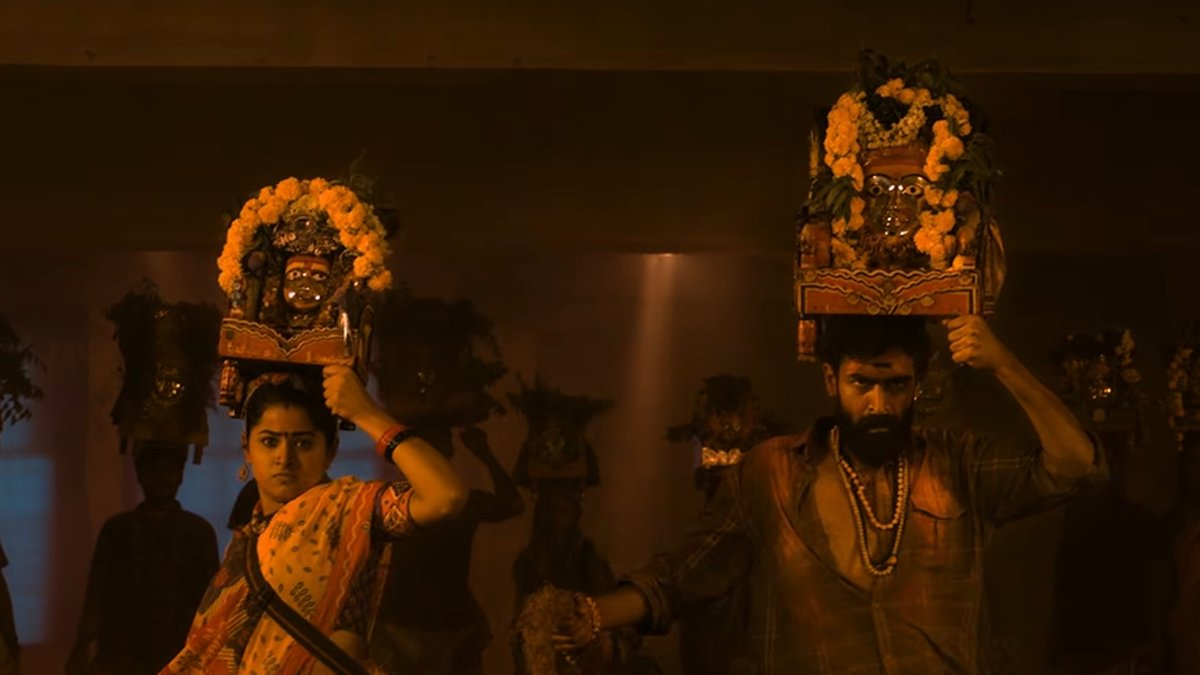


Monisha and Vinay Rajkumar in ‘City Lights’.
| Photo Credit: Anand Audio/YouTube
City Lights, starring Vinay Rajkumar and debutant Monisha, is actor Vijay Kumar’s third directorial. Vijay’s preference for the ‘message-meets-entertainment’ formula is plainly evident by now. While it’s far from a rare trope, what stands out in Vijay’s case is how his directorial skills seem to have deteriorated with each successive film.

Vinay Rajkumar plays Shiva, reminiscent of Vijay’s character Shivlinga in Duniya. As in the 2007 blockbuster, the protagonist in City Lights is an innocent rural migrant, unaware of the ugly side of a big city like Bengaluru. In fact, the protagonist’s naive persona, which eventually gives way to violence in the pursuit of justice, is hardly different from the archetype Vijay has played in several of his previous films.
The film reveals its cause very early in the narrative. If Salaga (2021) is about reformed rowdies, Bheema (2024) condemns substance abuse. City Lights explores the plight of women who are drawn into prostitution, often by circumstances beyond their control.
City Lights opens with another common factor in a Vijay directorial: Charan Raj’s pulsating music. The composer’s experiments in Vijay’s films have helped the director market his products strongly. However, in City Lights, Charan’s scores and songs get wasted in the relentless, mind-numbing violence.

The film’s first half ends with Shiva rescuing an innocent girl, essayed by Monisha (Vijay’s daughter), from a prostitution racket in the Majestic area in Bengaluru. It’s a short first half, running less than an hour. Naturally, the second half will feel longer. However, with a two-hour-and-nine-minute runtime, City Lights feels like a movie that just goes on and on.
The most shocking aspect of the movie is its lack of basic structure. The second half is a series of random scenes stitched together, as Vijay skims the surface of issues ranging from human rights to police encounters and corrupt politicians.
Even if his intentions are good, Vijay’s motive is to titillate rather than realistically portray harsh realities. The violence acts as shock therapy rather than a necessary tool for the proceedings. The film repeatedly returns to scenes of cops shooting rowdies in the knees. Vijay isn’t satisfied with that much brutality, so he makes the protagonist eat a blade!
Unimaginative writing and grotesque violence are replaced with a frustrating, random comedy track about a romance between a senior police officer and a junior woman cop. Vijay’s final tool to drive home his preachy movie is manipulation. So characters appearing to be crucial are introduced and killed conviniently, followed by melodramatic funeral sequences.
ALSO READ: Decoding the success of ‘Bheema’: How Kannada star Duniya Vijay is revelling in his new actor-director role
Amid the raining formulaic tropes, City Lights forgets what it set out to do. Majestic indeed has a dark underbelly, but the movie defines the neighbourhood solely through the crimes that occur there. Except for one song (’Kandamma’), City Lights doesn’t make room for the small joys, everyday struggles, and fleeting moments of happiness experienced by the people who live in and around the area. By focusing only on its darker side, the film could reinforce the perception of Majestic as a place to fear and its people as figures to be wary of.
City Lights is currently running in theatres
Published – September 19, 2026 10:20 am IST