

It was quite comical that just as Jenjum Gadi was talking of how gardens inspire his art, his gardener, who tends his Hauz Khas terrace garden, had already called him thrice. “My maali is not perfect but I just love him,” says the artist with a green thumb and an elephant’s memory. Back home in Arunachal Pradesh, his family communally owns and does jhum farming on the mountains.
Jenjum, 44, belongs to the Galo tribe that lives in the non-touristy Tirbin village, in Lower Siang district of the eastern Himalayas. For the last 20 years, he has made Delhi home.
Describing himself among Arunachal Pradesh’s first fashion designers, with two decades of shaping the runway, Jenjum, says, “after 20 years, for me, fashion is done”. Fabric gave way to metal. All the “beautiful clothes” he made would always end up “on a hanger, in cupboards”. “I feel they are not forever. That’s why I wanted to do art and choose a sturdier material, not textile,” he says.

Jenjum adds, “The Northeast is now mainstream in fashion, but that transition hasn’t really happened in art.” Two years ago, he shifted gears to become a career artist. The first-generation artist has already done four shows, including at Art Mumbai.
Carrier of memories
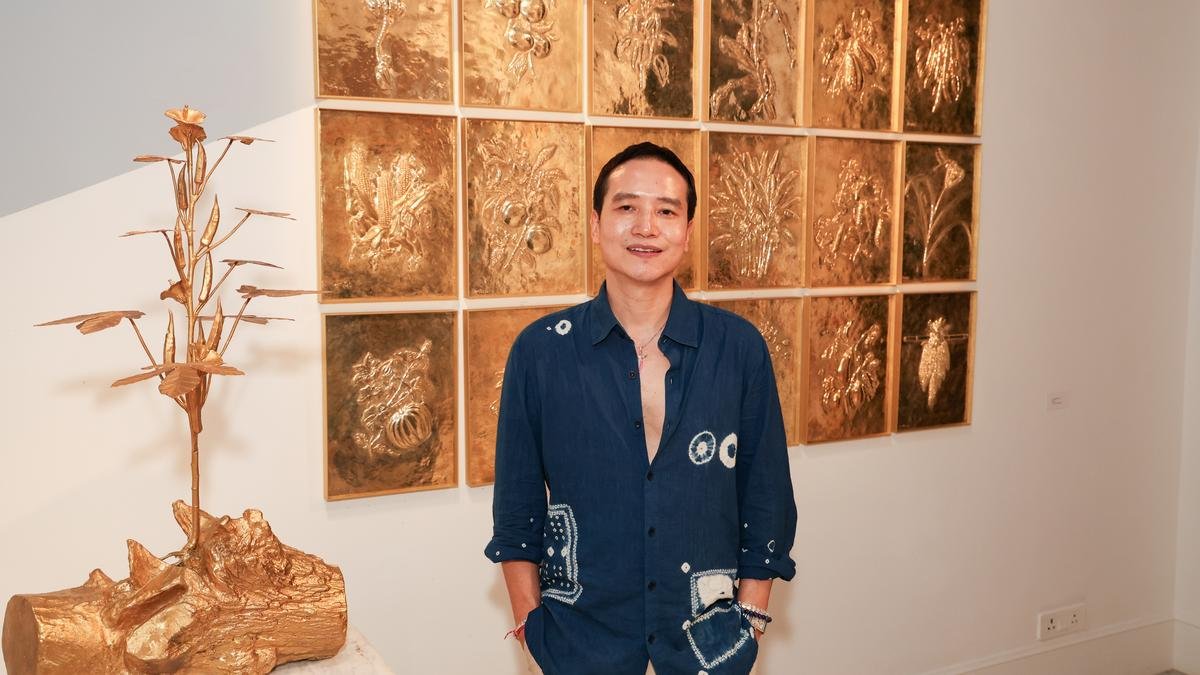
From digging into his early memories of his mother’s garden for his first exhibition Apase – from my Mother’s Garden (2024), the canvas is now wider to include his Tirbin village in Ngok Dolu (My Village). At Gallery Vayu-Design for Living in Delhi’s upscale Lodhi Road, looking at the gilded life-sized installations of food crops and vegetation, it is hard to not think of Jenjum as Tulsi Chakraborty from Satyajit Ray’s fantasy comedy Parash Pathar (1958), whose philosopher’s stone turns things into gold.
Gadi’s choice of metal is brass.

“In our culture, brass metal is used to make urlis and big plates. These antique pieces are exchanged at weddings and have come down through generations, often through trade from Tibet. Brass has a unique quality. As it ages, it develops a patina, telling the story of its surroundings, mimicking the natural world,” the artist says.
East meets West
A mature banana tree here, a young brinjal plant there, bitter-gourd creepers and okra work titled Benju – how his grandmother pronounced the vegetable’s name. Snippets of personal history, thus, get memorialised. There’s no word for the bitter gourd in Galo, just like pomegranates, which were brought in by outsiders. Then there are indigenous fruits/vegetables: the wild fruit taktir (Garcinia lanceifolia), which resembles a pomegranate or tomato but is sweet to taste.
A large work, titled Yirya/Yirnam (), depicts the fruits and veggies in Instagram-like grids. Amid the 42 works on show stands a circular wall-mounted work, titled Ane (mother). It shows his earliest memory of his mother sitting at the loom, weaving clothes, her back to him. She’s seated on a lotus flower, like a goddess.
In Jenjum’s works, brass meets pichhwai. The Rajasthani devotional art drew him, because “it depicts the natural surrounding: flora and fauna, peacocks, streams, cows strolling past. It took me back to my village. Nature is deeply knit with our existence. We’ve a spirit for trees, water, etc. that play a role in our lives,” says the animist, who sees pichhwai less as an image of a god than as “a spiritual connection, like a poem”. Before his first brass show, Jenjum did a show of around 10 collections of pichhwai on raw silk.
He brings to art his design philosophy — show, don’t tell. “Through this exhibition, I want to give the people a glimpse into my childhood, in a simple and beautiful way.”
The village is changing
He feels sad that the mountains of his childhood now have smaller trees, felled for easier farming. Jenjum rues, “My village is changing. All the beautiful bamboo houses are being converted into concrete. The innocence is going away.” But he’s most concerned about “deforestation and ecological disbalance”. When he returns home, “I can see the forests being cut, the rivers drying up, the small streams we caught fish in becoming non-existent,” he says.
Beyond himself, Jenjum wants to “bring out Northeast’s talent in art, its myriad forms, and give them exposure.” He has recently registered an art company called Northeast India Public Art Trust. “We have no dearth of talent, but there’s no proper channel,” he says.
Ngok Dolu (My Village) is on show till September 30, 11 am-7 pm, at Gallery Vayu, Lodhi Road, Delhi.
Published – September 18, 2026 04:07 pm IST